


Journalism of Courage
 46% of OECD students said they use AI chatbots weekly to help them learn, while 28% said classmates were distracted by digital devices (AI Image)
Learning levels among 15-year-olds across some of the world’s major education systems are falling, with reading and mathematics seeing the most decline over the past decade. Across OECD countries, average reading scores have dropped by 28 points since 2015, while mathematics scores have fallen by 22 points. The decline has also pushed the share of students performing at low levels across science, mathematics and reading to one in five, up from 16 per cent in 2022.
The OECD, or Organisation for Economic Co-operation and Development, is a Paris-based international organisation of 38 member countries that compares policies, shares data and develops common approaches to economic and social challenges. Membership spans Europe, North America, South America and Asia-Pacific, including Australia, Japan, South Korea, New Zealand, Israel, the US, Canada and Mexico.
PISA, the OECD’s Programme for International Student Assessment, tests 15-year-olds on how well they can apply what they have learned in science, mathematics and reading. It is not simply a test of whether students can recall facts. It examines whether they can use knowledge to interpret information, solve problems and participate effectively in society.
PISA 2025 was the largest edition so far, covering more than 760,000 students across 91 countries and economies, representing tens of millions of 15-year-olds worldwide. Science was the main subject in this cycle, with reading and mathematics also assessed.
The long-term decline is significant: the OECD equates the reading drop to roughly one-and-a-half years of learning, and the maths drop to just over a year.
| PISA 2015-2025 change | OECD countries | Non-OECD participants |
| Reading | -28 points | -16 points |
| Mathematics | -22 points | -8 points |
| Science | Modest decline | Broadly stable |
Source: PISA 2025 Results (Volume I)
The latest assessment also shows that the decline did not begin with the pandemic. Reading performance had already been weakening, while mathematics saw a sharp decline after 2018. PISA 2025 recorded the lowest OECD-average performance observed so far across all three core subjects.
Science, the main focus of the 2025 assessment, tells a different story: performance was broadly stable between 2022 and 2025, though it had declined between 2009 and 2022. The OECD average in 2025 stood at 482 points in science, 463 in mathematics and 461 in reading.
The overall decline does not mean every education system is moving in the same direction. Several systems have improved their science performance over the longer period, the OECD notes. These include Lithuania, the Slovak Republic, Turkey, the Dominican Republic, Georgia, Montenegro, Qatar, Thailand, the United Arab Emirates and more.
At the top, the Chinese provinces of Beijing, Shanghai, Jiangsu and Zhejiang, grouped as B-S-J-Z in the PISA data, and Singapore were the strongest performers across the three core subjects. Estonia, Japan, Korea, Macao (China), Chinese Taipei and the United Kingdom also featured among the top 10 systems across science, mathematics and reading.
PISA also highlights the influence of socio-economic background. Across OECD countries, advantaged students scored 85 points higher in science than disadvantaged students. That narrowing is misleading, though: it came from weaker performance among advantaged students, not real gains for disadvantaged ones.
Digital technology adds another layer to the problem.
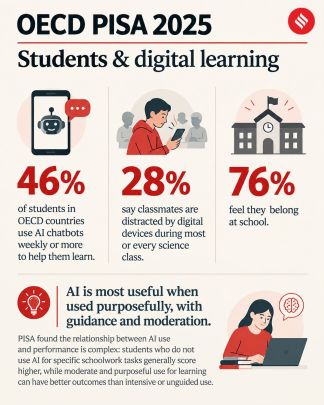
Forty-six per cent of OECD students said they use AI chatbots weekly or more to help them learn, while 28 per cent said classmates were distracted by digital devices during most or every science lesson. PISA found that excessive or leisure-oriented device use was associated with weaker performance.
AI use itself was not uniformly negative. Students who used AI to learn and had been taught to assess the quality of AI-generated information tended to perform better than frequent users who received no such guidance. The finding points to a distinction between simply putting technology in students’ hands and teaching them how to use it.
The same principle appears in PISA’s new assessment of computational problem solving. Almost two-thirds of students across OECD countries reached the relevant proficiency level, but only about half did so while also demonstrating basic proficiency in science, reading and mathematics. In other words, digital skills cannot easily compensate for weak foundations.


