


Journalism of Courage
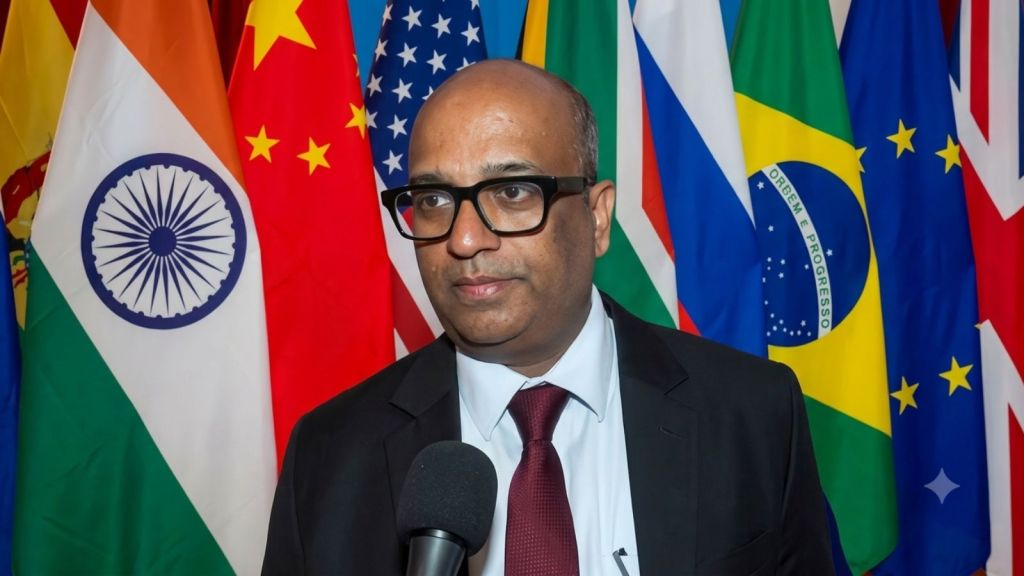 NTA DG Abhishek Singh on the sidelines of the 2026 BRICS Summit held in New Delhi (Image via ANI video-grab/Upscaled with AI)
The National Testing Agency (NTA) is looking to expand its testing framework beyond India, with plans to eventually work with other countries and learn from examination systems across BRICS nations. The agency is also exploring how its testing system could become a “digital public good” that can be adopted by other countries, NTA DG Abhishek Singh said.
“Right now we are trying to consolidate our own testing framework. So first is to improve the systems and strengthen the processes within India so that we are able to conduct examinations without any error in a completely fair manner,” Singh told ANI on the sidelines of the 2026 BRICS Summit held in New Delhi on September 12 and 13. He said the eventual aim was to create something that could be adopted by other countries, including BRICS nations.
Singh said NTA’s immediate focus is on strengthening its domestic examination systems before moving towards international and cross-border testing. “Cross-border examinations are the next step,” he said, adding that the agency first wants to ensure that Indian examinations can be conducted in a fair and transparent manner without malpractice or errors.
The agency also sees scope for BRICS countries to collaborate on examination security and question-paper technology. Singh pointed to China’s Gaokao, the country’s national college entrance examination used for university admissions, as an example of a large-scale examination system from which lessons can be drawn. The Gaokao is conducted across China on a massive scale and is known for the extensive security and logistical arrangements around the examination.
“Every examination will require generation of question papers. So there are areas in which we can discuss with each other, collaborate and share knowledge,” Singh said.
NTA’s plans for strengthening its own examination system also include moving more of its tests to computer-based testing (CBT), with NEET-UG set to be the next major examination to make the transition.
Unlike most major examinations conducted by NTA, NEET-UG is still conducted in pen-and-paper mode. Singh said the agency is now working towards changing that. “All our examinations are CBT except the NEET examination. On NEET also, we will be moving to CBT very soon,” he said.
The Nandan Nilekani-led high-powered task force is examining the transition. A move to CBT would involve more than simply replacing answer sheets with computers. NTA would need to expand the number of secure testing centres, ensure adequate computing capacity, establish reliable connectivity and build safeguards against question-paper leaks, impersonation and other forms of malpractice.
#WATCH | Delhi: When asked how BRICS countries can collaborate on secure question paper technology, National Testing Agency (NTA) DG Abhishek Singh says, "There are multiple ways. Every country faces this challenge. It's not that examinations are conducted only in India;… pic.twitter.com/RiKN83EeMK
— ANI (@ANI) September 13, 2026
NTA already conducts several large examinations through CBT, including the Joint Entrance Examination (JEE), UGC-NET, Common University Entrance Test (CUET) and NIFT examinations. “CBT is the future, so all our examinations will be CBT in the days to come,” Singh said.
The proposed shift also comes amid broader discussions on examination reform following concerns over the security and conduct of high-stakes tests. NEET-UG is one of India’s largest entrance examinations, determining admission to undergraduate medical courses across the country, making the security and reliability of its testing process particularly important.
Singh said NTA is also exploring AI for examination security, including analysing logs, data and patterns that could help identify irregularities and prevent fraud.
“Not with the BRICS partners, but we are currently looking at use of AI for conducting not only testing but also fraud prevention, trying to look at logs, trying to look at data, trying to look at analytics in order to ensure that the examinations are conducted without any error or without any problems,” he said.
While international examinations remain a later-stage ambition, Singh said the agency’s immediate priority is to strengthen its domestic systems. Once those systems are strengthened, NTA plans to explore conducting examinations for other global bodies, extending its testing framework beyond India’s examination ecosystem.


