


Journalism of Courage
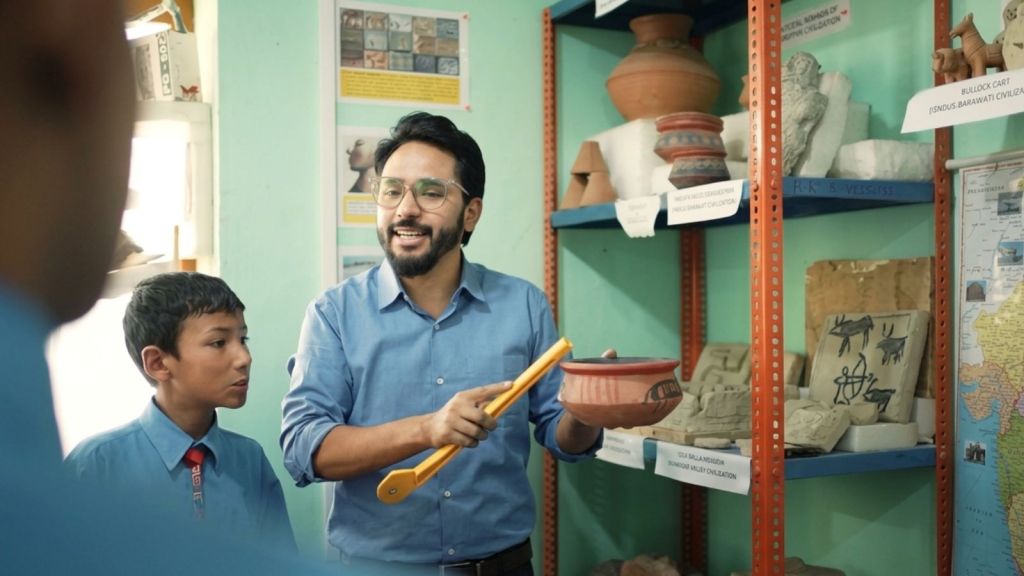 Mohd Mustafa Kamal is a recipient of the National Teachers Award 2026 (Photo via X/MoE)
At a time when the sound of shelling was a part of everyday life in Kargil, Mohd Mustafa Kamal was a schoolboy trying to keep up with his lessons. Years later, the 41-year-old teacher is using abandoned war bunkers as laboratories and turning classrooms into mock parliaments to make learning more engaging for children in the same border region.
Mustafa, a teacher from Wakha village near Kargil, was among the 48 school educators honoured with the National Teachers Award this year. He received the award from President Droupadi Murmu during a ceremony in New Delhi.
His own schooling was shaped by conflict, displacement and uncertainty. But those experiences would eventually influence his approach to teaching — one that seeks to take education beyond textbooks and connect it with the world students see around them.
Turning sand bunkers into classrooms
Mustafa taught students in classes 6 to 8 at Government Model Middle School Grong Pashkum from 2021 to 2026. The school compound had a few derelict war bunkers created by the defence forces during the Kargil War.
“Generally, bunkers are vertical, but those present there were actually horizontal sand bunkers, taking the shape of a cave. An idea popped up in my mind — let’s turn these vacant bunkers into labs,” he said.
Mustafa converted one of the bunkers into a prehistoric lab and started taking students there to help them visualise how, in ancient times, people dwelled in caves and what their daily lives looked like.
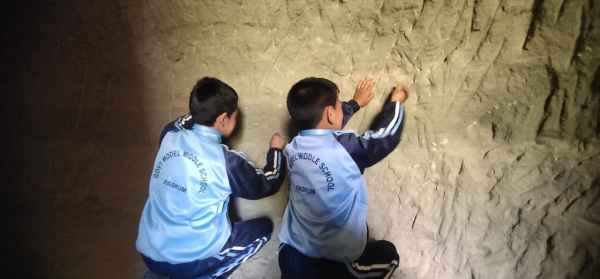 Students learning in pre-history lab
Soon, he observed that students’ participation increased and they started enjoying the subject rather than mugging it up. “I wanted to bring the NEP’s component of experiential learning into reality,” Mustafa said.
Making the classroom resemble a parliament
To teach students civics, Mustafa changed the seating arrangement in the classroom to resemble a parliament. The students were divided into two parties — ruling and opposition — while he acted as the speaker.
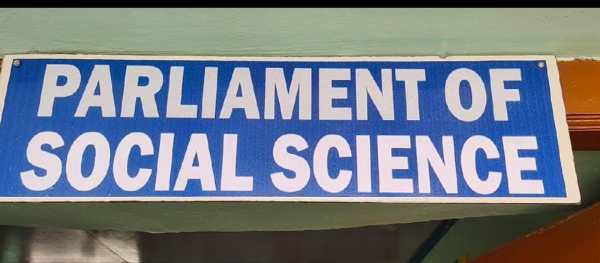 Mustafa arranged the benches in a U-shaped manner to make it look like an actual Parliament
In his classes, students were given a platform to debate contemporary agendas, through which they understood how democracy functions at the national level.
He also introduced Great Bath Ludo, a game based on Mohenjo-Daro, and other educational games through which he assessed students and implemented the concept of “stress-free examination” into his teaching method.
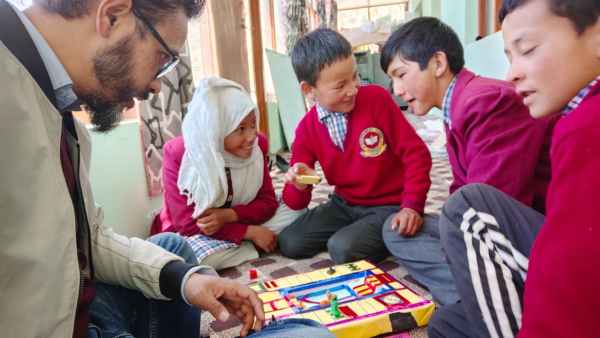 Students playing Great Bath Ludo
Mustafa also asked students to observe the presence of different types of stones and old utensils to get a glimpse of ancient history. Students started hunting for obsolete pots and presented them to Mustafa for a discussion. The archaic utensils and pots soon adorned the corners of the classroom, depicting the growing interest of middle school students in history.
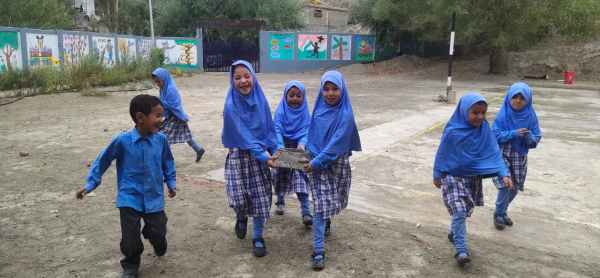 Students bringing ancient pots with enthusiasm
Students started performing better, and Mustafa’s urge to change the notion of Social Science being a boring subject increased.
Two students who still inspire him
Mustafa recalled two encounters with his students that remain particularly close to his heart — moments that, he said, continue to fill him with encouragement and gratitude when he looks back on his journey as an educator.
The first came when one of his middle-school students described History as a “practical” subject — an adjective more commonly associated with disciplines such as Science and Commerce. For Mustafa, the remark was deeply significant. It was, in many ways, evidence that he had achieved what he had set out to do: make students see History as a subject that could be experienced rather than merely memorised.
“This was the first time my subject was called practical, and that too by a middle-school student. It showed how students were beginning to perceive the subject,” he recalled.
The second incident took place inside the bunker-turned-laboratory. As Mustafa was teaching a class, a recently enrolled Kindergarten student came rushing towards him, excitedly holding a cup-shaped stone in his hands. The child told him he had discovered a unique stone.
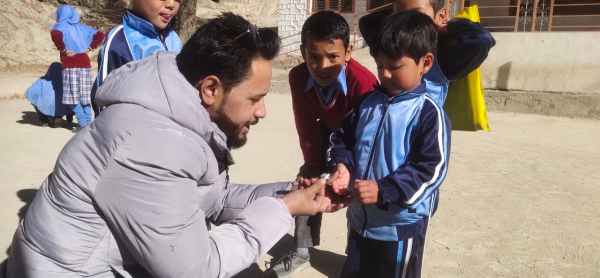 Kindergarten student bringing Mustafa a cup-shaped stone
“I still have that stone in my house. It is a cherishable memory of how curious a student as young as him can be,” he said.
A father who provided stalwart support throughout
Mustafa expressed gratitude to his father, Haji Mohammad Ali, who was the sole breadwinner of the family while he pursued higher education in Srinagar. He credited his father’s dedication and sacrifices for shaping the person he is today.
Kamal said his father had retired from the Handloom Department by the time he entered college. His pension was then the family’s only source of income for Mustafa, his three elder sisters and one younger sister.
Although his father never let the family feel the weight of their financial difficulties, Mustafa was aware of the pressures he was shouldering. He said this made him even more determined to pursue his studies diligently.
But there was one dream he quietly gave up along the way.
“Before entering the education sector, I always wanted to be a cricket player. When I went to Srinagar, I saw boys practising in the nets. I asked if I could join them, but I was told they were enrolled in academies that charged exorbitant fees. I knew my father would not be able to afford it, so I never told him about my passion for the game,” Kamal said.
He eventually chose to invest in the one resource he knew his family could afford — his education.
Giving up cricket was not easy, he said, but he channelled his ambitions into his studies and eventually into teaching, building a career that would allow him to give other children the opportunities he once wished for himself.
How meeting with Sonam Wangchuk led to a state award
Mustafa recalled meeting Sonam Wangchuk, an innovator and educationist from Ladakh, in 2016 during an oath ceremony where he launched the ‘pilot project’.
Shri Mohd Mustafa Kamal of Government Middle School Zgangjing, Sankoo, Kargil, Ladakh, has made significant contributions to experiential, contextual, and technology-enabled Social Science education in remote and resource-constrained classrooms.
Since 2011, he has transformed… pic.twitter.com/RaD5XWqShg
— Ministry of Education (@EduMinOfIndia) September 5, 2026
He served for 10 years as president of a Ladakh teachers’ association comprising like-minded teachers from the education department. The association took the initiative to visit schools in far-flung regions of Ladakh and implement an educational structure customised to address their major challenges.
Under the pilot project, the association had to run the schools for two years to observe improvements in the quality of education.
When Mustafa presented his idea to Wangchuk, the latter said it was not new to him. “This is something that every government document has; it is not new to me. But this is the first time that I see a bottom-up approach,” Mustafa quoted Wangchuk as saying.
Wangchuk stressed the importance of small, doable projects rather than big leaps that sound wonderful but are difficult to implement. He urged the Ladakh Autonomous Hill Development Council to endorse the initiative.
The council approved the idea, and the association worked on two middle schools in Ladakh, witnessing major improvements. The Kargil school won two national awards, while Mustafa received the Ladakh State Award 2021 for Teaching and Academics for his work at Government Middle School Langkarchey Thang.
Mustafa stressed the need to provide teachers and educators with hands-on experience and equip them with a proper understanding of Artificial Intelligence (AI). He believes that, in today’s rapidly changing technological landscape, teachers need to be more aware than students of the ethical use of modern technology and AI tools.
“It is the paramount responsibility of teachers to invest in students, groom them, and provide them with proper guidance on what they actually want to achieve. If we really want more innovators like Wangchuk to emerge from Ladakh, we should help students navigate their own paths instead of spoon-feeding them textbook knowledge and asking them to follow conventionally trodden paths,” he said, emphasising the crucial role of teachers.
Mustafa has also contributed to teacher training, curriculum development and academic work related to the NCERT. He has worked closely with local communities and School Management Committees (SMCs) to strengthen rural government schools in Kargil.
He was recently appointed Lecturer in History in the School Education Department, UT Ladakh, following his selection through the UPSC recruitment process for Group B Gazetted Lecturer and teaching positions.
Reflecting on the National Teachers Award, Mustafa said he was grateful to the Government of India for the recognition, but believed the honour had also brought with it a greater responsibility.
“The award has doubled my responsibility to build confident students for the nation,” he said, adding that the recognition had further strengthened his resolve to contribute to the education sector.
Mustafa now hopes to take up more initiatives to strengthen the education system and help the country move closer to the vision of a ‘Viksit Bharat’.


