


Journalism of Courage
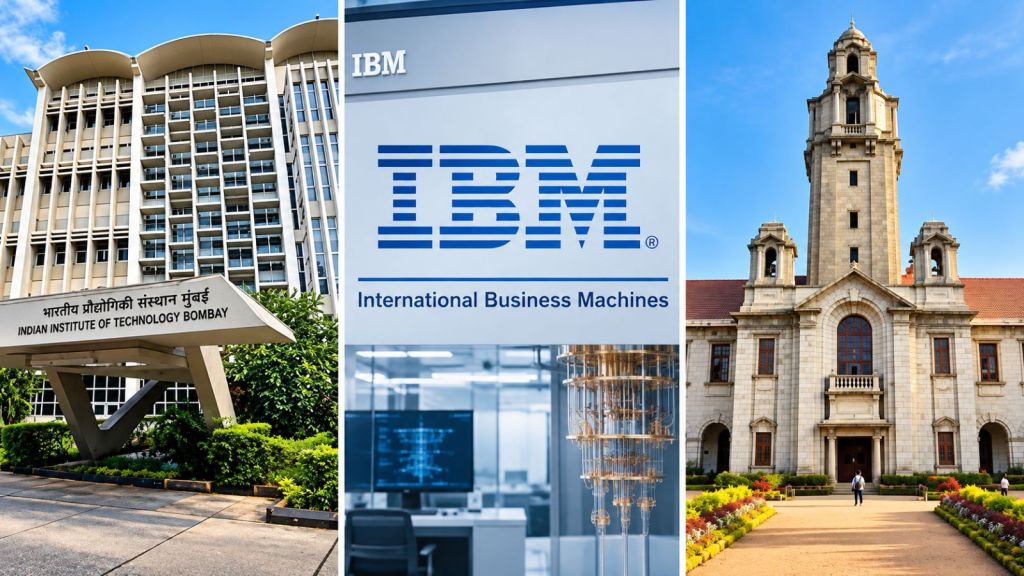 IIT Bombay and IISc Bangalore (Photo: AI Generated)
The Indian Institute of Technology (IIT) Bombay and the Indian Institute of Science (IISc) have partnered with the International Business Machines (IBM) corporation today to speed up innovation in agentic AI, sovereign AI, quantum computing, and next-generation computing systems, broadening its research collaborations in India.
Continuing the collaboration established in 2018 with IIT Bombay, IBM researchers will work with faculty and students to study sovereign and Indic language model adaptation, multimodal AI, as well as AI infrastructure and knowledge retrieval.
Both parties will work on advancing sovereign AI and Indic language models to improve multilingual AI capabilities for Indian languages through efficient model adaptation and optimisation tools. The collaboration will also focus on the development of multimodal AI systems that would fortify software programming education, human-AI collaboration and intelligent operations across hybrid cloud environments.
Also Read | IISc ranks top in India: THE World University Rankings 2027
IISc and IBM researchers’ collaboration, which was initiated in 2021, will witness a new turn as they plan to explore agentic systems, AI for applications, and quantum computing algorithm development.
The partnership aims to develop agentic AI workflows that would improve orchestration across hybrid cloud environments. It also plans to create lightweight time-series foundation models based on the IBM Granite model family for energy analytics to support forecasting, anomaly detection, load disaggregation and energy optimisation.
Also Read | 34% students felt like outsiders, 9% face suicidal thoughts, as per NTF survey
IIT Bombay, IISc and the corporation, through their collaboration, have worked to advance research across artificial intelligence, hybrid cloud, distributed systems and quantum computing, and produced opportunities for students and researchers to handle industry-related challenges, as stated by the institute.
With the new plans listed under the collaborations, the institutes aim to continue interdisciplinary research, encourage the next generation of scientific talent and facilitate innovations that would shape the future of computing, it added.


