


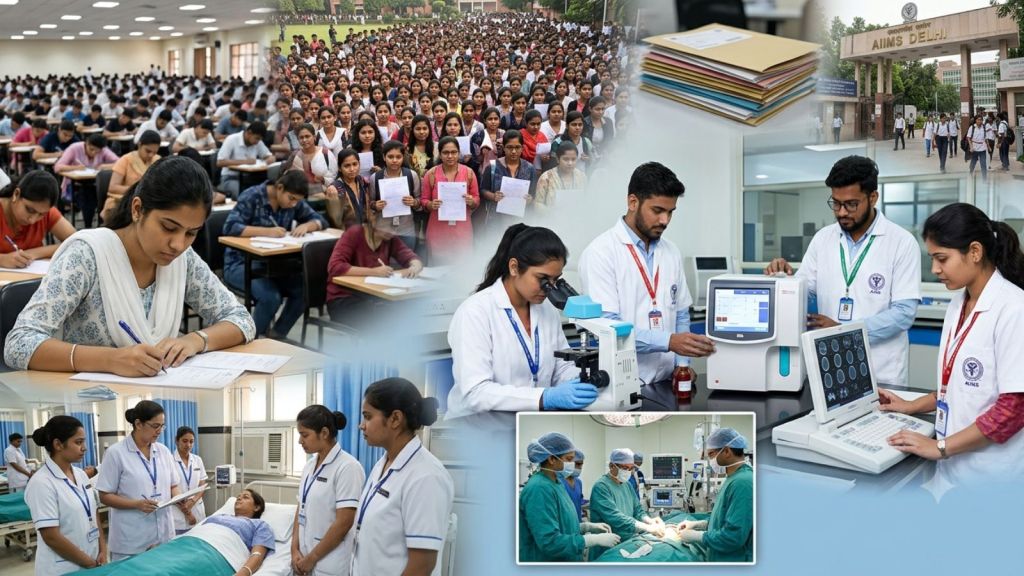
 Nursing continues to have greater visibility among students, partly because of the clearer government recruitment pathway (AI Image)
Nearly 1.91 lakh candidates applied for the BSc (Hons) Nursing entrance examination conducted by the All India Institute of Medical Sciences (AIIMS) for the August 2026 session, while more than 1.17 lakh applications were received for BSc Allied & Healthcare Courses, according to information obtained under the Right to Information (RTI) Act.
The data was sought by 30-year-old Vipul Sharma, an allied healthcare professional working in laboratory healthcare at Lady Hardinge Medical College.
According to the AIIMS RTI response, 1,90,740 applications were received for BSc (Hons) Nursing for the August 2026 session, compared with 1,17,033 applications for BSc Allied & Healthcare Courses.
| Category | 2021 | 2022 | 2023 | 2024 | 2025 |
|---|---|---|---|---|---|
| OBC (NCL) | 6,754 | 8,708 | 32,526 | 65,637 | 78,319 |
| UR (Unreserved) | 5,542 | 6,487 | 19,180 | 34,772 | 48,988 |
| SC | 2,292 | 2,755 | 9,883 | 22,109 | 28,543 |
| EWS | 1,334 | 1,700 | 5,405 | 11,865 | 15,218 |
| ST | 563 | 817 | 2,520 | 6,470 | 9,049 |
| Total | 16,485 | 20,467 | 69,514 | 140,853 | 180,117 |
| Category | 2021 | 2022 | 2023 | 2024 | 2025 |
|---|---|---|---|---|---|
| OBC (NCL) | 3,326 | 3,483 | 12,400 | 29,242 | 54,489 |
| UR (Unreserved) | 1,737 | 2,011 | 5,894 | 16,849 | 35,137 |
| SC | 859 | 967 | 3,380 | 9,593 | 20,150 |
| EWS | 759 | 809 | 2,321 | 6,692 | 11,586 |
| ST | 197 | 209 | 694 | 2,291 | 5,606 |
| Total | 6,878 | 7,479 | 24,689 | 64,667 | 1,26,968 |
Sharma said the figures point to the need for greater awareness about undergraduate healthcare careers beyond medicine and nursing.
“Not everyone knows about the multiple professions that cost less to study and can offer good career opportunities. These professions were earlier broadly referred to as paramedical professions, but are now recognised as allied healthcare,” Sharma said.
Allied healthcare includes a range of specialised undergraduate programmes, including medical laboratory technology, ophthalmic sciences, radiotherapy and perfusion technology. These professionals work across diagnostic, therapeutic and other specialised healthcare services.
Such programmes can also offer an alternative career pathway to students who aspire to become doctors but do not secure an MBBS seat. Around 22 lakh candidates appear for NEET-UG each year, while the number of MBBS seats is slightly above one lakh, leaving many students to explore other healthcare professions.
AIIMS offers nursing and allied healthcare programmes across its network, while institutions such as PGIMER Chandigarh also offer specialised allied healthcare courses.
Cost is another factor differentiating these programmes from conventional medical education. Government medical colleges and Institutes of National Importance such as AIIMS, PGIMER and JIPMER offer some allied healthcare programmes at relatively low fees. The fees at central institutions can range from around Rs 1,500 to Rs 15,000 for the programme, while courses in state-run medical colleges may cost around Rs 20,000 to Rs 60,000 a year.
Private universities and deemed institutions, however, can charge substantially more. Bachelor’s programmes such as physiotherapy, medical imaging technology and cardiac technology can cost between Rs 80,000 and Rs 3 lakh a year, depending on the institution and programme. Shorter, skill-focused vocational and state paramedical board diploma courses typically cost around Rs 20,000 to Rs 70,000 a year.
Sharma said nursing continues to have greater visibility among students, partly because of the clearer government recruitment pathway. The Nursing Officer Recruitment Common Eligibility Test (NORCET) and the government pay structure are among the factors that make nursing a more familiar option for students.
He also pointed to differences in work patterns. Allied healthcare professionals may work in specialised departments such as biochemistry and other laboratory services, where hospitals may operate services in shifts.
For students considering these programmes, Sharma said allied healthcare should not be viewed merely as a “Plan B” after NEET, but as a group of specialised healthcare professions in their own right.