


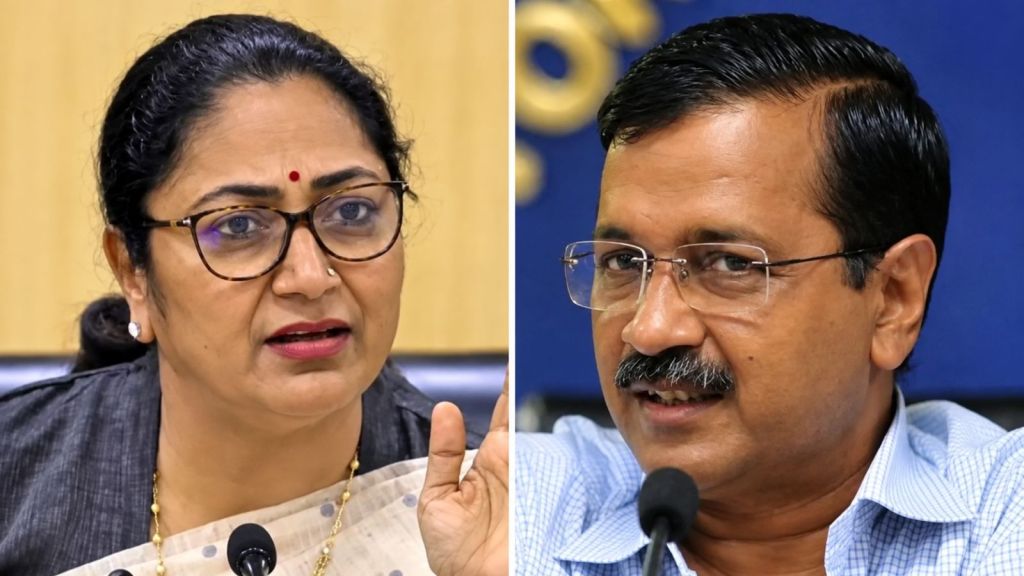
 CM Rekha Gupta and Arvind Kejriwal are among 33 lakh electors served verification notices. (File Photos/Enhanced using AI)
Chief Minister Rekha Gupta, former Chief Minister Arvind Kejriwal, New Delhi MP Bansuri Swaraj and former Delhi BJP chief Virendra Kumar Sachdeva are among the 33 lakh electors in the Capital who have been named amid the ongoing Special Intensive Revision (SIR) exercise for the issuance of notices to prove their eligibility
to remain on the electoral rolls, as per the lists made public on Saturday.
Gupta, who is an elector in Northwest Delhi’s Shalimar Bagh, was issued a notice as the difference between her age and her parents’ age appeared to be less than 15 years, according to the details provided by her in the enumeration form. However, after she provided the necessary documents, the details were validated, as per officials.
“Following due verification of facts and documents provided by the elector, the entry for Chief Minister Rekha Gupta has been validated and parked for inclusion in the Final Electoral Roll of AC–14 (Shalimar Bagh),” read a statement from the Electoral Registration Officer (ERO) of the Shalimar Bagh seat.
Former Chief Minister Kejriwal, who is the Aam Aadmi Party (AAP) national convenor, his wife Sunita Kejriwal, his parents and his son, had not provided the details of the last SIR exercise, according to the Election Commission.
“In case of Sh Arvind Kejriwal and his family, submitted enumeration forms were not complete in terms of details which would have enabled linkage of themselves with the electoral roll of the last revision of respective states, which were not present in their submitted enumeration forms,” read a statement from the Electoral Registration Officer of the New Delhi Assembly constituency.
The notice to Kejriwal prompted a political attack against the BJP from the AAP. “We’ve been saying since day one that this isn’t the SIR—it’s the BJP’s game at play. If they had their way, they’d reserve voting rights just for Modi and Amit Shah and delete the votes of all opponents,” Anurag Dhanda, National Media-in charge of AAP, posted on X, adding, “What kind of process is it to vanish the votes of three-time Delhi Chief Minister Arvind Kejriwal ji and his family from Delhi’s voter list @ECISVEEP?”
Meanwhile, former Delhi BJP chief Virendra Kumar Sachdeva’s details have been flagged in East Delhi’s Trilokpuri due to a mismatch in his name. “I just got to know that I have been issued a notice. I will look into it,” Sachdeva said.
BJP MP Bansuri Swaraj is also on the list of electors marked for issuance of a notice in the New Delhi Assembly seat. She could not be mapped to the last SIR roll, according to the official details.
Notices will be issued and disposed of between August 31 and October 29. The final electoral roll will be published on November 4.
Delhi had 1.45 electors before the SIR began. Names of 97.5 lakh electors made the draft electoral roll published on August 31.
Around 47.5 lakh electors were marked uncollectible and struck off the electoral rolls. These people can either register afresh as electors or can appeal their case.
Of 33.1 lakh electors marked on the lists for issuance of notices, 13.79 lakh electors could not link themselves to the electoral roll of the last intensive revision, while logical discrepancies have been flagged in the enumeration forms of 19.33
lakh electors, as per the official details.
As of Saturday, 31.6 lakh notices have been generated and are being delivered to electors, according to a statement from the office of the Delhi Chief Electoral Office (CEO).
The statement also notes that according to instruction from the Election Commission of India (ECI), names of members of judiciary, public representatives, holders of declared offices and personalities from fields of arts, culture, journalism, sports, and public services have been included in the draft electoral rolls so that necessary documents can also be collected during the “Claims and Objections” phase.
Those getting the notice will be asked to furnish one of the 13 documents listed by the ECI, which include birth certificate, passport, caste certificate and a permanent residence certificate.
An Aadhaar Card, however, alone is not enough.
It is the only document in the list that, by itself, will not suffice to prove eligibility, the EC has said. It must be accompanied by another document from the list that establishes the electors’ age and citizenship.
For those born in India before July 1, 1987, the EC requires a document proving date and/or place of birth. For those born between July 1, 1987, and December 2, 2004, the EC requires a document for the elector and one parent.
For those born after December 2, 2004, the EC requires documents for the elector and both parents. These categories follow the requirements under the Citizenship Act, 1955.