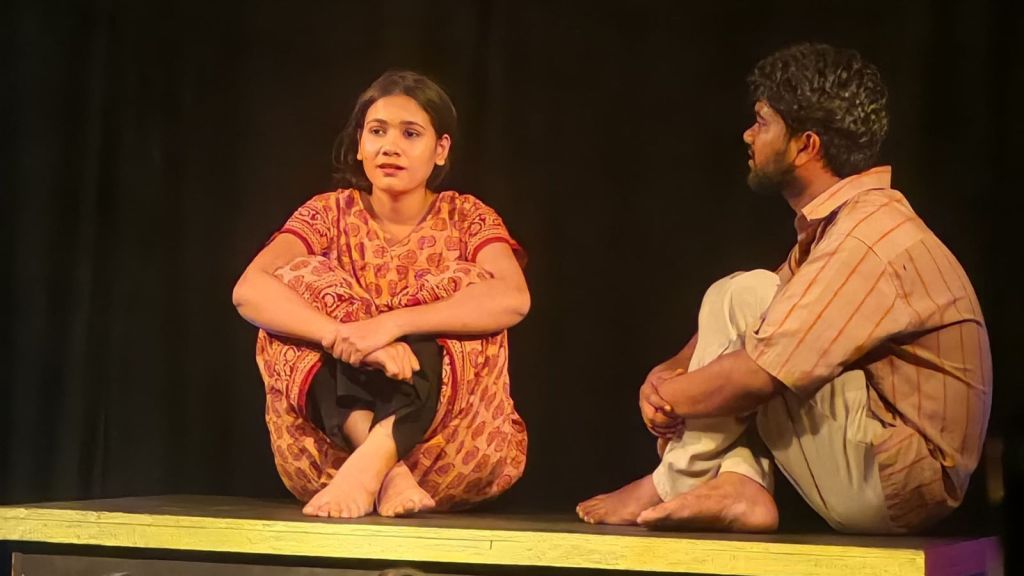

From margins to centre stage: A theatre programme lending voice to the unheard

Bargad is a training programme initiated by theatre practitioners from Delhi to overcome the obstacles of access for the marginalised

It is the brainchild of the Guild of the Goat and Incentive Foundation, a theatre company and an organisation that works in semi-rural India to address structural barriers to access and opportunity. (Express Photo)It is the brainchild of the Guild of the Goat and Incentive Foundation, a theatre company and an organisation that works in semi-rural India to address structural barriers to access and opportunity. (Express Photo)

Several weeks into drama training, Laxmi Kumari, 18, explored a new side to herself — a woman unafraid to talk, express her opinion or move around the city. “I come from a small migrant labour neighbourhood in Noida, where we are advised not to leave the house or talk too much,” she shares, and adds, “Yeh chhoti si jagah meri duniya thi (this small place was my world). I used to suffer from anxiety at the thought of going too far or speaking to people.”

At Black Box in South East Delhi’s Okhla, however, she seems to have found a new spirit of defiance.

Though she was introduced earlier to the world of theatre by an NGO, Kumari got her first experience of professional training only in 2025 when a group of theatre practitioners in Delhi kicked off a programme titled Bargad.

Possibly a one-of-its-kind initiative, Bargad reaches out to performers from historically marginalised communities — tackling gender, caste and class hierarchies — and offers them a “fully-funded, six-month intensive theatre training programme”.

Birth of an initiative

Bargad is the brainchild of the Guild of the Goat, a theatre company, and Incentive Foundation, an organisation that works in semi-rural India to address structural barriers to access and opportunity.

Among the theatre practitioners who have pushed Bargad are familiar names of the stage, such as Amba-Suhasini K Jhala, Anirudh ‘Rudy’ Nair and Sanyukta Saha of Aagaaz Theatre Trust, and Shambhavi Singh, the founder of Oddbird Theater.

Story continues below this ad

“The programme was born out of questioning the relevance of theater and what space it occupies in our world today. For theatre to continue to exist and have a meaning, it is vital that the audiences who engage with theatre in spaces across the city change. We believe that if we shift who has access to telling the stories and, therefore, the kind of stories being told, the audiences coming to engage with them will change too. The ecosystem will start changing,” says Nair.

Under the programme, talented performers from across communities find their footing in the world of stage under the training of India’s top theatre personalities, such as Lakshmana KP, Diya Naidu from Bengaluru, Hetal Varia and Sapan Saran from Mumbai, Neel Chaudhuri and Anuradha Kapur from Delhi, to conduct sessions and provide mentorship support.

Story of a sanitation worker

Their latest presentation is a two-day run of the play, Hawa Mahal, at Oddbird Theatre, which kicks off Saturday. The play revolves around the life of a sanitation worker who wishes to give his daughter a future beyond the work and caste boundaries that have shaped his own life.

How are such ideas born? “At Bargad, we are given a performance-making challenge every week. For our final performance-making challenge, we were asked to put up a play on ‘What matters to you’. A team member said, ‘Most of us are children of sanitation workers… so why don’t we tell a story about that?” recalls Anjali, a theatre educator who has learned more than storytelling from Bargad. “I used to always be unsure about myself. Once I joined this programme, I realised that it’s alright to be imperfect,” she says.

Story continues below this ad

During the extensive research for the play, the group discovered a detail nobody talked about any more. “When sanitation workers enter a sewer, they are surrounded by toxic gases. This affects them so, as soon as they come out, they drink Limca. Hamara natak isi ke around gloomta hai ki kaise ek glamour wali duniya aur ek sanitation worker ki life judi hui hai (This is what our play is about — how the two worlds intermingle),” says Anjali, adding that preparation for the play included reading ‘Annihilation of Caste’ by Dr BR Ambedkar.

She adds, “Hawa Mahal is prepared under ‘Bargad ka Chabutra Grant 2025’. Without this grant, our story would have been just an idea we wished to work on.”

In the first year, Bargad received 75 applicants for 14 spaces. In the second year, there were 200 applications.

“Right now, we are about a week away from the first official closing of the application deadline. We have about 78 applications. This will, probably, double because 90% of applications come in the last week,” says Nair.

Dipanita Nath is a Senior Assistant Editor at The Indian Express, based in Pune. She is a versatile journalist with a deep interest in the intersection of culture, sustainability, and urban life. Professional Background Experience: Before joining The Indian Express, she worked with other major news organizations including Hindustan Times, The Times of India, and Mint. Core Specializations: She is widely recognized for her coverage of the climate crisis, theatre and performing arts, heritage conservation, and the startup ecosystem (often through her "Pune Inc" series). Storytelling Focus: Her work often unearths "hidden stories" of Pune—focusing on historical institutes, local traditions, and the personal journeys of social innovators. Recent Notable Articles (December 2025) Her recent reporting highlights Pune’s cultural pulse and the environmental challenges facing the city during the winter season: 1. Climate & Environment "Pune shivers on coldest morning of the season; minimum temperature plunges to 6.9°C" (Dec 20, 2025): Reporting on the record-breaking cold wave in Pune and the IMD's forecast for the week. "How a heritage tree-mapping event at Ganeshkhind Garden highlights rising interest in Pune’s green legacy" (Dec 20, 2025): Covering a citizen-led initiative where Gen Z and millennials gathered to document and protect ancient trees at a Biodiversity Heritage Site. "Right to breathe: Landmark NGT order directs PMC to frame norms for pollution from construction sites" (Dec 8, 2025): Reporting on a significant legal victory for residents fighting dust and air pollution in urban neighborhoods like Baner. 2. "Hidden Stories" & Heritage "Inside Pune library that’s nourished minds of entrepreneurs for 17 years" (Dec 21, 2025): A feature on the Venture Center Library, detailing how a collection of 3,500 specialized books helps tech startups navigate the product life cycle. "Before he died, Ram Sutar gave Pune a lasting gift" (Dec 18, 2025): A tribute to the legendary sculptor Ram Sutar (creator of the Statue of Unity), focusing on his local works like the Chhatrapati Shivaji statue at Pune airport. "The Pune institute where MA Jinnah was once chief guest" (Dec 6, 2025): An archival exploration of the College of Agriculture, established in 1907, and its historical role in India's freedom struggle. 3. Arts, Theatre & "Pune Inc" "Satyajit Ray, Ritwik Ghatak were not rivals but close friends, says veteran filmmaker" (Dec 17, 2025): A deep-dive interview ahead of the Pune International Film Festival (PIFF) exploring the camaraderie between legends of Indian cinema. "Meet the Pune entrepreneur helping women build and scale businesses" (Dec 16, 2025): Part of her "Pune Inc" series, profiling Nikita Vora’s efforts to empower female-led startups. "How women drone pilots in rural Maharashtra are cultivating a green habit" (Dec 12, 2025): Exploring how technology is being used by women in agriculture to reduce chemical use and labor. Signature Style Dipanita Nath is known for intellectual curiosity and a narrative-driven approach. Whether she is writing about a 110-year-old eatery or the intricacies of the climate crisis, she focuses on the human element and the historical context. Her columns are often a blend of reportage and cultural commentary, making them a staple for readers interested in the "soul" of Pune. X (Twitter): @dipanitanath ... Read More


Advertisement
Loading Recommendations...
Advertisement
Advertisement
Latest Comment
Post Comment
Read Comments