Journalism of Courage



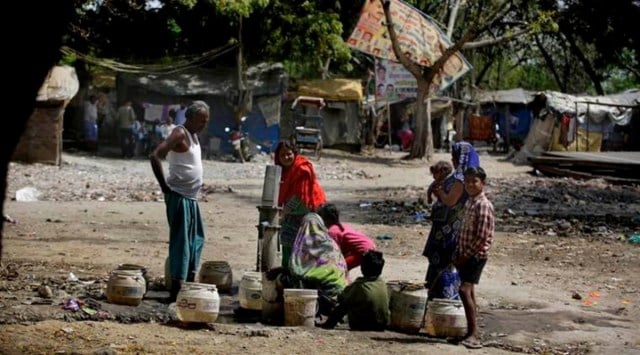 According to India Housing Report, around 100 million people are living in slums which is more than the population of Australia. (File)
Around 94,000 or 48 per cent of the 1.97 lakh families living in slum pockets in the towns of Gujarat want to construct houses on their own with state assistance under the Centre’s Pradhan Mantri Awas Yojana (PMAY) scheme’s beneficiary-led construction (BLC) component but have failed to do so largely due to the land ownership issues, a recent study has found.
The study titled ‘PMAY and Housing for All in Small and Medium size Towns of Gujarat’ has found that while a lot of work has been done in Gujarat under PMAY, most of the benefits have gone to non-slum areas. In fact, the demand fulfillment in the slum areas was a mere 0.26 per cent as only 522 houses were constructed against the demand of 1.97 lakh.
On the other hand, middle-class families living in non-slum areas of the state have bagged most of the benefits under the flagship housing scheme. It also found that the implementation of PMAY is better in bigger cities though the proportion of urban poor is quite high in smaller cities and towns.
This, despite large sections of the urban poor continuing to live in slums in cities and towns of the state.
“Of the total demand for BLC, (those from) slums comprised 66 per cent… Most of this demand remains unfulfilled as of now,” the study observes, adding “It is thus clear that BLC is the clearest demand of slum dwellers in small and medium towns of Gujarat and that this demand remains unmet. In short, while Gujarat may be a leading state in performance with respect to PMAY (U), it has not been able to meet the needs of slum dwellers in small and medium towns.”
The study pointed out that the slum dwellers did not hold the title of land on which their huts are built. The state government’s policy interventions to award them the titles are progressing slowly. The study also highlighted the lack of capacity of the slum dwellers to bridge the funding gap to build houses under the scheme.
The study was initiated by Homes in City (HIC), a Kutch-based umbrella organisation of NGOs working for the welfare of the poor and unorganised sectors, under the guidance of Prof Amita Bhide of the School of Habitat Studies of the Tata Institute of Social Sciences, (TISS), Mumbai.
PMAY was launched in 2015 with a mission to ensure housing to all by 2022. The flagship housing policy looked to address the shortage of housing through four verticals—Credit-Linked Subsidy Scheme (CLSS), In-situ Slum Rehabilitation (ISSR), Affordable Housing in Partnership (AHP) and Beneficiary-led Construction (BLC).
Under CLSS, the government provides up to Rs 2.67 lakh to beneficiaries who have purchased a house using a bank loan. Under ISSR, urban local bodies (ULBs) rehabilitate slum dwellers in the same location in partnership with private developers by generating funds from the land that will be freed, while in AHP, the beneficiaries, the Central and state governments as well as ULBs make contributions to build houses for the economically weaker sections (EWS). Under BLC, the government extends financial assistance to beneficiaries for funding construction of houses on plots of land the beneficiaries own.
Buy Now | Our best subscription plan now has a special price
As per the 2011 Census, the eight municipal corporations in Gujarat were home to 1.50 crore people while 162 municipalities had a cumulative population of 60 lakh. The municipalities have been categorised as Class ‘A’ (population of more than 1 lakh), Class ‘B’ (50,000 to 1 lakh population), Class ‘C’ (25,000 to 50,000 population) and Class ‘D’ (15,000 to 25,000 population).
Citing data from the Gujarat government, the study points out that the government assessment pegged the total number of slums at 1,534 in municipalities while assessing housing demand for slums in these towns under PMAY. Of these, 1,274 or 83 per cent were assessed to be tenable slums while 230 were assessed to be non-tenable slums. Of the more than 2.16 lakh households that were living in these slums, 1.97 lakh were assessed to be eligible to be covered by government schemes for making cities slum-free.
However, in the demand survey, those opting for BLC from the slum areas outweighed those from the non-slum areas. While 94,232 slum dwellers or 48 per cent of the total potential beneficiaries chose the BLC option, only 36,978 or 19 per cent chose AHP. A third or 65,828 opted for ISSR. On the other hand, BLC demand from non-slum category was only 46,999.
In fact, 69 per cent of the demand in slums in Class D municipalities was for BLC, followed by 58 per cent in Class B municipalities, 42 per cent in Class A and 34 per cent in Class C.
However, citing data provided by the state’s Affordable Housing Mission (AHM), the study underlines that as of September 2021, not a single house was constructed under PMAY despite demand from around 802 slum pockets.
Similar was the case under ISSR where there is demand for housing from 65,828 households living in 470 slum pockets. Under AHP, against the demand of 36,978 households living in 33 slums, only 522 houses were constructed and hence, the fulfillment was only at 1.41 per cent.
In contrast, 15,212 houses (27 per cent) were constructed under BLC in the non-slum areas of the municipalities against a total demand of 57,244.
HIC Director Aseem Mishra said the performance of PMAY in slum segment is in stark contrast to its performance in non-slum segment. “The CLSS vertical accounts for 3,79,609 houses of the around six lakh total houses constructed under PMAY in Gujarat. Those who benefited from CLSS are mainly from middle-classes. None of them are residing in slums,” he says.
As per the data provided by AHM, Mishra said, nearly 70 per cent of towns and cities in Gujarat have slums where plots are big enough to build liveable houses and resolve the housing problems. “The study also found that land regularisation and land rights to slum dwellers can significantly reduce the housing demand and improve the performance of PMAY scheme as well,” Mishra said, adding, “The success of such efforts has already materialised in Odisha and Punjab where land rights have been given to slum dwellers in the last few years,” Mishra added.

 6 min read