


Stay updated with the latest - Click here to follow us on Instagram
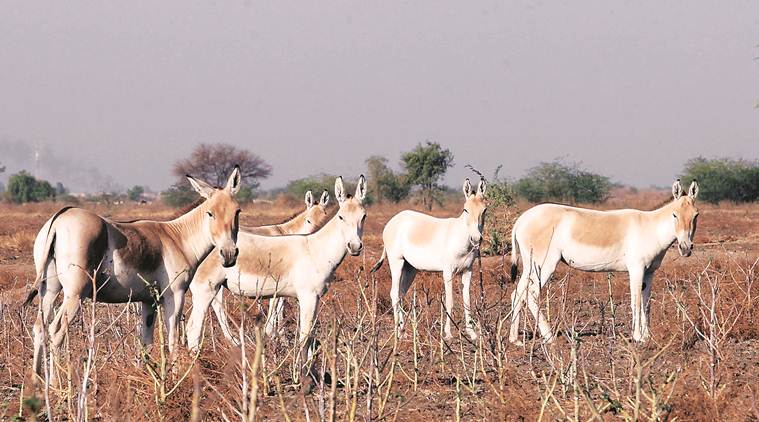 Wild asses at the Wild Ass Sanctuary in Surendranagar district. (Photo: Javed raja)
More than 1,200 people, including forest staff, volunteers and assistants, would fan out in desert, mudflats and plains spread across six districts of north and west parts of Gujarat to count the number of Indian wild assess (equss hemionus subspecies khur), the animals whose only wild population in the world is surviving in Gujarat, by using GPS tracking devices and drone cameras as part of the 9th Wild Ass population estimation exercise later this week.
The Gujarat forest department has formed a six-member core committee headed by Shyamal Tikadar, the principal chief conservator of forests and chief wildlife warden of Gujarat to steer the massive exercise which will be taken up in Surendranagar, Ahmedabad, Patan, Banaskantha, Kutch and Morbi districts on March 13 and March 14. The entire existing range of the wild asses have been divided into three regions – Dhrangadhra in Surendranagar, Bhachau in Kutch and Radhanpur in Patan on periphery of the Little Rann of Kutch (LRK).
Forest officers say that besides the 4,953.70 square kilometre (sqkm) area of Little Rann of Kutch which forms the Wild Ass Sanctuary, the census would cover areas deep into Ahmedabad and Kutch districts where movement of the animals have been recorded in recent years. Shwetank Pandit, conservator of forests (CF) of Gandhinagar wildlife circle, said that staff would cover at least 6,000 sqkm area for the purpose of counting the herbivores.
Around 15,000 sqkm area across these six districts now records movement of wild asses. “Their movement has been recorded near Nal Sarovar and Bhal area of Ahmedabad. Therefore, this census, we shall cover more area of Ahmedabad district,” Pandit told The Indian Express on Monday.
Large parts of Little Rann of Kutch and Great Rann of Kutch (GRK), the two deserts remain submerged in monsoon due to discharge of floodwaters from rivers flowing from the north Gujarat as well as Saurasthra. Therefore, the area become inaccessible even as wild assess and other animals seek refuge on larges islands on in the Little Rann of Kutch.
For the purpose of population estimation exercise, the three regions have been divided into 18 zones and 77 sub-zones. These sub-zones have been further divided into 362 census points or blocks where an enumerator would count number of wild asses by direct sighting method.
“The main challenge is the vastness of the area. Therefore, we have identified areas where movement of wild assess remain high, for example peripheral area of the sanctuary. We shall focus on those areas. Enumerators will assess number of wild assess in a herd on the basis of direct sighting, mark GPS location of the herd and if the heard is moving, will also record direction of its movement,” Pandit further said.
Story continues below this ad
The CF said that in order to cover the vast expanse, the Gujarat forest department has enlisted around 300 volunteers who are either associated with NGOs working in the filed of wildlife conservation or are wildlife enthusiasts. “Around 5,000 salt-pan workers are also working in salt-pans in Little Rann of Kutch. They have historically been helping us in the census exercise and we have sought their help this time also,” added Pandit.
S S Asoda, deputy conservator of forests (DCF) of the Wild Ass Sanctuary in Dhrangadhra, said that drone cameras would be used for the first time in the census. “Some of the areas in Little Rann of Kutch are inaccessible even today and therefore we have decided to use drones for the purpose of counting. With the help of drone cameras, we shall be able to count the numbers of animals in a herd even though it may not be possible to ascertain sex of animals by using this technology,” he said.
The DCF further said that around 700 members of forest staff, around 300 volunteers of various NGOs and wildlife enthusiasts and around 500 assistants would be on the field.
He said that besides the Little Rann of Kutch and Great Rann of Kutch, the census would cover most of eastern Kutch this time. “Wild ass movement has been recorded in some pockets of Bhachau, Gandhidham and Bhuj talukas of Kutch so census exercise would cover these areas also,” said the DCF.
Story continues below this ad
The exercise comes just around two months after three wild asses were allegedly shot dead in the sanctuary.