


Journalism of Courage
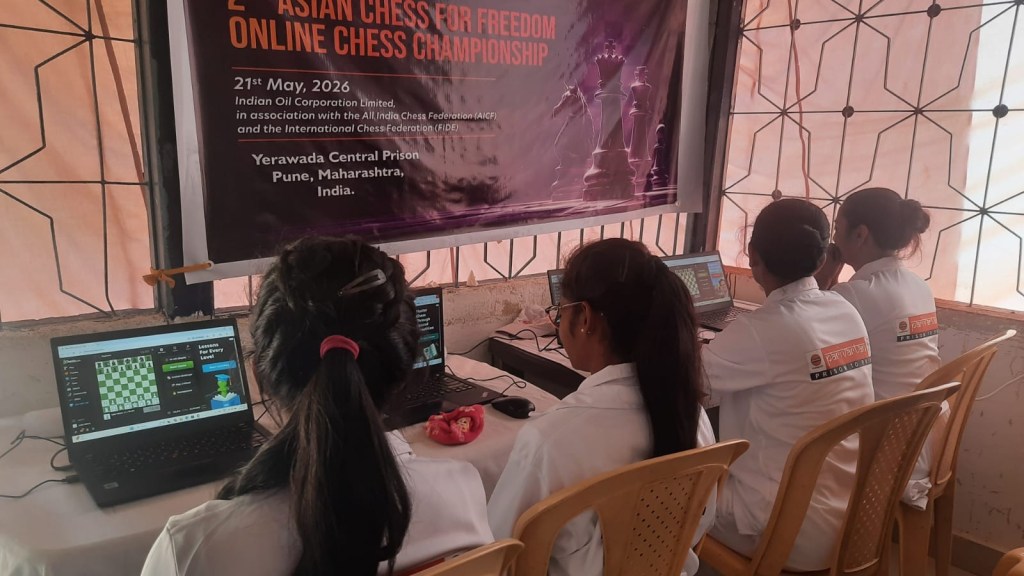 The four members of the team during the Asia qualifiers. (Express)
“Chess teaches us to think several moves ahead. If I had done that before making the mistakes in my life, I would not have been here,” an inmate who is in her 40s and lodged at Yerawada Women’s Prison told her chess coach, Pradnya Khaire — this during an endgame lesson a few weeks ago. As Khaire explained how a single move in the final stages can decide a game, the lesson seemed to extend beyond the board.
“We learnt that every move has consequences and invites a response from the opponent. In life, too, every decision sets something in motion,” said another team member to Khaire during a recent practice session.
For the six women on Yerawada’s team, chess has become an exercise in patience, strategy and consequences. The team has now, for the first time, qualified for the FIDE Intercontinental Chess Championship for Prisoners. The championship will bring together correctional institutions from around the world. “For these female inmates, it is not just an international competition, but an opportunity to put into practice a lesson they have learned one move at a time: think ahead.” said Sunil Dhamal, Superintendent of Yerawada Central Prison. One of the oldest prisons in India, established in 1871, Yerawada Central Prisons Women’s wing was established in 1927. It houses around 250 inmates.
The biggest-ever chess event among correctional facilities, the FIDE Intercontinental Chess Championship for Prisoners, organised by International Chess Federation (Fédération Internationale des Échecs) or FIDE and the Chicago Cook County Sheriff’s Office, is part of the Chess for Freedom programme and a continuation of the international championship first held in 2019. The sixth edition of the championship will be held online from October 15 to 17. “The six-member team comprises four main players and two are reserves, selected from a pool of 20 inmates who play chess,” said Khaire. Aged between their early 20s to early 50s, the contestants are either serving time as convicts or undergoing trial for serious offences including murder, kidnapping and assault.
The foundation for Yerawada Central Prison’s chess programme was laid in 2021 as part of Indian Oil Corporation’s (IOC) nationwide initiative, Parivartan: Prison to Pride. Conceived under the leadership of then-chairman Shrikant Madhav Vaidya, the programme sought to bring chess into prisons across the country. Indian Chess Grandmaster Abhijit Kunte is the mentor for the programme. In 2024, Pradnya Khaire was roped in as trainer for the women’s team. Her husband, Ketan Khaire has been coaching the men’s team. The men’s team’s achievements in the intercontinental tournament include a bronze medal in 2022, gold in 2023, fourth position in 2024 and another gold in 2025.
“In 2024, we began basic chess training with a group of inmates. The women’s team entered the Asian continental qualifiers in 2025 but did not make it through. This year, after more intensive training, they cleared the Asia round in May and qualified for the Intercontinental Championship in October. They now train on computers and physical boards inside the prison, with a dedicated laptop for the team coming soon. The players tell me some practice sessions stretch late into the night, often drawing fellow inmates who gather to watch. For those hours, chess gives them a way to step beyond the confines of prison life and the difficult environment around them. And among those who gather around the boards, today’s spectators can become tomorrow’s players,” said Khaire.
Currently the team is taking lessons on specific openings and endgames and is working on its time management. The intercontinental event will take place on Chess.com using a time control of 10 minutes plus a five-second increment per move. On October 15, teams will compete in round-robin groups of up to eight teams, grouped by time zone to ensure fair play conditions. No two teams from the same country will be placed in the same group. From India, in the women’s category, teams from Yerawada and Bhopal prison have qualified. For theiir training, Khaire is accompanied by assistant coach Arya Pise and the programme receives guidance from Additional Director General (Prisons) Suhas Warke and Special Inspector General Yogesh Desai.
They began with the fundamentals — castling, en passant, pawn promotion, piece development, basic tactics, checkmate patterns and simple endgames — before progressing to more advanced play. As their training progressed, they moved to basics pawn structures, piece coordination, tactical combinations, candidate moves, calculation, opening plans and endgame concepts. “The strategic game of chess, which demands focus and foresight, has been embraced across the world as a constructive correctional activity. Beyond offering a positive distraction, the game encourages patience, strategic thinking, decision-making and an ability to consider consequences before acting. We are definitely seeing a very positive change in inmates who participate,” said a prison department officer.
“The prison department is proud of these inmates to have qualified for the intercontinentals for the first time. And we wish them that they bag medals,” said Superintendent Dhamal. “One of the key lessons we are trying to impart is that every move changes the entire board. You have to visualise how the board will look and how your opponent might respond before making a move. It is something they all feel applies far beyond the 64 squares,” coach Khaire said.


