
US-based Pune engineer builds AI app for visually impaired readers

Engineer Yogen Prashant Ghodke began to use his academic knowledge and practical skills to develop an Android app, ListenToMe, which converts PDFs, photographs, scanned documents, notices and handwritten notes into audio that sounds natural rather than robotic.

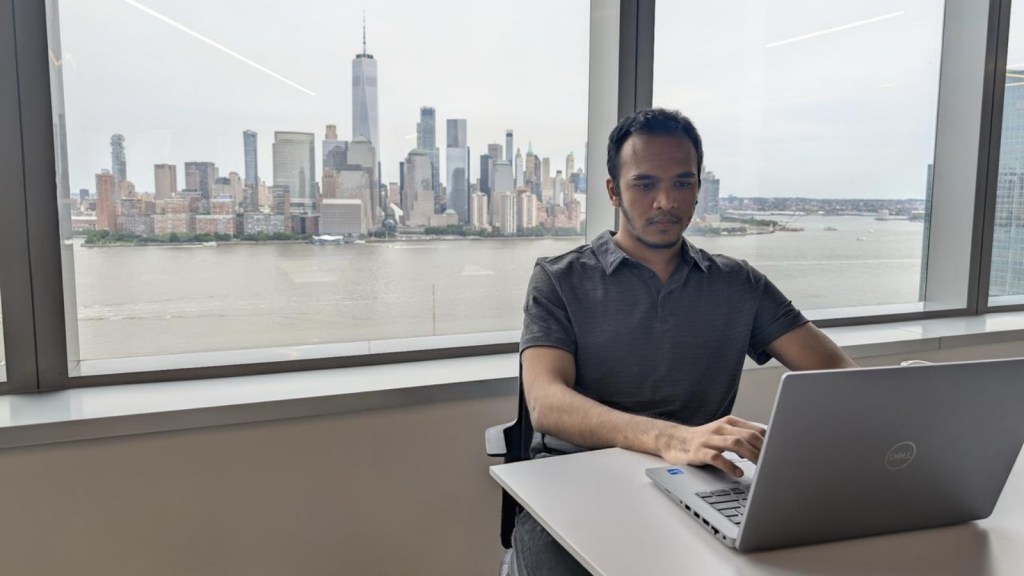
Yogen Prashant Ghodke, a Computer Science Engineering graduateA Computer Science Engineering graduate, Yogen Prashant Ghodke. (Source: Special Arrangement)

Pune-based Seema Kharad, a school topper in Class X and Class XII, wanted to pursue further studies, for which she needed access to higher-education reference books. The problem was not finding these books; it was reading them.

Kharad, who is visually impaired, found that few higher-education reference books are available in Braille. Despite being a brilliant student, she was completely dependent on others to record chapters from books or read out handwritten class notes and PDFs.

“Around this time, I was in the US, running various personal experiments on how Artificial Intelligence and Large Language Models could be used safely and effectively to make a positive contribution to society. Seema is a family friend and I got to know of her struggles,” says Yogen Prashant Ghodke, a Computer Science Engineering graduate from M.E.S. Wadia College of Engineering, Pune. He moved to the US for his postgraduation in Computer Science at the University of North Carolina at Charlotte, graduating in 2024.

Ghodke began to use his academic knowledge and practical skills to develop an Android app, ListenToMe, which converts PDFs, photographs, scanned documents, notices and handwritten notes into audio that sounds natural rather than robotic. Ghodke says that the app can also interpret and describe images, charts and diagrams rather than simply ignoring them, as many conventional text-to-speech systems do.

It took three to four months to develop the app. “I was writing code in New York, while Seema was putting the app to the test during her actual daily study routine in Pune. She would test it on actual university reference books, handwritten notes, or complex exam PDFs, and send me honest WhatsApp messages and voice notes flagging bugs and issues. I would debug the issue, rewrite the logic, and push a fix as soon as I had time,” he says. “Because I developed the software alongside an actual power user at every single step, the app avoided the blind spots that often happen when sighted developers build for visually impaired users in isolation,” he adds.

A major focus for the founder was vernacular support. “The app seamlessly supports English alongside major Indian languages like Marathi, Hindi, Tamil, and Telugu. According to Seema and her visually impaired friends, it is the only app they have found that reads Marathi books in such a natural, native cadence,” says Ghodke.

Since the app was launched on Google Play Store and Apple App Store in late August, users have processed nearly 7,000 pages of physical books and PDFs into approximately 280 hours of custom audiobooks. There are, at present, more than 110 registered users, with 30 active creators who have produced 140 bespoke audiobooks.

Story continues below this ad

“Analytics reveal that this solo project has quietly crossed borders through organic reach, reaching users across 13 countries on five continents. The community is anchored primarily in India, with 44 active users and the US, with 26 active users – which make up roughly 84 per cent of the engagement. Students are also actively discovering and using the app across Africa, Europe, South America, and Southeast Asia, in countries such as Angola, Chile, Ethiopia, Nigeria, Germany, Ireland, the Netherlands, Indonesia, Thailand and the Philippines,” says Ghodke. Users have also created audiobooks in English, Marathi, Hindi, Spanish, Bengali, Punjabi and Portuguese.

Ghodke says that user privacy, security, and student dignity were non-negotiable architectural principles from day one. “User documents are never stored long-term, never sold and never fed into public AI training datasets,” he adds.

Meanwhile, Kharad, who has created 73 audiobooks for her coursework, is preparing for a PhD in Political Science.

Dipanita Nath is a Senior Assistant Editor at The Indian Express, based in Pune. She is a versatile journalist with a deep interest in the intersection of culture, sustainability, and urban life. Professional Background Experience: Before joining The Indian Express, she worked with other major news organizations including Hindustan Times, The Times of India, and Mint. Core Specializations: She is widely recognized for her coverage of the climate crisis, theatre and performing arts, heritage conservation, and the startup ecosystem (often through her "Pune Inc" series). Storytelling Focus: Her work often unearths "hidden stories" of Pune—focusing on historical institutes, local traditions, and the personal journeys of social innovators. Recent Notable Articles (December 2025) Her recent reporting highlights Pune’s cultural pulse and the environmental challenges facing the city during the winter season: 1. Climate & Environment "Pune shivers on coldest morning of the season; minimum temperature plunges to 6.9°C" (Dec 20, 2025): Reporting on the record-breaking cold wave in Pune and the IMD's forecast for the week. "How a heritage tree-mapping event at Ganeshkhind Garden highlights rising interest in Pune’s green legacy" (Dec 20, 2025): Covering a citizen-led initiative where Gen Z and millennials gathered to document and protect ancient trees at a Biodiversity Heritage Site. "Right to breathe: Landmark NGT order directs PMC to frame norms for pollution from construction sites" (Dec 8, 2025): Reporting on a significant legal victory for residents fighting dust and air pollution in urban neighborhoods like Baner. 2. "Hidden Stories" & Heritage "Inside Pune library that’s nourished minds of entrepreneurs for 17 years" (Dec 21, 2025): A feature on the Venture Center Library, detailing how a collection of 3,500 specialized books helps tech startups navigate the product life cycle. "Before he died, Ram Sutar gave Pune a lasting gift" (Dec 18, 2025): A tribute to the legendary sculptor Ram Sutar (creator of the Statue of Unity), focusing on his local works like the Chhatrapati Shivaji statue at Pune airport. "The Pune institute where MA Jinnah was once chief guest" (Dec 6, 2025): An archival exploration of the College of Agriculture, established in 1907, and its historical role in India's freedom struggle. 3. Arts, Theatre & "Pune Inc" "Satyajit Ray, Ritwik Ghatak were not rivals but close friends, says veteran filmmaker" (Dec 17, 2025): A deep-dive interview ahead of the Pune International Film Festival (PIFF) exploring the camaraderie between legends of Indian cinema. "Meet the Pune entrepreneur helping women build and scale businesses" (Dec 16, 2025): Part of her "Pune Inc" series, profiling Nikita Vora’s efforts to empower female-led startups. "How women drone pilots in rural Maharashtra are cultivating a green habit" (Dec 12, 2025): Exploring how technology is being used by women in agriculture to reduce chemical use and labor. Signature Style Dipanita Nath is known for intellectual curiosity and a narrative-driven approach. Whether she is writing about a 110-year-old eatery or the intricacies of the climate crisis, she focuses on the human element and the historical context. Her columns are often a blend of reportage and cultural commentary, making them a staple for readers interested in the "soul" of Pune. X (Twitter): @dipanitanath ... Read More


Click here to join Express Pune WhatsApp channel and get a curated list of our stories

Advertisement
Loading Recommendations...
Advertisement
Advertisement
Latest Comment
Post Comment
Read Comments