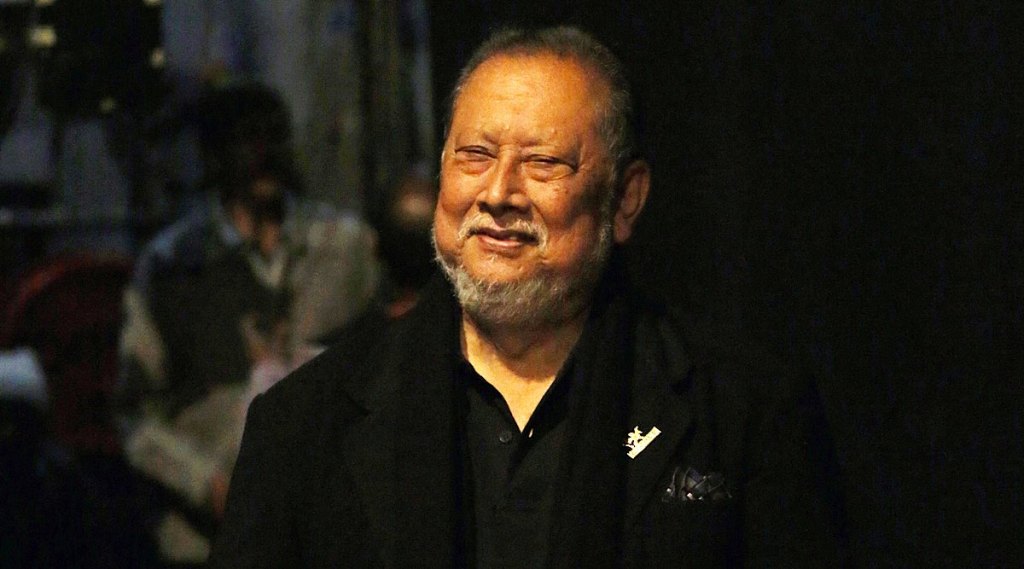
Around 50 people gathered at the condolence meeting held at The Box in Pune to remember one of the most towering figures of Indian theatre, Ratan Thiyam. The event had eminent director Atul Pethe reading excerpts from a write up about Thiyam and playwrights Ashutosh Potdar and Satish Alekar and filmmaker and film educator Anupam Barve talking about Thiyam.
Thiyam died at 76 at the Regional Institute of Medical Sciences (RIMS), Imphal. The condolence meeting recalled the influence of Thiyam, who had brought many of his iconic plays to Pune. Alekar shared many important incidents, facts and insights about Thiyam, his theatre and Manipuri tradition and culture.

Thiyam’s works seamlessly merged ancient Indian performance traditions with contemporary narratives. His death marks the end of an era in Indian performing arts. Thiyam was a recipient of the prestigious Sangeet Natak Akademi Award in 1987 and is remembered as a theatre guru who redefined the language of stagecraft in India.
“This is a massive loss to the cultural field of Manipur, and Indian theatre as a whole. A few years ago, we lost the other side of the coin, the director Heisnam Kanhailal. Now, with Ratan ji gone, Manipuri theatre has lost both its giants,” said Alekar, a Marathi playwright and co-founder of the Theatre Academy of Pune.
Born on January 20, 1948, Thiyam was a student of Ebrahim Alkazi at the National School of Drama (NSD) in Delhi. “He didn’t replicate Alkazi’s theatre. Thiyam created his own theatre with his own roots- Manipuri roots, which are distinctly different from Indian mainstream traditions,” said Alekar.
In plays, such as Antigone, Urubhangam, Ritusamhara and Andha Yug, Thiyam developed a language of theatre that was spiritually intense, visually immersive, and politically resonant. “Andha Yug was not just a play. It was a complete visual and sonic experience. The chorus was composed entirely of Manipuri performers. It became a tragedy of the people of Manipur told through a new angle. That was the genius of Ratan Thiyam,” said Anirudha Kuthwad, director and theatre educator associated with NSD and FTII.
Thiyam often referred to theatre as a medium of protest, not mere performance. “He believed in theatre as a tool to voice the pain of his people. He once said in a discussion, ‘I see theatre as protest. I see the play as a protest.’ And that’s how he lived it,” added Kuthwad.
One of his later landmark productions, When We Dead Awaken, an adaptation of Henrik Ibsen’s work, was placed in the contemporary context of Manipur’s turmoil, reinforcing his commitment to using myth to critique the present. Kuthwad echoed the sentiment, “We may never see someone like him again. His devotion, his creative energy, even in his senior years was unmatched. He didn’t just take Manipuri theatre to India, he took it to the world.”
“The government should take note of what Ratan and Kanhailal built. What Manipur needs right now is not more politics, but cultural intervention- classical concerts, traditional performances, contemporary plays grounded in reality. That would be the true homage to Ratan Thiyam’s life’s work,”said Alekar.



 Share


