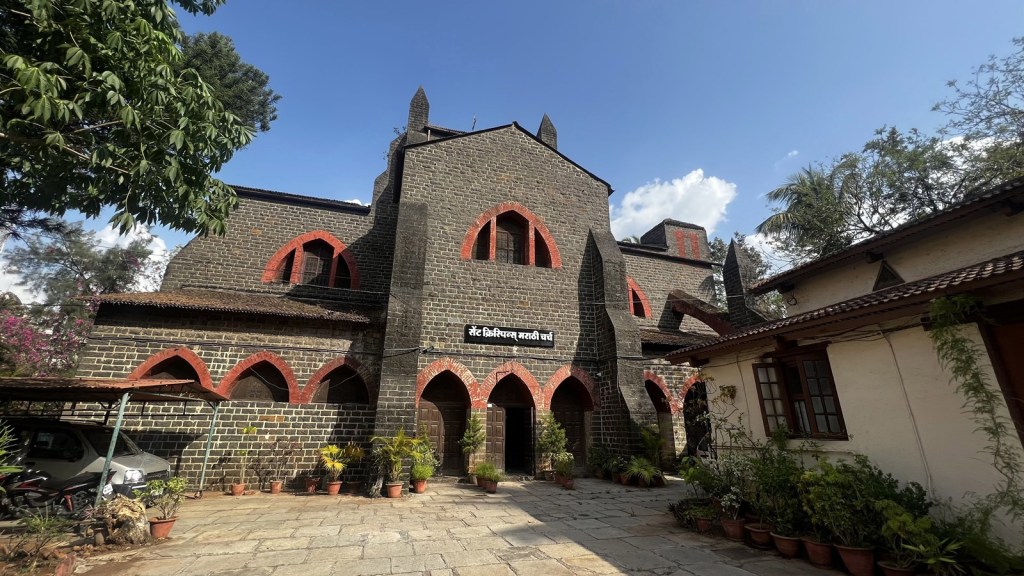
Early Saturday morning, amidst faint sounds of a chisel and whiff of a lemony scent, Punekars got a chance to engage with experts at the century old Saint Crispin’s Church to understand its restoration, which is currently underway. The visitors saw demonstrations of cleaning methods of historic stone walls, lime pointing works and work done by the drone visual survey team.
The workshop was hosted with an intent to educate citizens about what such restoration work entails by Nasadeeya Architect, Archana Deshmukh and her team, INTACH Pune Chapter and Architects Engineers Surveyors Association (AESA).

Deshmukh said, “The main objective of the project is to bring back the church to its original glory using sustainable conservation measures”. An audience of around 50 people, from young college students to senior citizens, saw a demonstration of the micro air abrasion technique (MAAT) which uses air pressure to clean stone walls. They also saw lime pointing works, and explaining the significance of the technique in the process, Deshmukh said, “It is a water-tightening procedure, where you fill the gaps between stones using lime. This pointing work doesn’t let the water into the masonry.”
Restoration
Among other things, the restoration process will involve removing invasive vegetation growth on the roof and walls. To fix water seepage, a thermography session has been conducted to find cracks which will then be sealed.
The church built around 1907 is built in a later Gothic style of architecture, defined by its fort-like look with pinnacles on the roof. Architect Deshmukh says the roof, water–seepage protection and lime pointing is the first phase of restoration. Phase two will involve plaster, painting and electrical work, and in phase three they will work on the furniture and compound wall. The aim is to complete restoration within two and a half years.
Another interesting feature of the church’s architecture are the stained glass rondels (round disks) in the windows. “They are handcrafted and we will restore the windows by procuring the rondels from London next year,” said Deshmukh.
Assistant Director, State Archaeology Maharashtra, Vilas Wahane, said, “We are working on many projects currently. Today, we have only around six to seven panel architects in West Maharashtra, which do not suffice for the number of projects we are doing.”
He has requested INTACH members and others to notify him about more sites that need to be restored. “It is not necessary that they must be declared protected monuments. If you see any important site that needs restoration, we will try to get a budget for it next year”.



 Share


