Until the lockdown forced him indoor, Milind Champanerkar, a Pune-based writer and winner of the Sahitya Akademi Award in 2017, was travelling through the interiors of Maharashtra in search of old people who had known Dalit literary stalwart Anna Bhau Sathe in the 1940s and’50s. Most of them are bed-ridden, ailing or suffering from dementia — making Champanerkar’s work of recording their memories that much harder.
Champanerkar is documenting one of the less-archived aspects of Anna Bhau’s contributions — the Loknatya theatre form that played a significant role in mobilising subaltern crowds, especially Dalits in rural Maharashtra and textile workers of Mumbai, in sociopolitical movements such as the Sanyukt (Unified) Maharashtra Movement. This year marks the centenary of Anna Bhau’s birth.

“Anna Bhau mainly wrote on the lives of the downtrodden and his body of work made the Marathi literary circle realise that subaltern writing with a subaltern consciousness makes a difference,” says Champanerkar. “Although a lot of research-based analytical books and articles have been written on Anna Bhau’s literature, one hardly finds detailed analysis of the Loknatya form or the discussion about its legacy,” he adds.
Anna Bhau transmuted the traditional Tamasha folk-theatre form, which had erotic overtones, into a popular tool to appeal to the masses to work to fight capitalism, caste discrimination and injustice in society.
“His content used characters people could easily relate to and clear language. Moreover, women characters in his play were no more entertainers, but rather socially conscious activists. who believed in gender equality, which was a diversion from the traditional Tamasha,” says Champanerkar.
He had little knowledge of Anna Bhau’s Loknatya until four years ago, when he came across a 90-year-old woman in Vidarbha who mentioned to him that she had been a loknatya performer.
“I asked, ‘Do you remember any of the songs?’ She began to sing the ballads one after another. She told me that inequalities still exist in society, but there are no groups or cultural movements any more,” says Champanerkar.
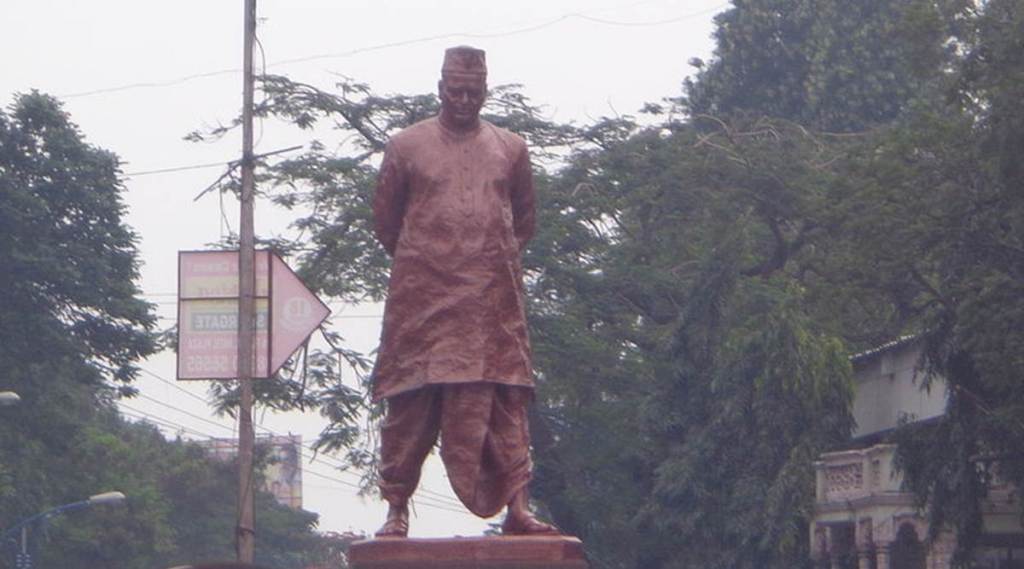
He was so moved that he started to travel to different parts of Maharashtra and saw that Anna Bhau’s legacy of Loknatya still existed in the hearts and minds of the people. In Beed, Iqbal Painter, an 80-year-old, had written a poem in tribute to Anna Bhau that began “Your statues / everywhere/ but not, / your thoughts…”.
“In villages with Leftist influence, every house had women singing Anna Bhau’s songs,” says Champanerkar, who was a district correspondent for Amravati for The Indian Express till 2000. “I thought that if Anna Bhau is so loved after so many decades, I must document his lokanatya,” says Champanerkar.
The process of documentation has been challenging as few records or recordings exist. Champanerkar is relying on the memories of people, who worked with Anna Bhau, and are 80-90 years old today. “All the evidence is fast slipping away,” he says.
The project, which has won funding from the India Foundation for the Arts, Bengaluru, under its Arts research Programme, will culminate in a documentary film. The world of Anna Bhau will be recreated through interviews with scholars, artistes and performers as well as short performances of parts of his plays. “I have contacted people who used to work with Anna Bhau to perform in the original style with authentic instruments so that the audience can get an idea of the power of the Loknatya,” says Champanerkar.
One of the plays by Anna Bhau, Aklechi Gosht, revolves around a moneylender and a milkman with much property. To settle an argument, they decide to play a game of lies in which each one can only speak lies. “Whoever tells the truth will lose his wealth and property to the other. The satire, written so many decades ago, still has political resonances today. This is one of the reasons that we must preserve the legacy of Anna Bhau’s theatre,” says Champanerkar.




 Share


