4 min readPuneJul 24, 2023 02:22 PM IST
First published on: Jul 24, 2023 at 12:37 AM IST
Pune Zilla Parishad CEO Ayush Prasad, who has been transferred to Jalgaon as district collector, said during his three-and-half-year tenure, that the administration worked tirelessly in enhancing the quality and merit of ZP schools.
“We implemented a focussed programme to improve the quality and merit of ZP schools,” Prasad said during the felicitation programme organised by Pune ZP. Those present at the event were former ZP president Nirmala Pansare, former chairman Baburao Waikar, additional CEO Chandrakant Waghmare, project director Shalini Kadu among others.

Speaking to The Indian Express, Prasad said that during his tenure he tried to strengthen all 18 ZP departments by implementing a model of “gap filling”. “We tried to standardise the working of all ZP departments via our model of administration gap-filling and we standardised every infrastructure at our disposal,” Prasad said. Prasad said by standardisation he meant strengthening them as per government norms by removing their deficiencies.
“For instance, if at a primary health care centre, we identified that it required 252 pieces of equipment, anganwadis required 32 items, or schools required 18 types of infrastructure. We analysed the gap by checking how many items were available. Then we either bought the items or repaired them, and ensured that all health centres, anganwadis and schools were standardised.
With this measure, all services provided by ZP improved drastically,” he said. Pankaj Patil, a ZP official who looked after CSR funds for improving infrastructure, said, “Via the ‘gap-filling’ model, we provided the requisite equipment to health centres, spending Rs 32 crore through DPDC funds, ZP funds and CSR funds. We tried to meet all requirements of all anganwadis, and 397 of the total 3,836 primary and secondary schools.
Prasad said he pushed his administration to ensure that all departments work efficiently and are citizen-friendly while discharging their duties. “Schools remained our top priority. We tried to revolutionise the education system. Our mantra was planning, training, upgrading, supporting, monitoring and improving,” he said.
Pune ZP, he said, played a proactive role. “Events, awareness drives, and other non-academic pursuits were banned to maintain a sharp focus on education,” he said. “We introduced class and subject-wise weekly study plans to guarantee comprehensive coverage of the syllabus. These meticulously designed study plans enable teachers to deliver the curriculum effectively,” he said.
Under his tenure, the Pune ZP received the Late SS Gadkari Award for innovation in public administration. “The award was a recognition of our relentless effort to innovate and implement an effective system of administration,” Prasad said.
One of the innovative projects, he said, was the ‘family folder’ concept and designing a single master form for families to access all schemes being implemented by Pune ZP. Another major step was the drive to include names of women as owners of properties in rural Pune district, he added. “About 8.15 lakh properties of the 9.27 lakh households in Pune district now have the name of at least one woman as a house owner.”
Prasad said the Pune ZP during his tenure has also launched a software system — Mazha ZP, Mazha Adhikar — for social audit of public work and elicit feedback of the work.

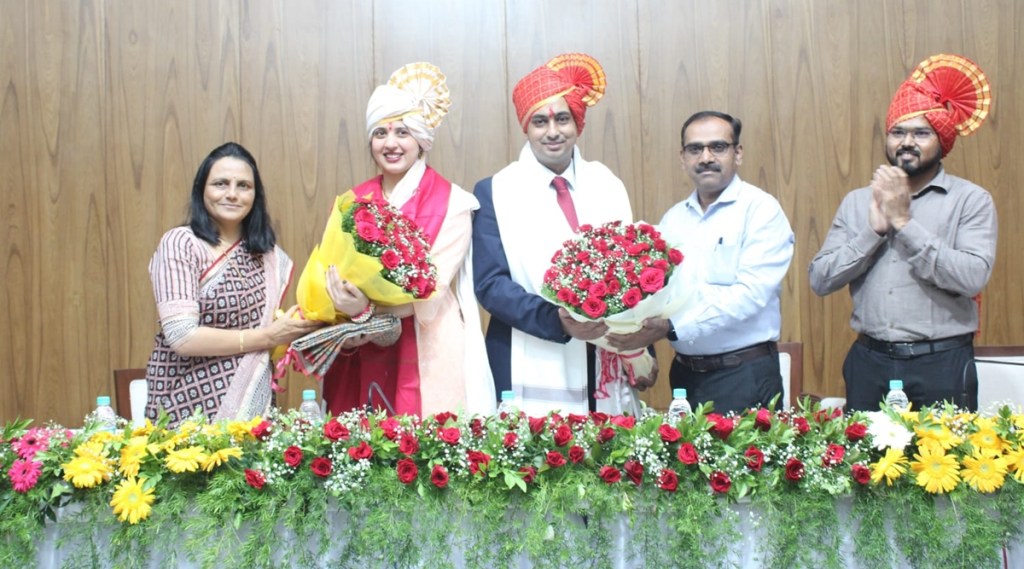 CEO Ayush Prasad (centre) is felicitated at an event organised by the Pune Zilla Parishad on Sunday. (Express File Photo)


 Share


