The demand, spearheaded by activist Vidyanand Bapat, calls for a completely noise pollution-free festival. But mandal leaders across the city say the picture on the ground is more nuanced than a simple case of compliance versus defiance, with some mandals having gone without loudspeakers for decades and others insisting that a single day of celebration with a sound system is a reasonable ask.
‘No choice but to opt for a sound system’
Uday Mahale, president of the Shri Gurudatta Mitra Mandal, Shivajinagar, said the sheer scale of Pune’s Ganeshotsav makes dhol-tasha troupes hard to come by for every mandal.
“Considering the main and smaller Ganpati mandals, thousands of processions take place every year in Pune, but we don’t have that many dhol-tasha groups, so actually we don’t have a choice but to opt for a sound system,” Mahale said.
His mandal, now in its 57th year, has used a DJ system during the visarjan procession for roughly the last 35 years, having earlier relied on dhol-tasha pathaks. Mahale said the mandal supports the Pune police commissioner’s mandate capping sound systems and opposes the use of plasma, pressure-mid, and laser lights.
“Throughout the year, mandal members work at their jobs, businesses or studies. During the Ganpati festival, barring the last day, we use only small speakers. So the members also demand a sound system to enjoy dancing at least one day during the Ganpati visarjan,” he added.
‘Our opinion should also be taken into account’
Pune BJP general secretary Ganesh Ghosh Khandaalkar, who is also president of the Shiv Darshan Mitra Mandal, Parvati, was more pointed in his response to Bapat’s call.
“We have always respected the celebration (noise) norms set by the government and will continue to do so. But mandal members won’t agree if someone suddenly calls for an outright ban on sound systems and dhol-tasha pathaks. Our opinion should also be taken into account,” Khandaalkar said.
Khandaalkar added that his mandal would abide by the permitted four-bass, four-top speaker configuration and noise limits, but suggested that anyone seeking a change in the rules should take the matter to a higher authority.
“If he (Bapat) really wants to change the norms, he should approach the Supreme Court, and not spoil the festive atmosphere here in Pune,” Khandaalkar said.
Khandaalkar also pointed to the role mandal volunteers play beyond the festival. “It should be acknowledged that even if Ganesh mandals play DJs as well as dhol-tashas, its members are also among the first responders to support people during disasters or a pandemic. So devotees should be allowed to celebrate—playing sound systems or traditional instruments—without violating the noise limits,” he said, adding that his mandal, in its 53rd year, plays a DJ on only one day through the year, during visarjan.
‘A technical fix, not a ban’
Aakash Sethi, owner of A2K Audio & Aux in Kondhwa, who has been in the sound systems business since 1991, backed the police’s cap on speaker configuration but argued that enforcement itself needs rethinking.
“I support and am following the decision of the Pune police to cap the sound system configuration to four bass and four top speakers. However, I think that during the police inspection, officials should ideally first check the ambient noise at the complainant’s location from an angle of 180 degrees opposite to the sound system, and then check the sound system’s noise levels, instead of checking it only from the loudspeaker source,” Sethi said.
Sethi also flagged a structural problem with how noise limits are applied in Indian cities. “The Ganesh mandals and sound system association should file a PIL to tweak the current noise pollution rules, because in most public spaces—main roads, intersections—the ambient sound, considering traffic and honking, is itself 93 to 112 decibels. When loudspeakers are played, it adds to it and easily breaches the safe limits, unlike in other countries where ambient sound is low,” he said.
Musical preferences vary across locations
A student team from the Gokhale Institute of Politics and Economics, comprising Tanvi Desai, Ira Navare, Chetana Chavan, Riya Limaye, and Madhura Dongre, surveyed 27 Ganesh mandals across Pune and found a location-wise difference in their musical preferences.
“In the Peth areas, eight of the 10 mandals surveyed both preferred and actually used only dhol-tasha, while in Kothrud and Shivajinagar, 10 of the 17 mandals said they ideally preferred only dhol-tasha but just four followed that preference. The difference could be linked to the traditional character of the older Peth mandals, many of which have been active for over 100 years,” said Tanvi Desai.
Not every mandal is pushing back against the demand for quieter celebrations. Some have already been practising restraint for years, long before the current campaign began.
Sunil Kunjir, president of the Garud Ganpati Mandal, said his mandal has gone without loudspeakers for over 26 years. “We have never used loudspeaker systems and, in a way, oppose them. We even support the view that dhol-tashas too should not play beyond the permissible noise limits,” Kunjir said.
To balance devotees’ desire for a procession with noise and congestion concerns, Garud Mandal and its neighbour, the Gajanan Mandal, have shared a single dhol-tasha pathak between them for the past 10 years, despite being permitted two pathaks each. “It balances the demand of celebration while also not violating the noise limits and congestion,” Kunjir said.
Pramod Kondhre, president of the Natu Baug Ganesh Mandal on Bajirao Road, struck a similar note. His mandal, celebrating its 89th year and known for its synchronised musical light shows, restricts itself to dhol-tasha pathaks on the first and last days of the festival.
“Even as the noise pollution-related protests are ongoing, we would follow the said norms and use only four bass and four top speakers during the music light shows, and dhol-tasha pathaks during the visarjan procession,” Kondhre said.

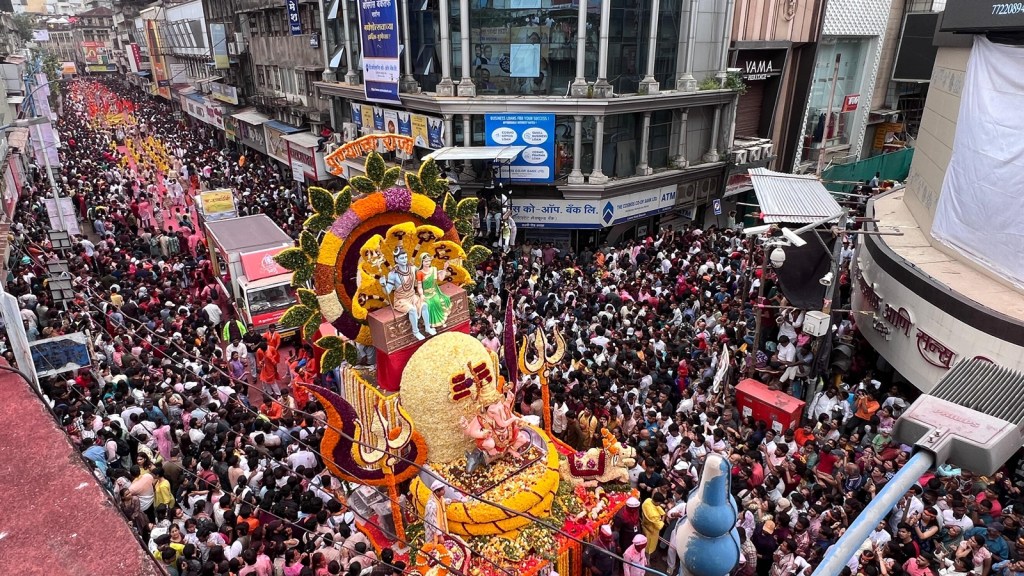 A mandal leader said the sheer scale of Pune’s Ganeshotsav makes dhol-tasha troupes hard to come by for every mandal. (File Photo)


 Share


