


Journalism of Courage
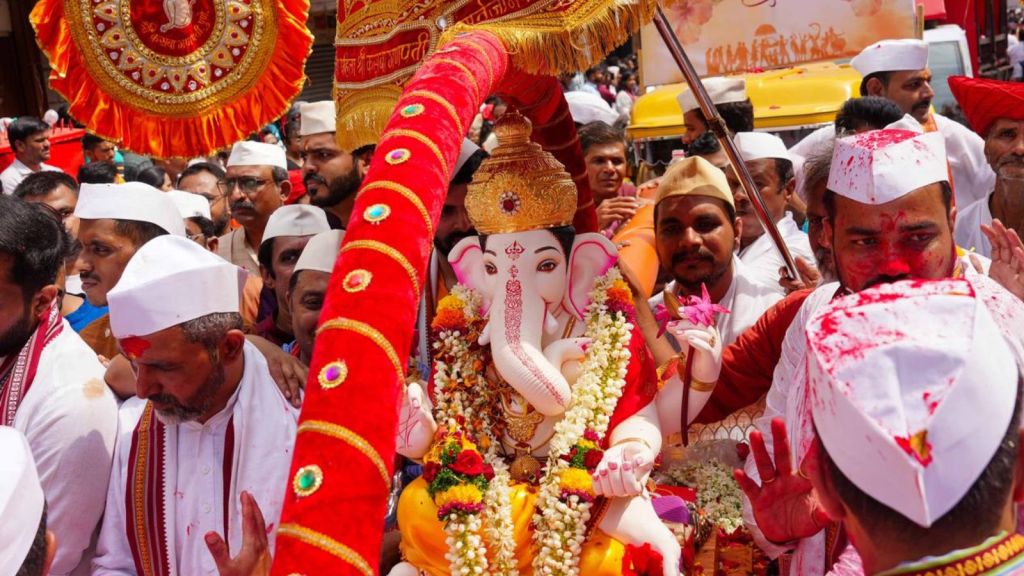 Drivers transport the huge Ganesha deities through dense crowds for anywhere from 15 to over 30 hours continuously (Express Photo by Arul Horizon)
As Pune bids an emotional farewell to Lord Ganesh on Anant Chaturdashi, the final day of the Ganeshotsav festival, the city’s grandest procession began with a traditional puja of the first ‘Manacha Ganpati’ (the most revered idol), Shri Kasba Ganpati, at around 9.30 am on Friday.
After the five ‘Manache Ganpati’, more than 600 Ganesh mandals will take to the four main procession routes—Laxmi Road, Tilak Road, Kelkar Road and Kumthekar Road—before converging at Alka Talkies Chowk. The mandals will then proceed for immersion at designated locations at ghats on the Mutha River and in artificial tanks installed by the Pune Municipal Corporation. In addition, thousands of Ganesh mandals and individual household Ganesh idols will also proceed for immersion.
Beyond the familiar sounds, colours and crowds, this year’s Ganeshotsav was dominated by one conversation, or rather debate: noise pollution. Much of that discussion began with Vidyanand Bapat, a Narayan Peth resident whose stand against excessive noise from DJs, loudspeakers and dhol-tashas (percussion instruments) brought the issue into the public spotlight.
Bapat’s stand sparked wider discussion, drawing reactions from Ganesh mandals, citizens, politicians and the police. The 37-year-old was also assaulted while speaking to a television channel on Tilak Road, an incident that sharpened the debate over the right to question established ways of celebrating a festival.
The issue has not remained confined to a public argument. The Pune and Pimpri-Chinchwad police have together registered 71 cases for noise-pollution violations during the festival, before the Visarjan day, when the Lord Ganesh idols are immersed in a body of water.
Now, as the city enters the final and most spectacular day of Ganeshotsav, the focus shifts to the enormous task of managing the crowds that will fill central Pune.
About 10,000 police personnel and officers have been deployed for the immersion arrangements, backed by technology including AI-based surveillance and a dedicated war room at Faraskhana police station.
The police will monitor feeds from more than 3,500 cameras, with the war room coordinating with the Integrated Command and Control Centre at Shivajinagar. The Pimpri Chinchwad police have deployed a 4,000-strong police force for Visarjan day.
The Pune police have also deployed 120 teams equipped with decibel meters. The police have also reiterated a ban on high-intensity sound and lighting equipment and held meetings with mandals over the number and duration of dhol-tasha performances during the immersion procession.
The traffic police, meanwhile, have prepared for one of the city’s most demanding days on the roads. The four principal procession routes will progressively close to traffic, with 17 major roads being shut in phases as the procession advances. AI-based traffic tools are also being used to identify congestion-prone locations and help redeploy personnel as per the ground situation.


