


Journalism of Courage
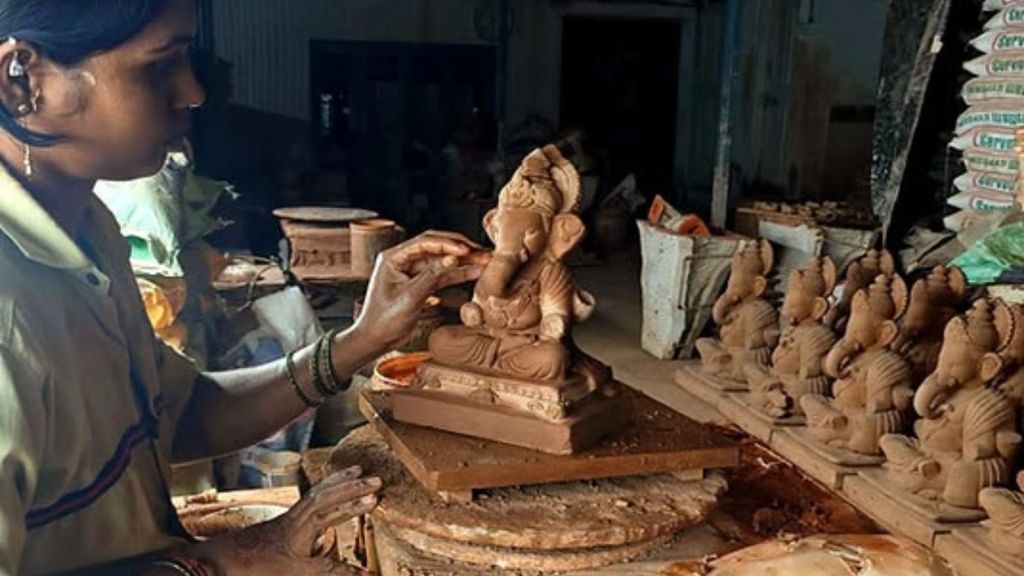 Ganesha idols made using farm soil in Pune (Express photo)
Written by Kalyani Lad
What if a Ganesha idol could return to the earth not as waste, but as life? For Dr Akshay Kauthale, founder of Vruskh Gajanan, a Pune-based initiative that produces Ganesha idols from farm soil, the answer lies in a simple cycle of soil, devotion, and a sapling.
With the Ganesh idol immersion ceremony taking place on Friday, this eco-friendly approach offers a sustainable alternative to traditional immersion rituals that often lead to water pollution.
Developed after years of research, the idols are handcrafted from farm soil sourced from the Bor region of Pune district. They are designed to dissolve within 30 to 45 minutes when immersed in a tub of water at home. The resulting soil and water can then be transferred into a planter, along with separately provided seeds, allowing devotees to grow a plant from the idol itself.
A distinctive aspect of the initiative is the distribution of Krishna Tulsi seeds, an indigenous species found in dense forests, along with the idols. The seeds are sourced through a long-standing association with the seed-conservation work of Padma Shri recipient Rahibai Soma Popere. The initiative has helped plant more than 1.5 lakh authentic Tulsi saplings over the past few years.
The initiative, started in 2018 to offer an alternative to conventional idols that contribute to water pollution, produces nearly 75,000 to one lakh idols annually at its facility in Uruli Kanchan, around 20 km from Hadapsar, with a workforce of about 200 women.
“We aim to conserve seeds that are becoming rare. Krishna Tulsi is authentic and has its own origin, unlike the hybrid varieties commonly available today,” Kauthale said.
“Delivered to Rashtrapati Bhavan, Union Minister Nitin Gadkari and Governors, the farm-soil Ganesha idols have travelled from Pune to devotees across India and overseas,” says Kauthale.
The idols are also shipped internationally, reaching countries including the US, Canada, Australia, Spain and the UAE.
The enterprise has developed around 20 to 25 copyrighted idol designs and supplies idols across India through dealers, outlets and online orders. Kauthale said that since 2018, not a single idol has remained unsold.
The idea was rooted in the family itself. Kauthale’s father, Dr V Kauthale, an agricultural scientist, is involved in the research and development process, while Kedar Kumbhar oversees the factory.
For the family, however, the initiative extends beyond manufacturing idols. It is part of what Kauthale describes as a wider “green movement” encouraging devotees to rethink what happens to an idol after the immersion ritual.
“We are creating a revolution where devotion does not have to come at the cost of the environment,” he said.
(Kalyani Lad is an intern with The Indian Express)


