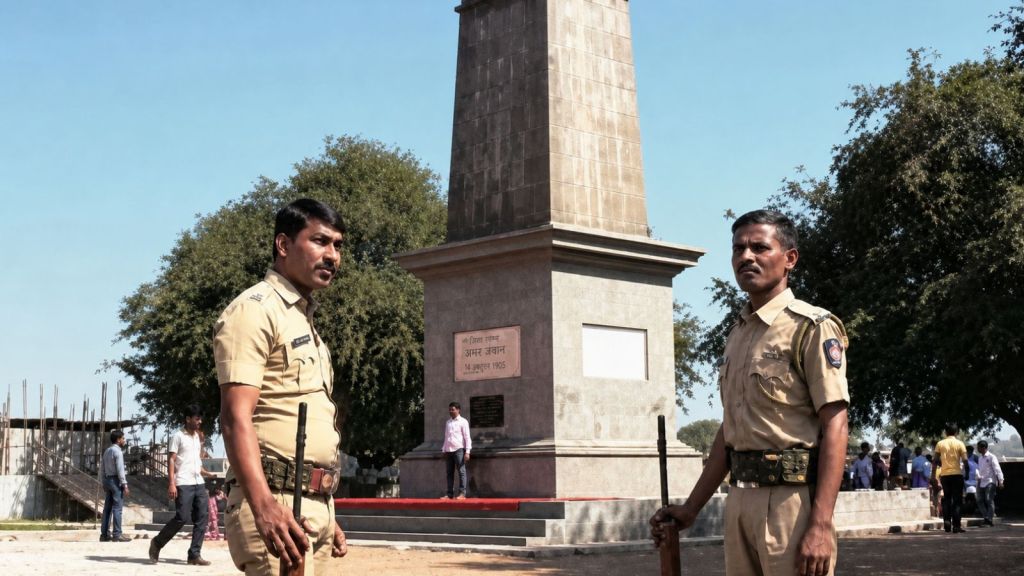
A court in Pune on Friday allowed the Jamadar-Malvadkar family’s permanent possession of Jaystambh and adjoining land (measuring about 9.25 acre) located at Perne village in Haveli taluka on the Pune-Ahilyanagar highway.
Amol Shinde, Joint Civil Judge (Senior Division) passed an order in this regard on Friday.

As per historical records, the Jaystambh, is a military monument erected by the British government in 1822 in memory of its soldiers who fought against the Peshwas in the Battle of Koregaon Bhima on January 1, 1818.
The British had appointed their soldier Kandojibin Gajoji Jamadar – who was wounded in the Battle of Koregaon Bhima – as the Jaystambh’s in-charge on December 13, 1824.
The British government had also granted him a “sanad” (official order) according to which his family was given possession of about 260 acres of land, along with the Jaystambh and adjoining land, till the time they had male successors.
His sixth descendant Captain Balasaheb Jamadar-Malvadkar, a retired Indian Army officer, produced the original copy of the “sanad” and other documents before the court.
The suit
In September 2015, the Bhima Koregaon Vijay Stambh Saurakshan and Savardhan Samiti, a private organisation, wrote a letter to then State Minister of Social Justice Rajkumar Badole, alleging that the Jamadar (Malvadkar) family’s name was “illegally” included in the 7/12 extract of land adjoining the Jaystambh.
Story continues below this ad
The Samiti demanded that the family’s name be removed from the 7/12 extract and the alleged “encroachment” constructed by them cleared. The Samiti pointed out that lakhs of followers of Dr B R Ambedkar, who visit Jaystambh every year on January 1, face problems due to the lack of space at the venue.
According to the Jamadar (Malvadkar) family, the minister’s remarks for action on the Samiti’s letter were later forwarded to the government-run Dr Babasaheb Ambedkar Research and Training Institute (BARTI) and Pune district collector.
The Jamadar family said that after learning the minister had directed the government officials to remove their houses, shed and agricultural produce from the said land, they filed a civil suit in April 2017 against the State of Maharashtra, BARTI and the Samiti, seeking an order of permanent injunction, to restrain the state government from evicting them from Jaystambh and adjoining land.
The suit was filed by Captain Balasaheb Jamadar- Malvadkar and his relatives, Namdev Jamadar-Malvadkar and Ashok Jamadar-Malvadkar. Namdev passed away in 2021.
Story continues below this ad
In the courts
While the lower courts rejected their pleas, the Jamadars got a status quo from the Bombay High Court, and moved the civil court (senior division), challenging the previous orders.
The High Court passed an order on September 17, 2025, asking the trial court to expedite the hearings of this civil suit and decide the matter within one year.
On July 17, 2026, as per a trial court order, BARTI and Bhima Koregaon Vijay Stambh Saurakshan and Savardhan Samiti were excluded from the suit.
Advocates Hemant Bhopatkar and Rohan Jamadar-Malvadkar, who too is a successor of Kandojibin Gajoji Jamadar, argued on behalf of the petitioners (Jamadars).
Story continues below this ad
On Friday, the court passed an order that the defendant (state government) and anybody representing the defendant “is permanently restrained from disturbing the possession” of the plaintiffs (Namdev’s heirs and Ashok Jamadar-Malvadkar) over the suit property. It also stated that the government is “permanently restrained from dispossessing” them from the suit property, without following the due process of the law.
The court dismissed the suit of Captain Balasaheb Jamadar-Malvadkar but allowed the suit of two others and decided the matter.
His son and lawyer Rohan said, “The court has given the order in favour of the Jamdar-Malvadkar family. A British general order of 1824, a British court order of 1826 and other documents were additionally submitted in the court to prove our possession on the Jaystambh and adjoining land. Dismissing the suit for Captain Jamadar-Malvadkar is a technical issue. He was in possession of the original copy of ‘sanad’ granted by the Britishers regarding the suit property. Application for adding his name on the 7/12 extracts of the said land is pending before a revenue court.”
Sensitive location
Jaystambh is a historically sensitive location in Maharashtra. According to the Jamadar family, which belongs to the Maratha community, both British and Peshwa forces who fought the Koregaon Bhima battle comprised soldiers of different castes. Thus, they say, this battle cannot be linked to any particular caste or religion.
Story continues below this ad
However, as per a Dalit-Ambedkarite narrative, the British Army, comprising 500 soldiers from the Mahar community, defeated a 28,000-strong force of Peshwas in this battle.
Lakhs of Ambedkarites across Maharashtra and other parts of the country visit the Jaystambh every year on January 1, calling it “Shaurya Din” (victory day) to pay tribute to soldiers who, they believe, fought a war for freedom against the alleged casteism of the Peshwas.
Widespread violence was reported in Koregaon Bhima area on January 1, 2018, at the time of the 200th commemoration of the battle.
As the matter was subjudice, every year in December, the state government sought permission from the Bombay HC to make arrangements at the Jaystambh and adjoining land, for the programme to mark the Battle of Koregaon Bhima.