


Journalism of Courage
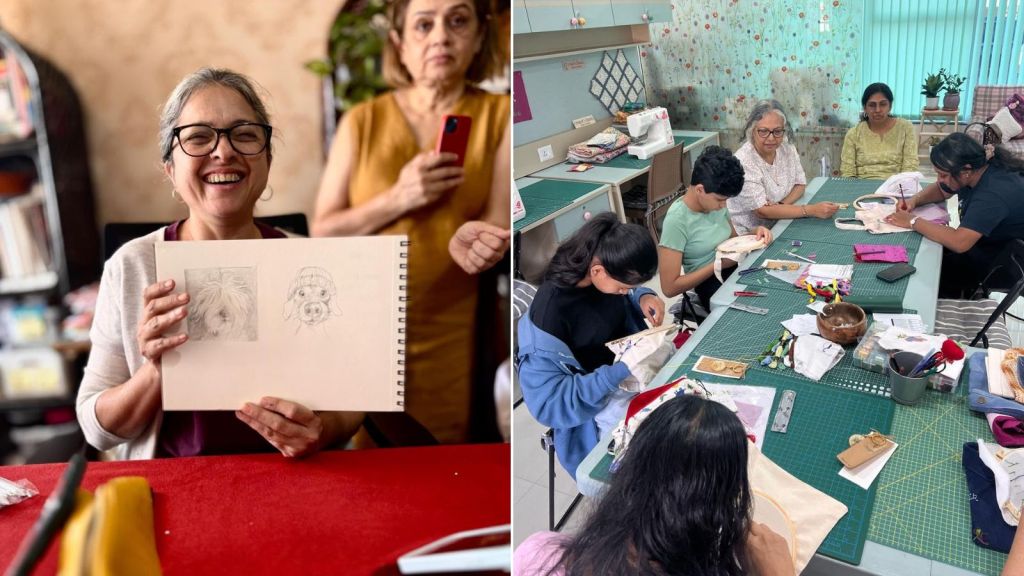 While the studio opened by Aditi Deo (left) offers regular classes in watercolour, pen-and-ink and pencil sketching and more, In Kharadi (right), another small space filled with yarn, fabric and conversations is bringing together people looking to learn traditional crafts while spending time away from screens. (Express photo)
Written by Kalyani Lad
For many adults, leisure is squeezed between work, family responsibilities and the demands of everyday life. But what happens when the desire to learn something new remains, while the time, confidence and community to pursue it seem increasingly harder to find?
Two art and craft spaces in Pune are attempting to answer that question by creating places where adults can learn, experiment and, perhaps, find a community along the way.
One such studio, inaugurated in August, is barely a few weeks old, but its idea has been nearly two decades in the making. Its founder, Aditi Deo, an artist and teacher who has worked with children and adults, says the idea emerged from a gap she saw in the city: the lack of spaces where adults could simply learn and experiment without feeling they had to be experts.
“There are hardly any activities like these for adults. You tend to attach importance to an activity based on how it benefits your overall well-being. It is not just about learning the activity; through the activity, you get a sense of well-being,” says Deo.
The studio offers regular classes in watercolour, pen-and-ink and pencil sketching, while gradually expanding into yarn crafts, crochet, knitting, embroidery and other creative workshops. A ukulele club has also begun, with a zine-making workshop planned.
For Deo, however, the studio is about more than acquiring a skill. It is about creating a space for adults who may suddenly find themselves with more time, but fewer opportunities to connect with others.
“We are now at an age where there is a lot of time, but there is nothing to do, and no place to go,” she says.
The classes are therefore kept flexible. Participants can move between batches, attend individual sessions and access recordings, allowing them to fit learning around unpredictable schedules rather than the other way around. The approach also takes into account the multiple responsibilities many women continue to juggle.
Yet time may not be the biggest barrier. For many adults, it is the hesitation to begin.
Deo believes people often assume they need to possess a certain talent before taking up art. She argues that creativity need not be pursued for a certificate, career or even perfection.
“If you remove the expectation that I want to be a good artist, you will be good from day one. Good in art is very subjective,” she says.
While paid classes help sustain the studio, Deo also hopes to keep parts of the space accessible to those who simply want to sit, create or spend time in an environment that encourages creativity.
In a city where adult life can easily become defined by work and obligation, the studio is attempting something simple: creating space for curiosity.
A screen-free sanctuary
In Kharadi, another small space filled with yarn, fabric and conversations is bringing together people looking to learn traditional crafts while spending time away from screens.
Rhoda Stanley, 62, started The Craft Room in July 2025. It was not originally conceived as a business. After spending years abroad and returning to India in 2020 during the pandemic, Stanley noticed how people were increasingly isolated, indoors and glued to screens.
The space had initially been intended for her son’s clinic. When he began practising elsewhere, Stanley decided against renting it out and instead asked herself what she could give back to society.
The answer came through something she had always known: craft.
A social work graduate from Mumbai and a lifelong maker, Stanley works with crochet, knitting, embroidery and quilting. Over time, she says, she noticed a break in the transmission of these skills between generations.
“People would always say, ‘I have seen my grandmother do it.’ Their mothers didn’t, they don’t, and so their children won’t,” she says.
What began as hobby classes has grown into a space where participants can learn crafts while also meeting others. In its first year, more than 100 participants, from 10-year-olds to working professionals, mothers of children with special needs and expectant mothers, have attended the classes.
Aishwarya Raj Katawat, who attended one of Stanley’s classes, says the space helped her reconnect with a part of herself she had put aside.
“During my pregnancy, when I was five months along, discovering the studio felt like a godsend gift. It gave me a way to reconnect with the creative side of myself that I had put aside. I had always thought of embroidery as something girls were simply expected to learn. But here, I discovered that it could be a form of artistic expression, a way to mend, create and tell a story,” she says.
Stanley’s courses are structured, with five sessions for crochet and embroidery and six for quilting. They include material kits, lessons on the history of the crafts and informal conversations over tea.
For Stanley, the process is as important as the finished product. The classes, she says, teach patience, perseverance and a sense of ownership.
“Growing old is not a block,” she says. “God has prepared for every stage of life something. I am in a stage where I can give, and people are willing to receive.”
At a time when many activities are increasingly mediated through screens and designed for instant consumption, these spaces are bringing people back to something slower: the simple act of making something by hand.
(Kalyani Lad is an intern with The Indian Express)


