If security concerns are not worrying Aundh residents, the area considered one of Pune’s most developed and progressive, it’s the garbage disposal system or rather the sheer lack of it.
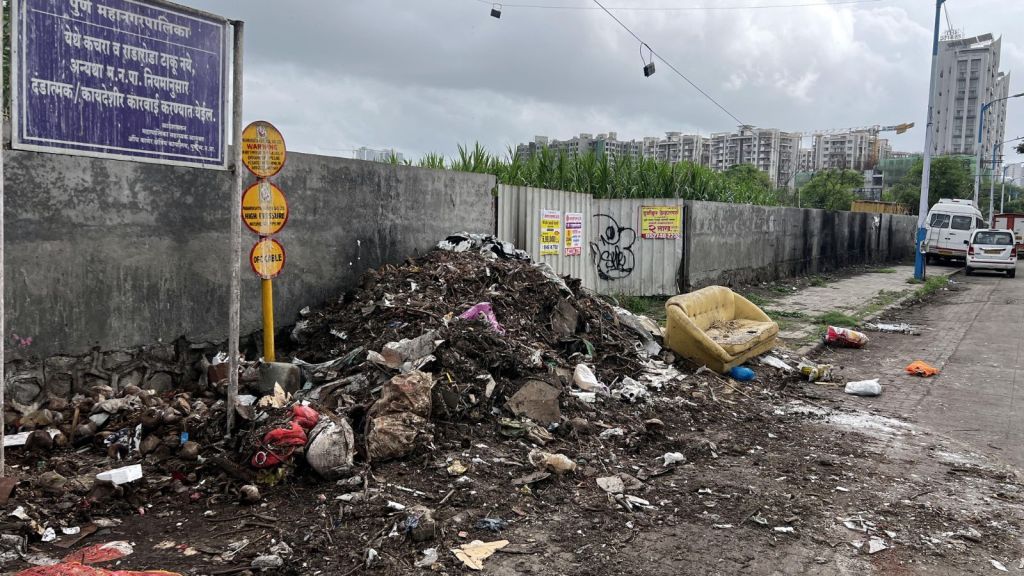
Garbage frequently dumped at various spots in Aundh-Baner areas, like those between Jupiter Hospital and Nagras Road, has created an environment that signals improper waste management. Residents are concerned about the various problems this could compound into.
“I know there are these agencies that dump garbage anywhere in Aundh. There are specific spots around the areas between Jupiter Hospital and Nagras road where this can be observed. There is no control at all,” said Subhabrata Sanyal, 51, a resident of Kumar Padmalay.
“When you walk on the streets, you see food fed by various groups and volunteers just littered there on the street. We have to be careful that we don’t step on it. It gets scattered everywhere. It is unhygienic,” said Deepa Adiga, 47, a resident of Sylvan Heights. “This food matters to the strays, and if we end up going near all of this by mistake, they could even attack us.”
“There is no proper municipal collection system, or rather, it doesn’t meet the schedules of those people (living in those areas). The municipal truck might come at a particular time and the waste is generated later, particularly from restaurants, where garbage is generated very late at night, post 11 pm or 12, after the restaurant is closed,” Anil Gokarn, founder of ProEarth Co., a firm that deals with effective waste management, said, while discussing the impact of poor waste management in such urban areas that contribute to the formation of an entire ecosystem. “The municipal services have to reach every doorstep. They have to be open to considering the schedule for collection, maybe if there is a need to do 2 collections in a day. Right now, there is only one single collection in an area at a particular time.”
Some residents have other opinions regarding how the waste is managed. “The garbage used to lie in the same area for a long time, but in the past year they cleaned up all of it,” said Arjun Deepak, 20, a resident of Aloma County. He noted how this does not mean the problem has vanished from the streets as a whole. “Don’t even get me started on what they have done to the poor river!” he exclaims, talking about the river flowing between the bridging areas of Nagras Road.
Shubha Kulkarni, 46, projects coordinator of Jeevitnadi, an organisation raising public awareness and participation developing scientific and ecological management of rivers, highlights the indiscipline among citizens stating, “People start throwing stuff anywhere, and then more people follow, turning the area into a dump site. There are not enough dustbins provided by the PMC. When we go for regular cleanups at the river in the Nagras Road area, we come back having collected large bags of garbage.”
Kulkarni talks about the importance of segregating waste at home and conducting awareness sessions in various establishments to educate people particularly about river ecology and promote eco-friendly practices. She also urges imposing fines for improper waste disposal to break the vicious cycle of mindless consumption.
“There is door-to-door collection of garbage, for which our vehicles are assigned. Chronic spots have special squads to take care of the area — proper monitoring for about 10 or 15 days takes place,” Girish Dapakekar, Assistant Commissioner of the Aundh-Baner region said. “I will instruct my SI and DSI to take cognisance of this situation immediately. We will review the teams. Accordingly, we will sort out this issue immediately.”



 Share


