


Journalism of Courage
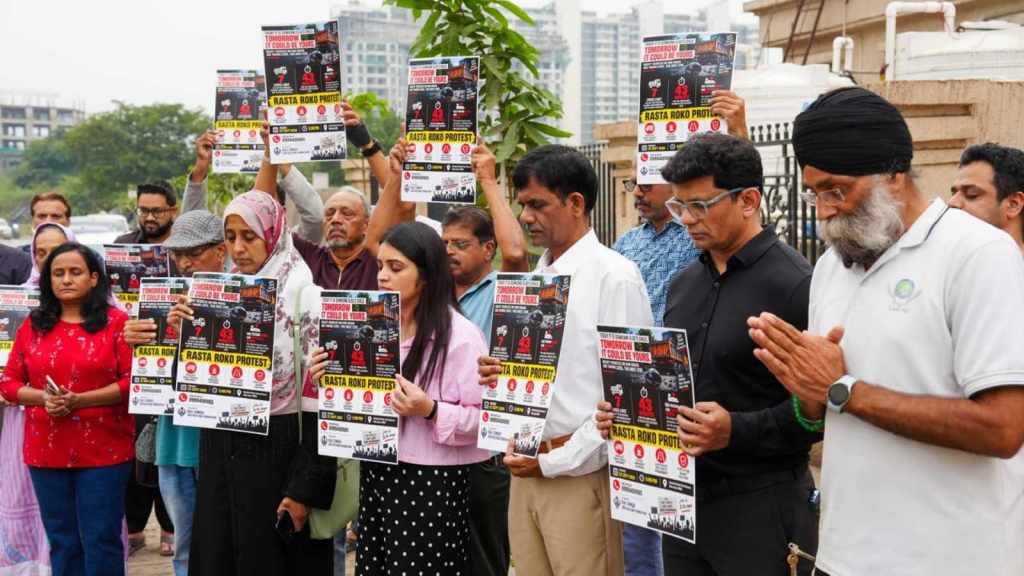 Residents of Mohammadwadi and NIBM staged a protest demanding immediate action to restrict the movement of heavy vehicles through residential areas and strengthen road-safety measures. (Express Photo: Arul Horizon)
A 20-year-old motorcycle pillion rider was killed and his friend injured after a dumper truck rammed their two-wheeler from behind in Mohammedwadi on Monday evening, prompting residents to protest against the movement of heavy vehicles in the NIBM, Mohammedwadi, Undri and Wanowrie areas.
The accident occurred around 5 pm when Hamza Ibrahim Sarkar, 20, who was riding pillion, and his friend Quais Wasim Khan, 20, were travelling towards Raheja Vista Chowk. The dumper truck hit their motorcycle from behind, killing Sarkar on the spot and injuring Khan.
Monday’s accident is not an isolated incident. In April, two people were killed within 48 hours in separate accidents involving water tankers in the same area. The latest death prompted residents to take to the streets on Tuesday, demanding steps to regulate the movement of heavy vehicles and improve road safety.
Deepa Cheema, co-founder of the Mohammedwadi Undri Residents Welfare and Development Foundation (MURWDF), said several two-wheeler riders had died in accidents involving heavy vehicles, but little had been done to improve roads and essential infrastructure.
“Lack of traffic discipline among both heavy vehicle drivers and bikers is a major concern, and accidents will keep recurring until this improves alongside road infrastructure,” she said.
Cheema suggested restricting the movement of heavy vehicles to night hours, between 10 pm and 6 am, making helmets compulsory for bikers, and deploying police volunteers or marshals to check traffic violations. She also flagged delays in emergency response, saying an ambulance took around 40-45 minutes to reach the spot of Monday’s accident in NIBM.
Nitin Deshpande, a finance professional who lives near Bishop’s School in Undri, pointed to the lack of planned road infrastructure despite extensive construction in the area.
“For several years, political leaders have announced budgets for roads here, but the quality remains poor at major stretches. Narrow roads at some points, barely 10 feet wide and without footpaths, make it difficult for ambulances, fire tenders, heavy vehicles, bikers, and pedestrians to pass,” he said.
Deshpande said road repairs were largely limited to patchwork that left surfaces uneven. He said residents’ demands for height barriers to restrict heavy vehicles had not been accepted so far. He also called for action against unbarricaded excavation trenches and open chambers, as well as better street lighting, particularly for students commuting to schools.
“Thirty children from Delhi Public School Pune have to navigate heavy and light motor vehicle traffic every day near Raheja Reserve society, standing on the very road where three lives have been lost in the past 10 months. Neither the school nor the authorities are sensitive to the dangers these children face,” another resident said.
Rohan Gaikwad, a Mohammedwadi resident, said construction activity in the locality had led to frequent movement of JCBs, water tankers, dumper trucks and RMC trucks.
“This traffic is necessary to complete infrastructure work, but not at the cost of innocent lives. Now, enough is enough, these vehicles should be allowed to ply only at night,” he said.
Gaikwad also blamed the irregular presence of traffic police in the Kondhwa and Kalepadal areas for recurring accidents, saying the absence of checks on rash driving allowed heavy vehicles to violate restricted-entry timings. He urged the Pune Municipal Corporation (PMC) to complete pending road-widening work in NIBM, which he said was held up due to litigation.
Kalepadal police senior inspector Girisha Nimbalkar confirmed that the truck driver had been arrested and the vehicle seized.
“A case has been registered with charges under the Motor Vehicle Act, and other sections have also been invoked,” she said.
Nimbalkar told The Indian Express that she and traffic officials had visited the accident site and were identifying accident-prone spots within the police station’s jurisdiction.
“We would install signages, speed breakers, and rumbler strips as soon as possible,” she said.


