


Journalism of Courage
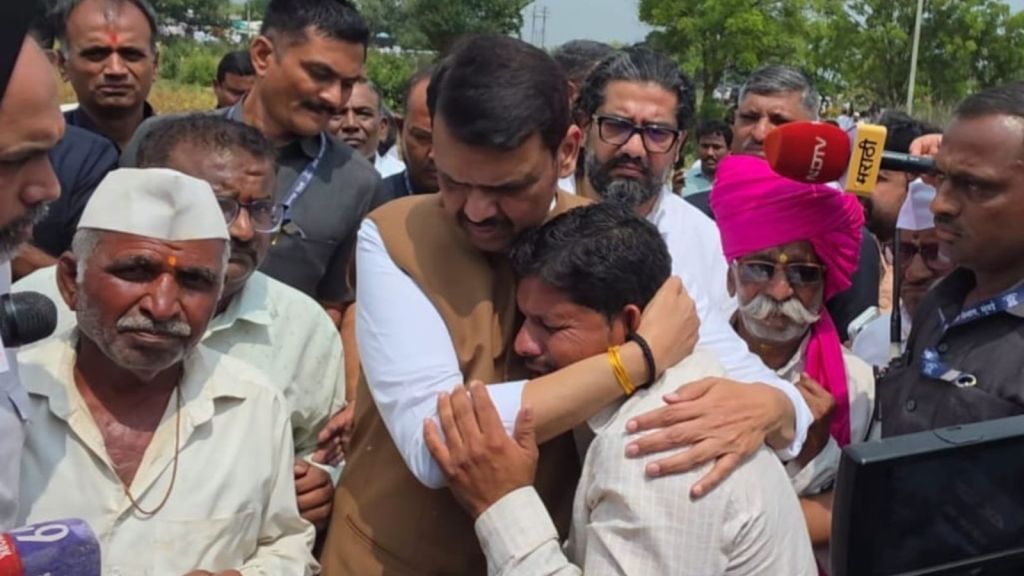 Maharashtra Chief Minister Devendra Fadnavis consoling a farmer who broke down during his visit to Latur to inspect the plight of farmers on Wednesday. (Express photo/Special Arrangement)
Maharashtra is heading for a severe drought which is likely to be worse than that of 1972, Chief Minister Devendra Fadnavis said on Wednesday, adding the government would issue a notification shortly. The CM’s remarks came during his day-long tour of drought-prone districts of Latur, Dharashiv and Solapur.
Describing the situation in Latur and Dharashiv in Marathwada region as “extremely serious”, the CM said that the two districts received only half the normal rainfall this year, and promised all possible assistance to the affected farmers. Along with Marathwada region, several other districts in Maharashtra are reeling under severe rain deficit caused by the El Nino, resulting in massive crop loss, the CM said.
“There is distress and anguish among farmers. But I have told them that the government will stand firmly behind them. We will provide all possible assistance. There will be no shortage of funds for drought relief,” he said.
The 1972 drought is perceived as the worst calamity that led to massive crop loss and acute shortage of foodgrain in Maharashtra. It also caused massive fodder shortage adversely affecting cattle, goats and other animals.
The chief minister said, “We have initiated the process of survey and panchanamas as part of the administrative process. But relief measures will be taken irrespective of these surveys.”
The financial aid will be directly credited in the bank account of the farmers who are subjected to hardships due to drought like situation, the CM said.
“We have gathered all the reports and are taking action accordingly. The government has taken the drought situation very seriously and has started working. We are going to help the farmers, and our loan waiver scheme is also operational and will not be stopped. We are arranging water and fodder as well,” he said.
Fadnavis said the state government would issue a Government Resolution (GR) on the drought situation before Saturday and initiate relief measures.
“Wiping the tears of farmers is the government’s first duty. We will certainly seek funds from the Centre under the NDRF norms. However, farmers will not be made to wait till central funds arrive. The state government will immediately start providing assistance from its own treasury,” he said.
Assistance would also be provided to enable farmers to take up sowing for the rabi season, the chief minister added.
On the drinking water situation, Fadnavis said the rainfall deficit had severely affected groundwater levels and water bodies.
“If only 50 per cent rainfall is received, there will obviously be an impact on water in reservoirs and wells,” he said, adding that the government had anticipated a drinking water crisis and planned water reserves accordingly.
“We have tried to conserve sufficient water for drinking purposes. We have water required until December, and we have also tried to preserve water up to June. Even then, there will be a drinking water crisis and we are making arrangements for it,” he said.
Fadnavis attributed the severity of the situation to unusual weather conditions including “Super El Nino”.
There is a rain deficit in 31 out of the total 36 districts across Maharashtra. Of these, 20 districts have recorded rainfall deficits in the range of 25 to 60 per cent.
After the initial spell of rain this monsoon, farmers took to kharif sowing across 147 hectares of land across five regions — Marathwada, Vidarbha, Konkan, Western Maharashtra and North Maharashtra. Taking adequate precautions to ensure perfect soil moisture sowing started from mid-July instead of June. The long gap between two rains after sowing — stretching up to 36 days — led to crop failure. In some talukas, the intense rain in shortest duration led to soil erosion, damanging the kharif crop.
The chief minister said he has directed all the ministers and elected members to be in their respective constituencies to help farmers. The government has already initiated the process to submit a proposal for drought relief measures under NDRF next month.
State Revenue Minister Chandrashekhar Bawankule who heads the sub-committee for drought has directed district collectors and revenue officials to start the relief process, including dam water management taluka wise, school fee waiver and free electricity to farmers.
According to the agriculture ministry, “The biggest challenge for the government is to ensure adequate drinking water and fodder.” The government has initiated process to set up camps for animals and make provision for fodder cultivation on barren land.
Officials indicated that absence of return rain has compounded the crisis for farmers as they will not only fail to salvage their kharif crop on 147 lakh hectares but also stare at an uncertain rabi season beginning November across 61 hectares of land.


