


Journalism of Courage
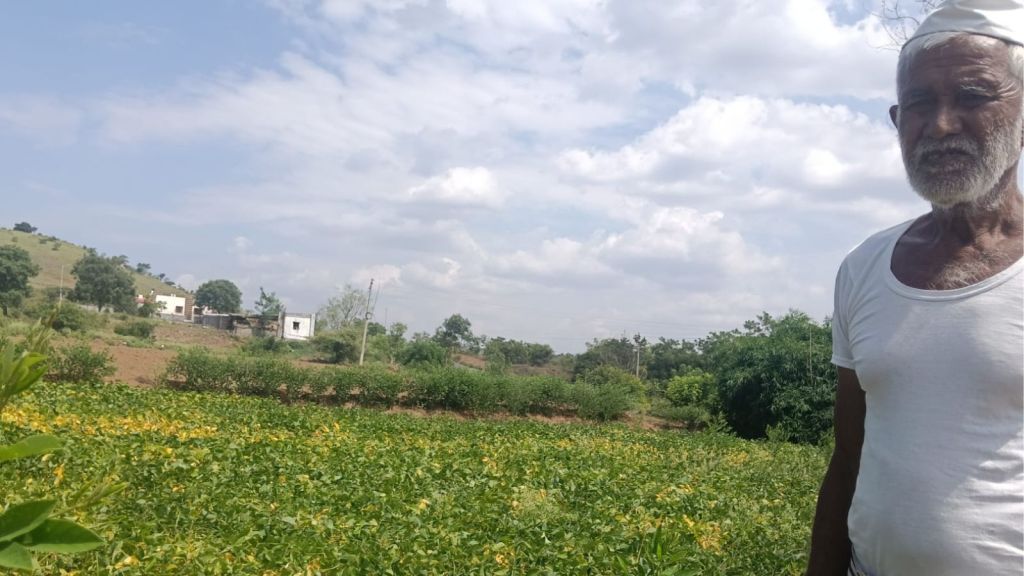 Visitors to Ralegan Siddhi are greeted by acres of green fields, standing crops, and percolation tanks filled to the brim. (Express Photo by Manoj More)
* A farmer couple in Punawadi village stares at a pile of charred bajra. “It got wrecked on its own. How can the crop survive when there is no rain?” asked farmer Macchindra Borude, who had invested Rs 15,000 in the crop and lost everything. “I hope there will be some rain when the monsoon withdraws. I am expecting an onion crop. If it doesn’t rain…”.
* A few kilometres away, in Parner village, another farmer stands before 18 acres of flattened fields. “After last year’s crop failure due to wet drought, I was expecting good rain this monsoon. But in August and September, we could not collect even a glass of rainwater. All our wells, which are 70-80 feet, are running dry. As a result, our crop of soyabean, onion, tur, maize, and bajra has been destroyed,” said Balasaheb Awati, 55. Having borrowed Rs 10 lakh, he now faces the prospect of repaying the loan with little or no income from this season’s harvest.
* In another farm, Vilas Borude’s decision to run a rotavator through his standing bajra crop shocked villagers. “The crop had grown to a couple of feet and there was no possibility of it growing further as in last two months we only had half an hour of rain. It did not make sense to wait for the crop to wilt completely…so I destroyed it,” he said.
These heartbreaking scenes are emblematic of the crisis unfolding in Parner, one of the 14 talukas declared drought-hit in Maharashtra’s Ahilyanagar district. Across the taluka’s 131 villages, a prolonged dry spell and severe rainfall deficit have left farmers devastated, grappling with uncertainty about repaying their mounting debts.
Last week, with the state recording a rainfall deficit of 18 per cent this year, the government declared drought in 265 of the state’s 358 tehsils—about three-fourths of Maharashtra.
Though the Maharashtra government has promised compensation, farmers remain unconvinced. “The government made a similar promise after last year’s wet drought. But so far, it has failed to pay even that amount. I don’t know when this year’s amount will be released,” Balasaheb said. “’Our village has a population of 13,000 and more than 3,000 farmer homes and we all are facing a similar predicament. We have no clue what the future holds for us,” he added.
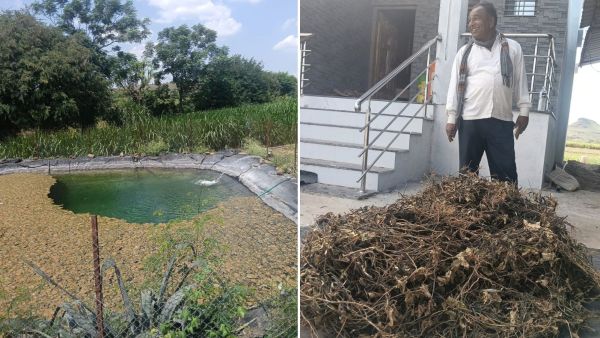 Water stored in Ralegan Siddhi (left) and Vilas Borude (right), who ran a rotavator through his standing bajra crop in frustration. (Express Photos by Manoj More)
Yet, amid the parched landscape, one village stands out: Ralegan Siddhi, thanks to the watershed conservation model implemented by social activist Anna Hazare since the 1970s, seems relatively insulated from the drought.
“Compared to other villages in the district, Ralegan Siddhi is better placed. This is because our villagers capture every drop of rain water and store it in check dams and nala bunds (embankments), which has resulted in recharging of the groundwater table,” Hazare told The Indian Express in Ralegan Siddhi.
The contrast is evident. Unlike other parts of Ahilyanagar district, where crops have withered away due to poor rainfall or have been destroyed by frustrated farmers, visitors to Ralegan Siddhi are greeted by acres of green fields, standing crops, and percolation tanks filled to the brim.
“We are in a good position today as far as the water situation is concerned. Our farm ponds and percolation tanks have adequate water,” said Ashok Awati, a 40-year-old farmer from Ralegan Siddhi, adding a word of caution. “As of now, we are getting borewell water but we are not confident how long this will sustain. This is because it rained only for three days this monsoon. In August and September when we expected rain, it hardly rained.”
Ashok’s father, Baban, 73, recalled the drought in 1972. “When Maharashtra was hit by the worst drought in its history, another villager and I left Ralegan Siddhi and worked in Gujarat to sustain our families. Several other villagers also did the same. The situation is better for us today because of Anna Hazare’s efforts. We have water, other villages don’t,” he explained.
Ralegan Siddhi sarpanch Jaysing Mapari credited Hazare for the village’s current situation. “It is due to his efforts that several check dams and nala bunds have come up in Ralegan. It has helped us save every drop of water and recharge our groundwater table. If it rains heavily once more, we will be completely drought-free,” he added.
Hazare said that while the villagers have no reason to complain right now, the situation could worsen. “Ralegan Siddhi offers hope today, but in the coming months, we do not know what will happen. The rain has stayed away for days…that is why it is important that the state government makes scientific plans to conserve water, which will help farmers in the long run,” he added.
“It is no use taking measures when the drought hits us. It is important to initiate proactive measures in anticipation of what could happen. It is important to conserve every drop of water, identify catchment areas, build check dams, and ensure rise in the groundwater table. This requires an integrated approach,” he said.
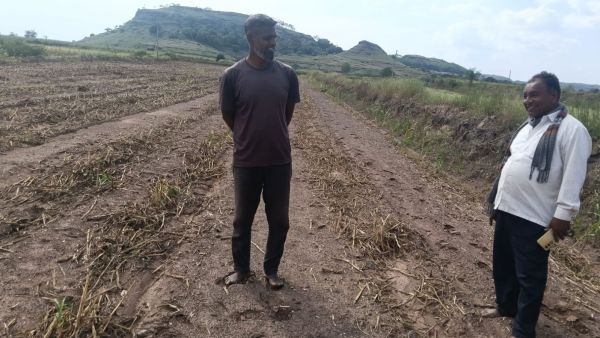 A farm in Ahilyanagar district, where crops have withered away due to poor rainfall. (Express Photo by Manoj More)
Officials said Ahilyanagar district has seen a rain deficit of 30 to 35 per cent and an extended dry spell of nearly 51 days. “This has ruined the Kharif crop to a large extent. Crops which have survived have little chance of giving a good yield. There has been no rain and even the groundwater table has depleted,” an official said.
While there was a rain deficit of nearly 39 per cent in the district in June, in July, some parts of the district received good rainfall. “This led to sowing for the Kharif season like cotton, soyabean, bajra, maize, black gram, green gram, pigeon pea and paddy, and finger millet (ragi),” an official said.
August proved to be a dampener, with the district recording a 73 per cent rainfall deficit. “Farmers held out hope for September, which typically sees the highest average rainfall at 147 mm. But the district only received 32.7 mm of rainfall,” an official said.


