


Journalism of Courage
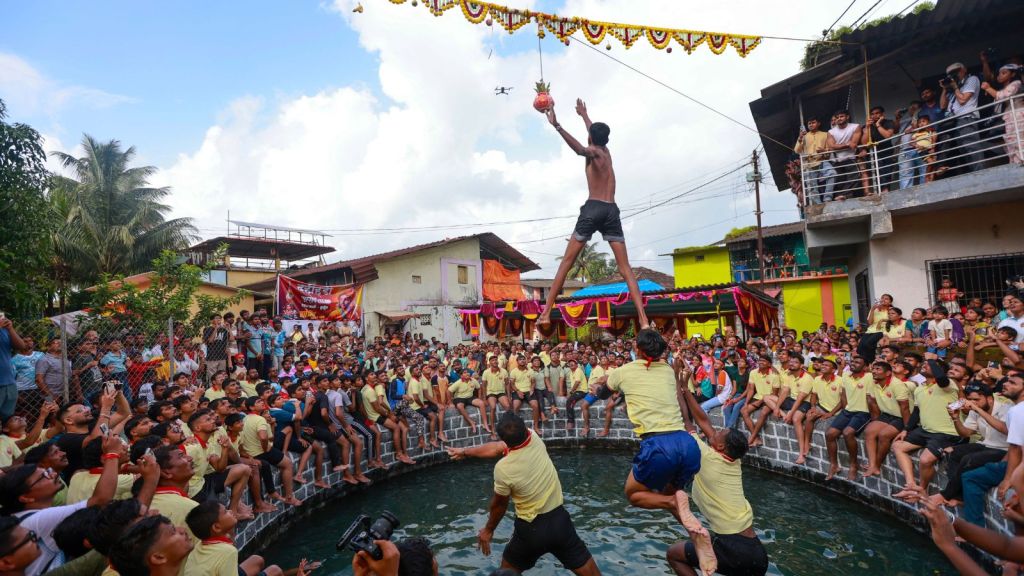 Kurdus Dahi Handi tradition sees villagers jump towards a handi suspended over a village well instead of forming conventional human pyramids (Express photo by Narendra Vaskar).
Every year during Dahi Handi celebrations, human pyramids are formed on rooftops and in streets across Maharashtra to reach the clay pot filled with curd, milk, or butter. However, in the village of Kurdus, located in the Alibaug taluka of the Raigad district, residents celebrate Dahi Handi in a unique way.
In Kurdus, the handi is not hung at a height that requires climbing on top of one another. Instead, it is suspended from a rope over the centre of a large village well, and breaking the handi involves jumping rather than climbing.
Located about 150 km from Pune, Kurdus draws large crowds every year for this one-of-a-kind celebration, with visitors now travelling from neighbouring villages and beyond to watch.
The tradition dates back to 1992, when it began as a simple, fun activity among a few farming families in the village.
“This distinctive Dahi Handi tradition has been organised in Kurdus since 1992. Instead of forming human pyramids, the practice here involves breaking a Dahi Handi suspended in the centre over a large well,” said Sachin Pingle, a resident of Kurdus.
According to Sachin, the credit for starting the tradition goes to the Patil, Pingle, Keni, Thale, and Sheramkar families, all engaged in agriculture. “It started as a fun activity started by farmers from our village. There was a custard apple tree adjacent to the well, from which people used to jump to break the hanging handi,” he said.
Over time, the format evolved. “With time, villagers tried to jump from the well curb to break the handi, situated around 15 to 20 feet high from the well wall. And the same practice has continued for 34 years now,” Sachin added.
The well at the centre of it all is as much a part of the story as the festival itself. Dhanaji Pingle, another resident of Kurdus, explained its significance to the village.
“The well is 40 feet deep, and safety precautions are taken into consideration – the jump is usually very precise, so that the Govinda doesn’t crash into the walls, and the well is also sufficiently wide, around 40 feet,” Dhanaji said. “The well was built in 1954 by villagers through shramdan (voluntary labour) and belongs to the whole village. Its water is used throughout the year by villagers for daily use.”
Ahead of the festival each year, the villagers voluntarily come together to prepare the site. “During every Dahi Handi, we paint and beautify the well wall, clean the water, prepare the handi, and everyone from our village, neighbouring villages, and now tourists, visits to experience the joy,” Dhanaji said.
Unlike the conventional celebration, which can involve anywhere from 50 to over 100 participants forming multiple tiers of a human pyramid, the Kurdus version requires just four people for each attempt: three form the base, launching the fourth person, the jumper, up and towards the handi.
Anyone who touches the handi is declared the winner. If the handi doesn’t break mid-air on the touch, it is then lowered and broken separately. Either way, the jumper’s landing is in the well itself, cushioned by water.
“To date, there have been no injuries, as one lands in the well and everyone enjoys playing in the water,” said a village resident, underlining how the water landing has kept the sport safe over more than three decades.
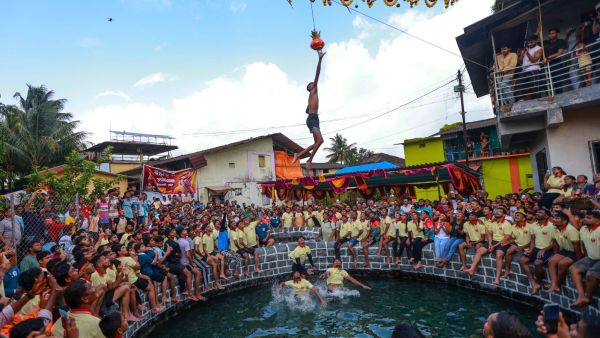 Participants jumping towards a handi suspended over a 40-foot-deep village well (Express photo by Narendra Vaskar).
More than 100 people across age groups take a turn at the jump every year, and organisers say the event is deliberately kept open to everyone who wants to participate. Notably, 70-year-old Kanchan Keni, who broke the handi for the very first time back in 1992, returned to attempt the jump again this year.
The celebration typically begins around noon and continues till 3 or 4 pm, by which time a winner has emerged after well over a hundred attempts.
This year, that winner was Harsh Pingle, who broke a run that belonged to Akash Pingle, who had been the one to break the handi for the previous eight years straight.
Villagers say flexibility, more than sheer strength, tends to decide the outcome. “As per our experience so far, the individual with more flexibility has a higher chance of winning,” said Sachin.
What started as an informal contest among a handful of farming families has, in recent years, found an audience well beyond Kurdus. Videos of the jump circulating on social media have turned the festival into something of a local phenomenon.
“We are amazed to see that what started as a fun activity has now become very famous due to Instagram, Facebook and YouTube videos,” said Dhanaji.


