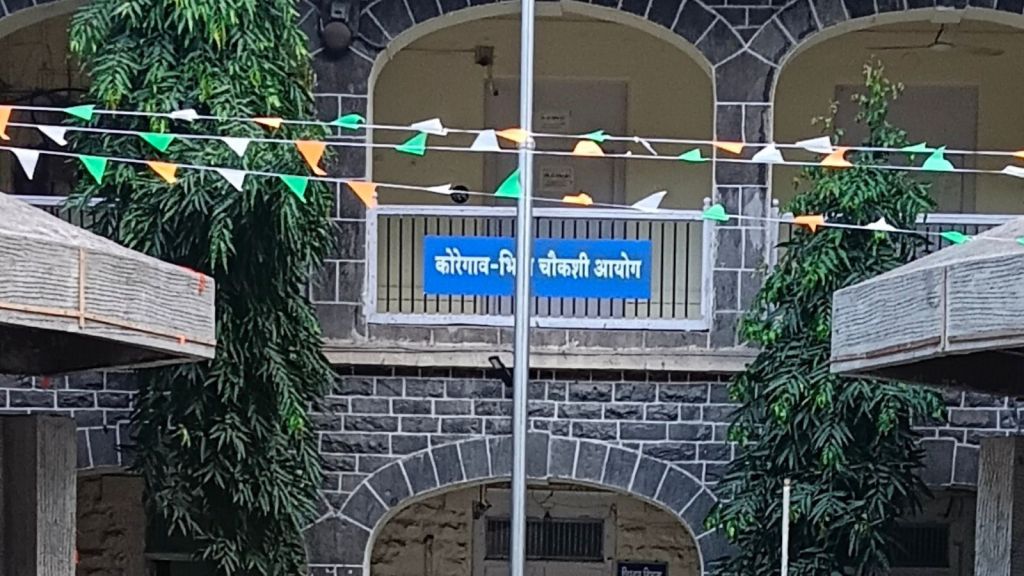
Commission probing Koregaon Bhima violence concludes hearings after 8 years

V V Palnitkar, the Commission’s secretary, told The Indian Express on Friday, “The government has given an extension to the Commission of two more months to complete its work.

Koregaon Bhima Commission of Inquiry concludes evidence-recording hearings nearly eight and a half years after 2018 Pune violence. (File)Koregaon Bhima Commission of Inquiry concludes evidence-recording hearings nearly eight and a half years after 2018 Pune violence. (File)

Nearly eight and a half years after the Koregaon Bhima Commission of Inquiry was formed by the Maharashtra government to probe the causes for violence in Pune’s Koregaon Bhima area on January 1, 2018, the panel has concluded its hearings to record evidence.

The Commission has received yet another extension till October 31, 2026, to submit its final report to the state government. Rajendra Holkar, Joint Secretary, Home Department, issued a letter in this regard on September 11. This is the 23rd extension granted to the Commission.

V V Palnitkar, the Commission’s secretary, told The Indian Express on Friday, “The government has given an extension to the Commission of two more months to complete its work. The Commission concluded the hearings of witnesses that were conducted to record evidence. The Commission will now prepare its final report that will be submitted to the government.”

“The Commission has extended full opportunity and hearing to every witness and party concerned. The Commission is now proceeding to finalise its report,” said advocate Ashish Satpute, lawyer for the Commission.

Satpute said 58 witnesses were examined before the Commission so far. They include senior politicians like NCP(SP) chief Sharad Pawar, VBA president Prakash Ambedkar, various government and police officials like Rashmi Shukla (the then commissioner of Pune city police), Suvez Haque (the then superintendent of Pune rural police), Saurabh Rao (then the Pune district collector), former IAS officer and noted author Vishwas Patil, Elgaar Parishad activist Harshali Potdar, and villagers from Koregaon Bhima and Vadhu Budruk.

One person had died and several others were left injured in violence that occurred in Koregaon Bhima and adjoining villages in Pune district on January 1, 2018, at a time when lakhs of Ambedkarites had gathered in the area to commemorate the 200th battle of Koregaon Bhima.

The state government constituted a two-member commission, headed by retired high court justice J N Patel with former chief secretary Sumit Malik as the other member, on February 9, 2018, to inquire into the “exact sequence” of events that led to Koregaon Bhima violence.

Story continues below this ad

Initially, the commission was given four months to submit its report, but its tenure had to be repeatedly extended to allow it to complete its work. The commission could not function during the Covid-19 outbreak. The last extension was granted till August 31, 2026.

After it was formed, the Commission had appealed to the people and government officials to submit information in connection with the Koregaon Bhima violence, in the form of affidavits. Subsequently, the Commission received over 400 affidavits from police, government officials and civilians.

The Commission sorted out the witnesses it wanted to examine so as to collect evidence regarding the Koregaon Bhima violence and understand the steps needed to be taken for preventing such an incident in future.

The Commission started conducting hearings of witnesses in Mumbai and Pune, a few days every month. Lawyers representing different parties before the Commission were allowed to cross examine every witness. The Commission had also issued summons to various political parties in Maharashtra to understand their suggestions over what could be done to control law and order situations better.

Story continues below this ad

There were, largely, two parties before the commission. One party blamed Hindutva leaders Milind Ekbote and Sambhaji Bhide, while the other party claimed organisers of Elgaar Parishad — a conclave held in Pune’s Shaniwar Wada on December 31, 2017 as per an alleged plan by the banned CPI-Maoist — had a role in instigating the January 1 violence.

Lawyers representing different parties, along with the advocate for Vadhu Budruk gram panchayat and special public prosecutor Shishir Hiray, cross examined the witnesses. Lawyers have submitted their final arguments to the Commission.

Located over three km from Koregaon Bhima, the historic village of Vadhu Budruk is known for Chhatrapati Sambhaji Maharaj samadhi. The village also has a disputed tomb-like structure, which, according to the Dalit Mahar community, is the samadhi of Govind Gopal Dhegoji Meghoji, a 17th century figure.

The village also has an old memorial of ‘Bapuji and Padmavati Shivale’. Citing this memorial, Marathas from Vadhu Budruk believe it was their ancestors, the Shivale Deshmukhs, who had defied the orders of Aurangzeb and performed the last rites of Sambhaji Maharaj after he was killed by the Mughal emperor in 1689.

Story continues below this ad

The Dalit Mahar community, however, claims that Govind Gopal performed the last rites of the king. A board with the ‘disputed history’ of Govind Gopal erected in Vadhu Budruk on the intervening night of December 28 and 29, 2017, had led to an altercation, which was seen as one of the triggers for Koregaon Bhima violence of January 1, 2018.

Chandan Haygunde is an Assistant Editor at The Indian Express, based in Pune. With over 20 years of experience in journalism, he is one of the region's most authoritative voices on crime, national security, and legal affairs. Professional Profile Specialization: He specialises covering issues related to Crime, Courts, National Security and Human Rights. He has done investigative reporting on incidents of terrorism, left wing extremism, espionage cases, wildlife crimes, narcotics racket, cyber crimes and sensational murder cases in Pune and other parts of Maharashtra. While working on the ‘Centre for Science and Environment (CSE) Fellowship on Tigers, Tiger Habitats and Conservation’ in 2012, he reported extensively on the illegal activities in the Sahyadri Tiger Reserve in Maharashtra. He is at the helm of the widely read weekly series “Pune Crime Files”. He is widely recognized for his deep-dive coverage of the cases related to the Koregaon Bhima violence in Pune and the Elgaar Parishad investigation. Key Beats: His portfolio includes covering crimes mainly under the jurisdiction of Pune City, Pune rural and Pimpri Chinchwad Police, along with the sensitive cases from the state, being investigated by the Maharashtra Anti-Terrorism Squad (ATS), Central Bureau of Investigation (CBI), and the National Investigation Agency (NIA). Background: Before his long tenure at The Indian Express, he worked with other Marathi and English publications, giving him a unique grassroots understanding of Maharashtra's socio-political landscape. Awards and Recognition: He got the CMS PANOS Young Environment Journalist Award in January 2014 for investigative reports on illegal activities in Sahyadri Tiger Rerserve. He received the award for outstanding investigative journalism by the Lokmat group in Pune in January 2020, “Missing since 2010, Pune youth a ‘Maoist Commander’ in Chhattisgarh”, which appeared on July 9, 2019. Signature Style: The Investigative Hit Chandan is known for his ability to cultivate deep-cover sources within the police and intelligence agencies. His writing often goes beyond the "police version" of events, providing historical context and identifying systemic lapses. He is particularly respected for his balanced reporting on sensitive communal issues and his persistent tracking of the Maoist urban-link cases, making his columns essential reading for legal experts and policymakers. X (Twitter): @chandan_pune ... Read More


Click here to join Express Pune WhatsApp channel and get a curated list of our stories

Advertisement
Loading Recommendations...
Advertisement
Advertisement
Latest Comment
Post Comment
Read Comments