On a Saturday closest to the new moon day every month, a group of people gets together a few kilometres outside Pune and holds a star party. There’s stargazing, astro games, slideshows and telescopic viewing of objects in the sky, such as the moon, planets, nebulae and galaxies. “Nobody sleeps from sunset to sunrise,” says Deepak Joshi, vice-president of Jyotirvidya Parisanstha (JVP), the Pune-based oldest club of amateur astronomers in India. JVP started on August 22, 1944, when World War II was raging, and its history is linked to preserving the Indian science of timekeeping that is thousands of years old.
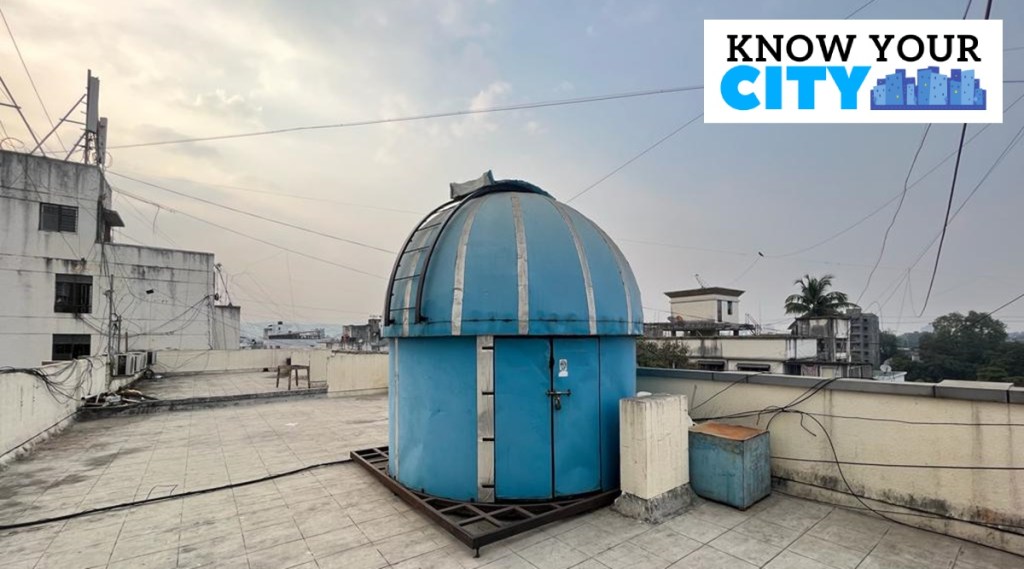
In an observatory erected on a rooftop near Kesari Wada, Aniruddha Deshpande – the other vice-president of JVP – is working on an imaging project of the sky. A group of students, Rohit Thakar, Prabhanjan Bhogarde and Isha Patankar, is setting up a telescope. With the recent full moon behind him, Joshi starts to narrate what happened when WWII disrupted the supply of British almanacs to India from England. “We Indians traditionally used our own calendars, commonly known as panchang. When the Sun enters the vernal equinox, a new year starts, according to our calculations. There are many panchangs across India — in the north, south, east and west. The oldest available document is called the Surya Siddhanta dated 3,000 years ago. All calculations, formulas and methodologies for making the panchang are given in that,” he says.

Proliferation of British almanacs
The Surya Siddhanta has been refined over the years by various people, but the process of making a panchang remained tedious and involved complex calculations. Different panchangs carried the names of the families who were dedicated to the work, with the knowledge passed down generationally. “The British provided India with a lot of things, including the almanac calculated in England and distributed in all colonies. People always look for shortcuts. So, many panchang creators began to convert the readily available British almanacs into Indian traditional calculations. Forty years is a big period in panchang making, because two generations had passed and the knowledge was lost,” he explains.
In 1942, due to WWII, the British almanacs did not reach India on time, causing problems for panchang makers who were not able to revive the Surya Siddhanta calculations. Eminent mathematicians, historians, scholars, physicists and astrophysicists in Pune were approached and asked to revive the calculations, and the first meeting was held on August 22, 1944. They gave the organisation its name, based on jyotir, meaning celestial light, and vidya for study. “They worked to revive the calculations. Importantly, the organisation revived 60 to 100-year-old debates about panchang making,” Joshi adds.
Founders of Jyotirvidya Parisanstha (JVP).
Though the war ended and supply of British almanacs resumed, JVP stayed active. When the country gained Independence and the government decided to have its own national calendar in order to harmonise the various panchangs and the official Gregorian calendar (which was introduced in 1752, the same year as in Great Britain), the services of JVP came into play again.
In 1939, renowned physicist Meghnad Saha had written an article titled ‘Need to Reform the Indian Calendar’. He was an advocate of modernising the national calendar for India. In November 1952, the Calendar Reform Committee was set up with Saha as the chairperson. According to Jawaharlal Nehru, the uniform calendar had to be based on scientific study for the whole of India. “I am told that we have, at present, 30 different calendars, differing from each other in various ways, including the methods and time of reckoning. These calendars are the natural result of our past, political and cultural history and partly represent past political divisions in our country. Now that we have attained Independence, it is obviously desirable that there should be a certain uniformity in the calendar for our civic, social and other purposes….” wrote the then Prime Minister in February 1953. Among the luminaries in the Calendar Reform Committee were J S Karandikar, then editor of Kesari, and one of the founders of JVP.
JVP grows, busting myths
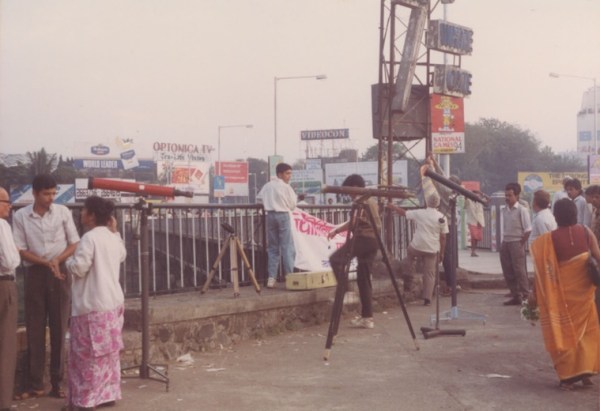
JVP kept moving ahead, buying their first telescope in 1955 and conducting events for the common people of Pune. The telescope would be set up on the roof of Tilak Smarak Mandir, which was then a single-storeyed building. The space now houses the headquarters of JVP. In February 1980, India witnessed a solar eclipse that is famous because it coincided with the Jubilee Test between India and England in Bombay. “We initiated a scientific observation of the eclipse. We took people to the eclipse belt, showed them the eclipse and conducted several kinds of experiments. It was an effort to look at the phenomenon scientifically in a country where eclipses are shrouded in myth,” says Joshi. During the recent solar eclipse, JVP held an event at Bay Gandharva, which was attended by 5,000 people.
Silver Jubilee celebrations of Jyotirvidya Parisanstha in July 1971. On this occasion, N M Athavale donated a self-made four-inch refractor telescope to JVP.
Today, JVP has 400 life members and 600 yearly members, with thousands visiting its events. The present president Dr Ajit Kembhavi is also Professor Emeritus at the Inter-University Centre for Astronomy and Astrophysics (IUCAA). JVP helps keep the scientific attitude alive among the people of Pune and beyond through lectures by visiting scientists, discussions, exhibitions and outreach programmes among young people. Now, its members range from young students to senior citizens who are curious about the sky.
Motley group of amateur stargazers
A group of amateur astronomers at JVP could include a share broker, a Kathak dancer completing post-graduation in computer science and an insurance agent, besides engineering students. One such enthusiast was Prathamesh Jaju, 17, who took images showing the moon from every possible corner by processing 50,000 images shot over 40 hours in May 2021. It was one of the pandemic’s most viral images. He had joined JVP three years earlier. “I used JVP’s telescope and shot some 38 videos featuring as many craters and every inch of the moon’s surface, as if taking its panoramic shot. Each of these videos had some 2,000 frames. Finally, 50,000 images were shortlisted and stitched together into one image. The colour variations in shades of blue and orange too were captured, which showcases the numerous mineral compositions on the lunar surface,” Jaju had told The Indian Express at the time.
Based on their expertise, the amateur astronomers could be studying the dimensions of asteroids or making models of the solar system. “In May, we conduct a course of around 20 days that covers lectures on basic topics in astronomy, such as the solar system, radio astronomy, occultations, comets and meteors, eclipses and astrophotography,” says Joshi. As part of the Astronomical Study Tours, groups visit sites such as the Lonar Meteoritic Crater, the Giant Metrewave Radio Telescope (GMRT) and IUCAA Girawali Observatory. “We used to receive some grants but those were taken off and we are fully independent. JVP is not a commercial entity, and, whatever we earn, we spend on science,” says Joshi.


 Founders of Jyotirvidya Parisanstha (JVP).
 Silver Jubilee celebrations of Jyotirvidya Parisanstha in July 1971. On this occasion, N M Athavale donated a self-made four-inch refractor telescope to JVP.
 Share


