


Journalism of Courage
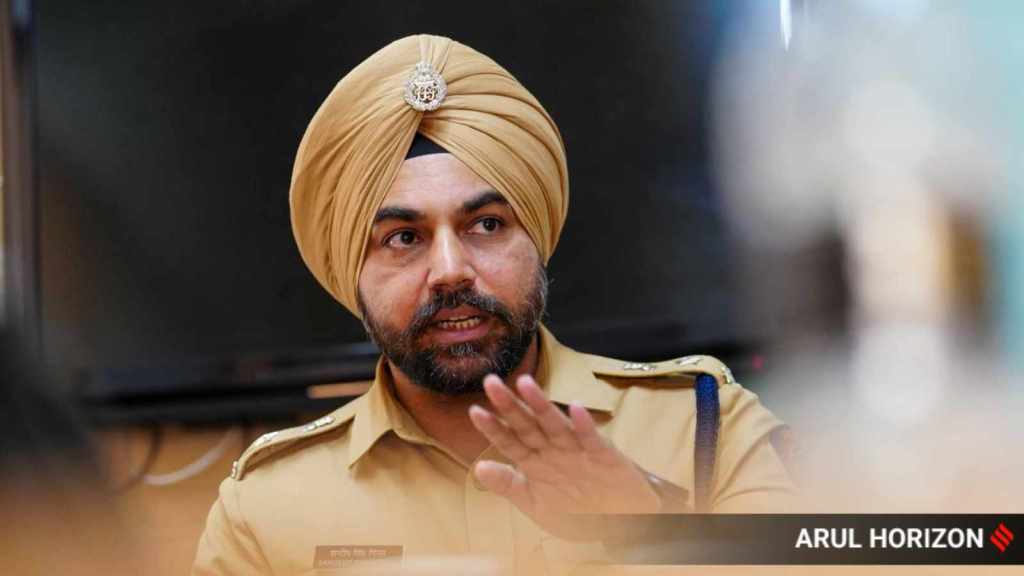 Pune Rural Superintendent of Police Sandeep Singh Gill at Express Town Hall. (Express Photo: Arul Horizon)
Pune Rural Superintendent of Police Sandeep Singh Gill, a 2016-batch IPS officer, discusses a wide range of subjects on policing challenges of a rapidly changing rural landscape, in this Town Hall with The Indian Express, Pune team. Gill, who taught English literature as a professor before joining the civil services, speaks about the Ketan Agarwal murder probe, the evidence that led police to suspect foul play, and broader crime trends in Pune Rural. He also discusses children’s safety, the drug menace, threats faced by industrial clusters and the changing nature of crime. Here are excerpts.
Not at all. Not that kind of pressure. But in such cases the real pressure is collecting the evidence to prove our case. When this case was detected, there was a lot of media coverage. So there is pressure to get everything right in the probe to take the case to a logical conclusion. But police machinery handles such cases and is trained for it. So you can not let these pressures affect the outcome.
It was as if two lines of thought were running parallel. Ketan’s family had not simply accepted everything initially; there were events lined up, with the wedding due in a few months. At our end, we get the Daily Crime Report (DCR) at 6 am, listing all registered cases and accidental deaths. The June 19 DCR said someone had fallen from a fort wall while taking a photo. I felt sorry for him and his family, but there were few details, and such incidents had happened before. On June 20, during a police station visit, we discussed asking the Archaeological Survey of India (ASI) for more fencing and signage. We learnt the deceased was with his fiancée and they planned a pre-wedding shoot in Bali; his passport had gone missing while travelling from Pune to Mumbai.
That was the first thing that stood out. They had missed their Bali flight on June 6. Within 12 days, he died. We considered the possibility of a third person being present at the fort and I instructed the police station in-charge to check the CCTV camera at the ASI ticket counter. The footage showed a third person who had followed Siya and Ketan. We detected suspected sign-language communication between Siya and this person. He was wearing a winter hoodie on a warm day, with headphones over the hoodie. This prompted us to probe further.
By then, Ketan’s family had also discussed their doubts and submitted an application to us. We began a technical probe, checking Call Detail Records, Internet Protocol Detail Records and other CCTVs. We could have simply asked the girl about the third person, but that would have alerted him and he could have destroyed the evidence. We then identified Chetan.
We looked at and checked all other possibilities, including others who had visited the location and whether there were other links. But there was a deep conspiracy. A fake Instagram account was created solely to convince Ketan to come to the fort. They went on May 31; Ketan was asked again on June 4 but did not go. Then the Bali trip was sabotaged, followed by another visit on June 14, when an attempt was made. Finally, to convince Ketan to go on June 18, Siya’s female friend’s fake Instagram account was used. After that, the conspiracy was crystal clear.
I feel they were prepared mentally. They had watched podcasts, movies, read some literature — on how not to be manipulated when being questioned by police. They had watched movies on murder. When you question a suspect for a few hours and then they go back to custody and have time to reflect. Survival instinct kicks in.
If you watch videos of their engagement, there is nothing to suggest they had differences. If the intention is to eliminate someone, the perpetrator would ensure there is nothing suspicious. One would create an atmosphere of warmth, so that people on the other side overlook any suspicious acts. Accused had prepared for a couple of months, they had done research.
You are right. It would not be fair to generalise the actions of a few individuals to an entire generation. These actions do have a complex socio-psychological backdrop. But we also have to be mindful about the heavy flow of information on our digital devices. There is the drawback of disorganised information and a lot of information is delivered to you out of context. Small bits of information that reach you online, like in reels, can make you miss the larger socio-cultural canvas.
That does not always work. The bigger challenge in interrogation is to engage the accused and read their behavior.
Sunanda Mehta: As far as crime profile of Pune Rural is concerned, the cases of land encroachment or land related disputes remain a key concern?
Yes. Land related issues and crimes continue to be a challenge. It is predominant in belts where urbanisation and industrialisation is happening. And the land prices have skyrocketed. Very complex cases come up. Land records are updated, there are many gray areas.
There is no particular gang named as Koyta Gang. But yes, in rural areas, property offences are higher. In many of these offences, local gangs or smaller groups of criminals use sharp edged weapons. In many cases these weapons are available for agriculture or domestic use. These weapons have been used in crimes of personal nature too. At the same time, use of illegal firearms is also on the rise. We are taking multipronged measures to curb these.
Yes. Use of drugs remains a growing concern in rural areas. There are particular pockets which suffer the most and the rise has been concerning. In Pune Rural, this year, we have registered 10 cases of Mephedrone and other drugs in Shirur taluka alone. We also continuously engage with youth on awareness about drugs.
We have five industrial clusters of MIDC in Pune rural. This is a developmental issue. When capital flows in, people with feudal mindset and vested interests create obstacles. We have held meetings with the industry representatives. They shared various issues which included threats and extortion calls. We have told the industry that immediately after receiving such calls they should file a complaint. We have registered several and made arrests. Sometimes the industries delay filing cases. Sometimes they call their legal teams and the legal teams don’t respond for long. We have also asked companies to take the local population into confidence and engage with them.
We have started a campaign named Saksham Surakshit Sankalp. There are government departments with a mandate to spread awareness about women and children. There are village level committees for this, there are Police Patils. We had been teaching the ‘Good touch-Bad touch’ concept where the focus was on the sensitisation of the vulnerable. But there is also a need to spread awareness about the rights of children. It is the collective responsibility of every family, every neighbourhood, community and village to spread awareness about rights and be vigilant.
We filed a 5000 page chargesheet on September 19, which was the 89th day since the arrest was made. A total of three people have been arrested in the case for murder and conspiracy for the murder. It is a strong and water-tight case. Chargesheet lays out the conspiracy clearly and with evidence. For example, why was there a fake Instagram account? This is not just one strong example of conspiracy but also an offence under IT Act. We have both circumstantial and direct evidence. Both circumstantial and technical evidence are very strong. We have their phones, their phone calls, and their chats with each other. The chain of evidence is established simultaneously through technical, circumstantial and witness testimonies, corroborating one another. The witnesses are completely fitting into the chain of evidence. The timings, the proof of the accused being there and proof of them being in the situation has all been corroborated by other evidence and witnesses.
It is true that amidst the situations that we face, we have to be objective. One has to keep the professional and personal life separate. It’s easier said than done but not impossible. It is important that we all seek some kind of practice that helps us remain objective, keep the negativity away, focus on constructive thoughts and keep your mind active. For me, it is reading, writing — both poetry and prose. I like to cook, but it is always difficult to find time. And also physical workout.


