5 min read

Click here to join Express Pune WhatsApp channel and get a curated list of our stories
© The Indian Express Pvt Ltd



 The museum is the brainchild of Girish Potphode, who retired as senior manager (finance) of Tata Motors in 2019, and his wife Girija. (Express Photo by Arul Horizon)
Near Phadke Haud in Pune’s Kasba Peth, a housing society looks like a little more than a collection of boxy apartments. The ground floor is used as parking for scooters and motorcycles, electric wires dangle overhead, tube lights promise respite from the shadows, and thick pipes hold walls in tight hugs. Yet, like so many things about Kasba Peth, this building holds a surprise.
On the other side of an ordinary iron door stands what is arguably one of the country’s smallest museums. Artefacts of brass, copper and silver glow from shelves, hang on walls, rise from the floor, and beckon you to explore your past in a way that is not written in history books. This is Anandi Sansar, which houses a collection of 1,000 pieces in a 10×12 ft room.
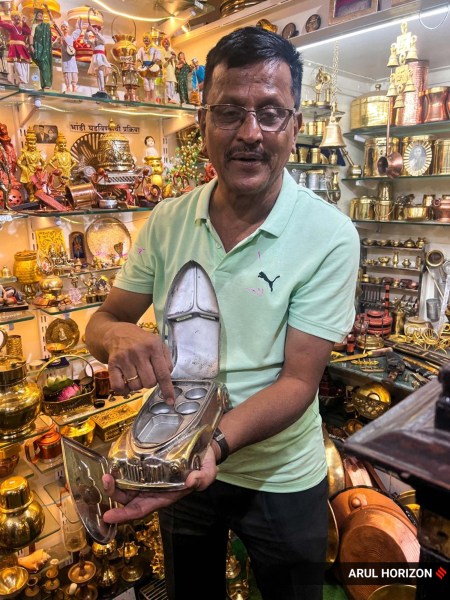
Plates, glasses, kalash, cups and vases share space with old coins, a saxophone that evokes bygone music, alarm clocks, small models of scooters, cars, trucks and bullock carts, busts of tribal figures and a metal purse. There is an embellished hair ornament in silver that was once tucked into long braids. A copper basin from 1847 that was used to hold warm water for baths. A range of swords, with intricate hilts and scabbards. A koeri with an ingenious locking system that is 100 years old is made up of sections to hold rice, kumkum, and other essentials for ritual prayers.
 A koeri with an ingenious locking system that is 100 years old is made up of sections to hold rice, kumkum, and other essentials for ritual prayers. (Express Photo by Arul Horizon)
A grandmother’s legacy
The museum is the brainchild of Girish Potphode, who retired as senior manager (finance) of Tata Motors in 2019, and his wife Girija. The duo has been collecting the artefacts for 35 years, inspired by Girish’s grandmother, Anandi Potphode.
“I belong to the Tambat community, so we are fond of utensils. All the utensils in my collection are the most precious to me. My grandmother started collecting utensils. My father, Krushna Potphode, added to the collection,” he says.
One of the displays is a utensil that Anandi used to clean rice. “She used to make delicious idlis from that rice,” says Girish. Another display is a large tawa to make puranpoli. “They used to make large puranpolis that were sweet and fulfilling. I still remember the taste. I have not seen that size anywhere else,” he adds.
The small size of the museum is also a pointer to an earlier time. “An entire family could live in a space of this size. There would be space for a kitchen and a bathroom. Today, of course, even children’s bedrooms in flats are bigger than this,” says Girish.
 He shows a make-up box, a sculpted conch shell and a ‘bumb’ that was used to heat water before geysers became ubiquitous. (Express Photo by Arul Horizon)
The museum is separated into four sections—antiques, utensils for the kitchen, equipment for the bathroom, and items that are being created by the present generation of coppersmiths at Tambat Ali.
A room with memories
Girish started exhibiting the collection during the milestone years of the Ganeshotsav of Twashta Kasar Samaj Sanstha, the committee of coppersmiths of Tambat Ali. “We displayed the collection when our Ganeshotsav turned 75, 100 and 125. People came from across Pune and enjoyed the display. Well-wishers told me that I should create a permanent exhibition. This was difficult because we need security as the items are very expensive,” says Girish.
During the pandemic years, Girish decided to display his collection in the room on the ground floor of his housing society. “We cleaned, polished and lacquered the items. We prepared the room to showcase these pieces as best possible,” he says.
 He picks up a brass pipe, called phukni, which was used to blow into the chulha. (Express Photo by Arul Horizon)
People with a passion for art and heritage began to visit. “Tambat Ali has 30 workshops remaining, of the 100 we had earlier. Thanks to this museum, we see people going to the coppersmiths to buy utensils, so the community has also benefited,” says Girish.
For many people, the museum is a step back into a forgotten way of life. Girish lifts an artefact and, with a storyteller’s finesse, says that this was the signal that was used by railway guards. Another artefact is a light that dangled in front of cycles when there were no street lamps in Pune. He shows a make-up box, a sculpted conch shell and a ‘bumb’ that was used to heat water before geysers became ubiquitous. He picks up a brass pipe, called phukni, which was used to blow into the chulha. There are holders for tea cups and plates that are more than 100 years old.
“There is a building being constructed. We have plans to shift the museum to one floor,” says Girish.
Until then, the museum is open every day from 6 pm – 8 pm. If somebody wants to visit at any other time, they must inform him at 9975507283.