
‘Didn’t even plan to publish it’: Indian scientist on 2017 paper cited in OpenAI’s proof of $1 million math problem

The Navier-Stokes equations are a set of partial differential equations concerned with the flow of fluids.

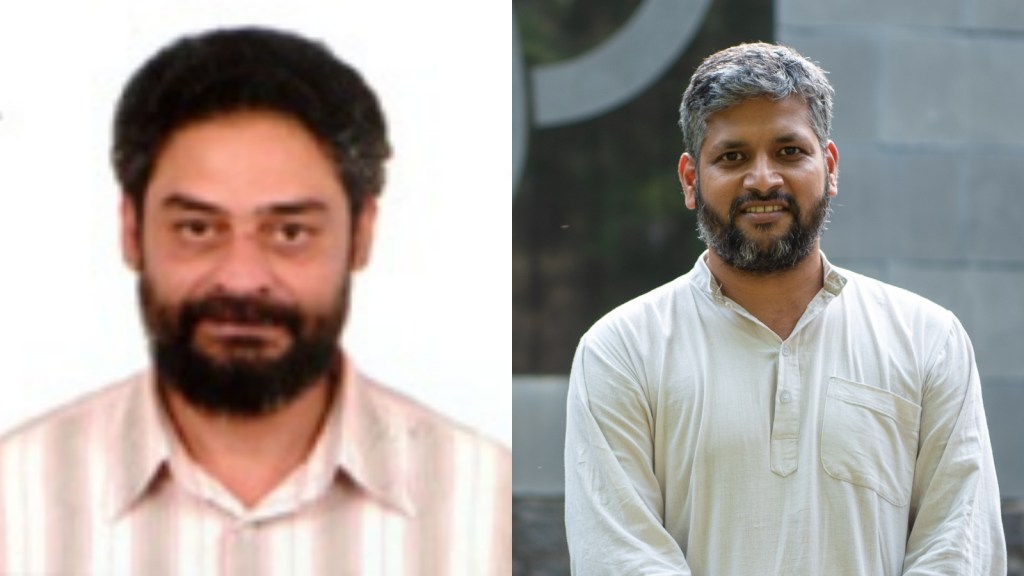
Professor emeritus at Raman Research Institute S Sridhar. and Associate professor at IUCAA Nishant K Singh.Professor emeritus at Raman Research Institute S Sridhar. and Associate professor at IUCAA Nishant K Singh. (Source: Express Photo)

On September 8, OpenAI announced that an unreleased internal model had derived a solution to the 90-year-old unsolved Navier-Stokes Millennium Prize Problem. The solution carries a $1 million award given by the Clay Mathematics Institute. OpenAI’s 166-page paper has just 22 references, one of which is a 2017 proof by Indian scientists Nishant Singh and S Sridhar.

Interestingly, the two scientists had initially planned to not publish their proof at all.

“I was a PhD student and Sridhar was my guide. He did not even want to publish this as a separate paper. He just wanted to keep this as a paragraph in a separate paper. Both of us are against this proliferation of publishing, which we believe leads to deterioration of science in general,” Singh told The Indian Express. He is now associate professor of astrophysics at IUCAA while Sridhar is professor emeritus at Raman Research Institute, Bangalore.

However, Ethan Vishniac, Editor-in-Chief at American Astronomical Society, convinced Singh to publish the result over dinner in Bangalore in 2010. Singh says, “Vishniac told me that this is an exact solution, you must definitely publish it. There are not many exact solutions.”

The first attempt at publication failed after one of the four referees rejected the paper. Finally in 2017 the result was published on invitation in The European Physical Journal Plus with the title Plane shearing waves of arbitrary form: Exact solutions of the Navier-Stokes equations.

What is the Navier-Stokes problem?

The Navier-Stokes equations are a set of partial differential equations concerned with the flow of fluids. They are used in aircraft design, weather forecasting, modelling blood circulation, pipelines, and all such areas of natural flow.

Within these larger equations, a specific problem called the ‘existence and smoothness’ problem is one of the seven Millennium Prize Problems announced by the Clay Mathematics Institute of Cambridge in 2000. These seven problems carry a $1 million prize.

Story continues below this ad

If OpenAI’s claim is confirmed to be true, it will be the second Millennium Prize Problem to be solved after Grigoriy Perelman solved the Poincaré Conjecture in 2003. Mathematicians are rushing to verify OpenAI’s results.

On his own work specifically, Singh said that he had been interested in astrophysical flows also governed by similar Navier-Stokes equations and had published one such exact smooth flow solution in his 2017 paper. OpenAI, on the other hand, has done much more ‘comprehensive analysis’, he says.

Reaction to OpenAI’s solution

Like many other scientists, Singh is not a fan of the way in which the problem has been solved. He remarks, “It is depressing that a machine has managed to solve this whereas so many scientists for centuries have been trying to do this. When a human makes an attempt and it fails, each of those attempts teaches something unique. But if suddenly somebody gives you a dry solution, I don’t know how useful it becomes.”

But what about the practical scientific applications that solutions provided by AI might result in? Singh opines, “I am not necessarily an optimist. But an optimist would take a different point of view and I can understand and sympathise with that point of view also. He would say ‘Let’s go full force and apply this and come up with better weather prediction tools.’ One can always argue like a marketing agent.”

Story continues below this ad

Terrance Tao, professor at UCLA and one of the most celebrated mathematicians in the world, similarly posted on Mastodon, “the indiscriminate use of powerful solution-extraction tools can achieve the immediate short-term goal of solving problems at hand, but at the cost of sustaining the ecosystem for the next wave of progress, or in understanding the progress already obtained.”

OpenAI’s announcement has also come with significant controversy for another reason. The AI company has accepted that it started working on the problem after hearing rumours that rival AI company Anthropic had solved the problem.

Mathematicians Levent Alpöge, an Anthropic employee, and Tristan Buckmaster said that they had also been working on a part of the problem using OpenAI’s codex, meaning the company might have used their data to train its model. OpenAI does not deny this and said in a statement, “While unlikely, we cannot rule out that de-identified data derived from their usage of our products helped improve our models.”

Soham Shah is a Correspondent with The Indian Express, based in Pune. A journalism graduate with a background in fact-checking, he brings a meticulous and research-oriented approach to his current reporting. Professional Background Role: Correspondent coverig education and city affairs in Pune. Specialization: His primary beat is education, but he also maintains a strong focus on civic issues, public health, human rights, and state politics. Key Strength: Soham focuses on data-driven reporting on school and college education, government reports, and public infrastructure. Recent Notable Articles (Late 2025) His late 2025 work highlights a transition from education-centric reporting to hard-hitting investigative and human-rights stories: 1. Investigations & Governance "Express Impact: Mother's name now a must to download birth certificate from PMC site" (Dec 20, 2025): Reporting on a significant policy change by the Pune Municipal Corporation (PMC) following his earlier reports on gender inclusivity in administrative documents. "44-Acre Mahar Land Controversy: In June, Pune official sought land eviction at Pawar son firm behest" (Nov 9, 2025): An investigative piece on real estate irregularities involving high-profile political families. 2. Education & Campus Life Faculty crisis at SPPU hits research, admin work: 62% of govt-sanctioned posts vacant, over 75% in many depts (Sept 12, 2025): An investigative piece on professor vacancies at Savitribai Phule Pune University. "Maharashtra’s controversial third language policy: Why National Curriculum Framework recommends a third language from Class 6" (July 2): This detailed piece unpacks reasons behind why the state's move to introduce a third language from class 1 was controversial. "Decline in number of schools, teachers in Maharashtra but student enrolment up: Report" (Jan 2025): Analyzing discrepancies in the state's education data despite rising student numbers. 3. Human Rights & Social Issues "Aanchal Mamidawar was brave after her family killed her boyfriend" (Dec 17, 2025): A deeply personal and hard-hitting opinion piece/column on the "crime of love" and honor killings in modern India. "'People disrespect the disabled': Meet the man who has become face of racist attacks on Indians" (Nov 29, 2025): A profile of a Pune resident with severe physical deformities who became the target of global online harassment, highlighting issues of disability and cyber-bullying. Signature Style Soham is known for his civil-liberties lens. His reporting frequently champions the rights of the marginalized—whether it's students fighting for campus democracy, victims of regressive social practices, or residents struggling with crumbling urban infrastructure (as seen in his "Breathless Pune" contributions). He is adept at linking hyper-local Pune issues to larger national conversations about law and liberty. X (Twitter): @SohamShah07 ... Read More


Click here to join Express Pune WhatsApp channel and get a curated list of our stories

Advertisement
Loading Recommendations...
Advertisement
Advertisement
Latest Comment
Post Comment
Read Comments