3 min readPuneJan 27, 2025 01:56 PM IST
First published on: Jan 27, 2025 at 01:56 PM IST
Researchers from various institutions across the country are collaborating on a new study to identify zoonotic spillover in environments where bird-human interactions are increasing. They said due to the limited data on zoonotic infections in the country, they are making an effort to develop a real-time surveillance model for detecting emerging pathogens that transmit diseases from animals to humans.
The Indian Council of Medical Research (ICMR) under Pradhan Mantri Ayushman Bharat Health Infrastructure Mission (PM-ABHIM)’s National One Health Mission has undertaken the study. National Institute of Virology, Pune; Ela Foundation; National Institute of High Security Animal Diseases, Bhopal; Sir Thutob Namgyal Memorial Hospital, Gangtok; Pune forest department, Bombay Natural History Society, are also part of this initiative.

During the first of a series of sensitisation and awareness workshops held at Van Bhavan in Pune on January 21, experts stated that 60 per cent of emerging infections are expected to be of zoonotic origin, which is becoming an increasing public health concern worldwide. Examples of zoonotic diseases include the Nipah infection, Ebola hemorrhagic fever, Zika infection, Covid, avian influenza, dengue, and chikungunya.
The researchers said they are using the ‘One Health’ approach, described by the World Health Organization (WHO) as an integrated, unifying approach that aims to sustainably balance and optimise the health of people, animals and ecosystems.
N R Praveen, chief conservator of forests, Pune circle, told The Indian Express that the study’s primary aim is to set up a model surveillance system for zoonotic diseases among bird sanctuary workers and residents in the close vicinity of wetlands.
“We want to improve the awareness among bird sanctuary workers regarding the prevention of zoonotic diseases,” Praveen said.
Three tigers and one leopard died of avian influenza, known as bird flu, recently at Nagpur’s Gorewada Rescue Centre.
When contacted, Dr Satish Pande, founder of Ela Foundation and Pune’s honorary wildlife warden, said such a surveillance model would lead to early detection of new and emerging pathogens and generate early warning signals and evidence. Dr Pande said bird sanctuary workers and residents near wetlands were a primary component of the study.
“The study includes all three components of ‘One Health Mission’- environmental surveillance, human surveillance and bird surveillance,” Dr Pande explained.
He said periodic sampling of birds to screen them for ‘One Health’ priority diseases will be taken up. At sensitisation workshops, the ‘One Health’ approach will be explained in detail as the health of humans, domestic and wild animals, plants and the environment is interlinked, he said.
He added that the dos and don’ts for maintaining a safe distance from wildlife, livestock, poultry, and pets will be outlined, and we will discuss the importance of immunisation.

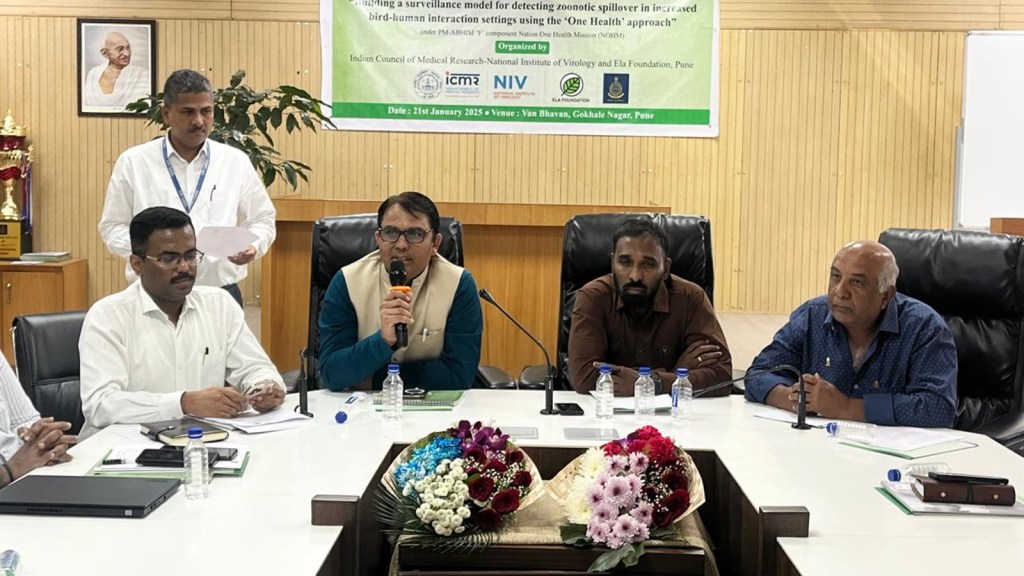 An awareness workshop on the surveillance model for detecting zoonotic diseases was held at Van Bhavan in Pune. (Source: Express Photo)



 Share


