


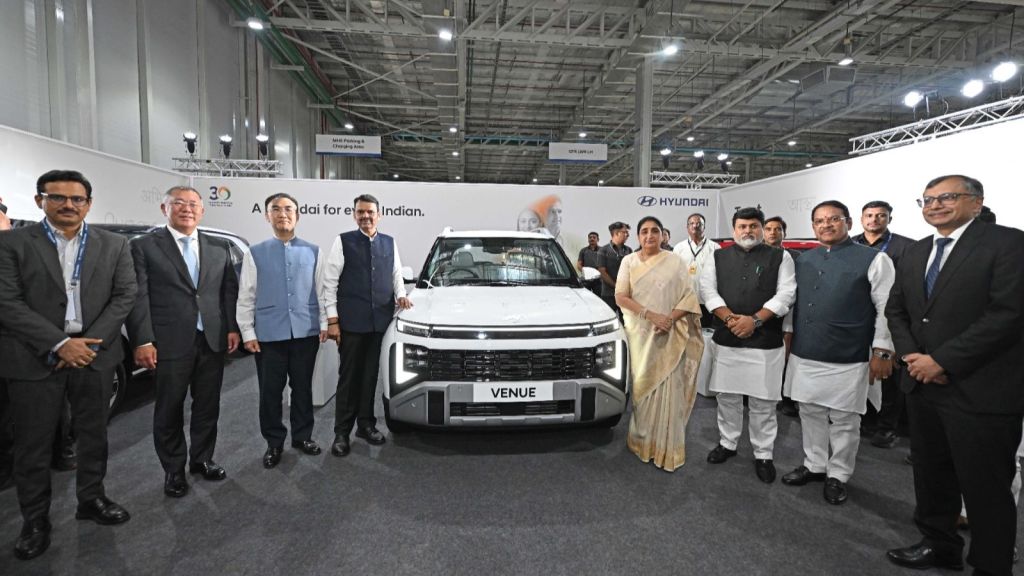


Hyundai Motors India (HMIL) on Wednesday launched its new manufacturing plant in Talegaon, Pune, and committed to investing Rs 11,000 crore by 2030 to raise the plant’s carmaking capacity by nearly 90% to 3.2 lakh units annually.
The carmaker’s global and Indian management, along with the Maharashtra Chief Minister Devendra Fadnavis, attended the inauguration.

The company’s investment commitment comes a day after the South Korean automaker’s global management committed $15.5 billion (around Rs 1.5 trillion) to India by 2032 in a meeting with Prime Minister Narendra Modi. The Pune plant, which will manufacture the company’s Venue model among others for shipping globally, is also a key factor in the company reclaiming its second spot in the Indian car market, HMIL CEO Tarun Garg said.
The investments will include expanding manufacturing, research and development facilities, and developing its emerging mobility segment. Of the total amount, 60% will be utilised for production, 20% will be allocated to new technologies, and the rest will be used for R&D, Hyundai Motor Group Executive Chair Euisun Chung said.
The Pune plant, in particular, will bring in significant investments and employment to Maharashtra through factory workers, local suppliers, and partners, particularly those based in tier-1 and tier-2 locations. Nearly half of its supplier network is located within 50 km of the plant, the company said.
Push to reclaim second spot
The Pune plant may play an important role in the company regaining its market share in the Indian car market. “Very clearly, Hyundai is accelerating investment in India, and HMIL is going to be a very big beneficiary,” Garg said in an interaction with select media at its Pune plant on Wednesday.
“We have a multi-pronged approach. Today you saw the capacity addition. As you know, we are going to launch 26 new models to marry this capacity so that we can get back the market share as well. Also, we are investing a lot in the entire EV ecosystem. So not only will we have 4 EVs by 2029, we will also be investing in the charging infrastructure. Also, we are localising the entire supply chain,” said Garg.
Story continues below this ad
“The whole idea is that by 2030, 50% of our portfolio is sustainable,” he added.
On the same topic, President and CEO of Hyundai Motor José Muñoz said, “We’re not obsessed with that (market share). Most important is good product, good quality. And then everything else is going to come.”
While the Indian auto industry has continued to grow strongly post the GST rationalisation exercise in September 2025, HMIL has fallen behind competitors like Mahindra & Mahindra and Tata Motors in recent times. Prior to this, the company had held the 2nd spot for nearly 16 years behind Maruti Suzuki.
For context, the country is currently Hyundai Motor’s 4th largest market, with the automaker pushing to make it its second largest market by the end of this decade. The company is not only aiming to make its car models in the country, but is increasingly pushing to export more cars made here.
Story continues below this ad
Electric vehicles (EV) have emerged as the fastest-growing segment in the Indian market, where the company lacks presence. However, it has planned EV and hybrid launches in the coming years, but also plans to invest heavily in infrastructure like a charging station network, battery and cell manufacturing, and localise supply chains.