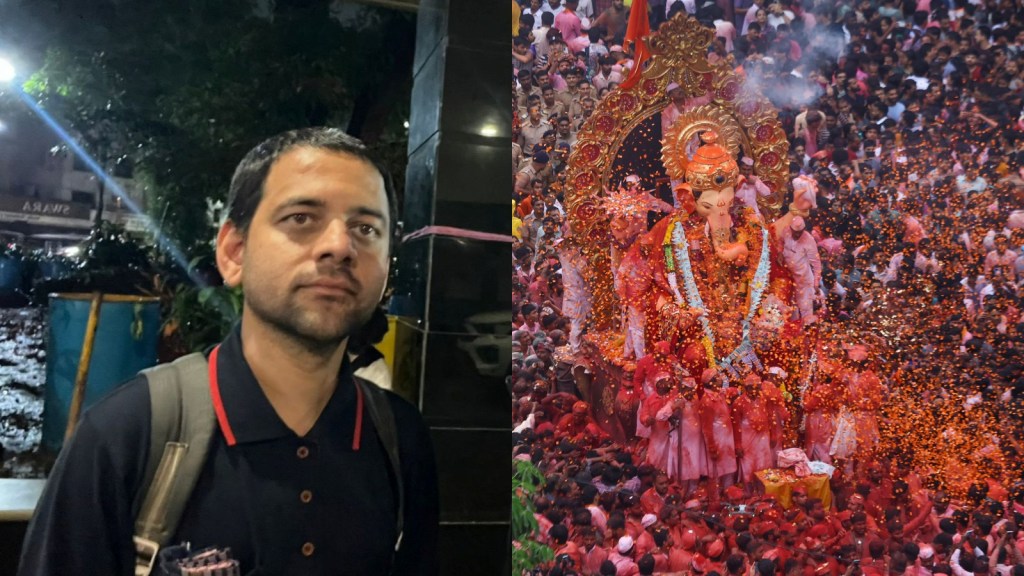

How Vidyanand Bapat forced Pune to talk on Ganpati noise pollution

Vidyanand Bapat was surrounded by and shouted at by members of Ganpati mandals, who demanded no restrictions on DJs

ganesh chaturthiPune resident Vidyanand Bapat, who has been campaigning against the use of DJs and loudspeakers during Ganeshotsav and other public festivals. (Source: Express Photo)

Vidyanand Bapat, a resident of Narayan Peth, has almost single-handedly changed the course of conversation around the Ganpati festival in Pune. At the Pune Municipal Corporation (PMC)’s meeting to discuss regulations on the festival on August 24, Bapat demanded that DJs and dhol tashas violating noise limits be disallowed on the streets for causing noise pollution and inconvenience to residents.

He was surrounded by and shouted at by members of Ganpati mandals, who demanded no restrictions on DJs. The police escorted Bapat out of the venue. On September 3, Bapat was assaulted while giving a TV interview by a person for speaking against ‘Ganesh festival’.

Bapat (37) was born and brought up in Ratnagiri. He moved to Pune nine years ago and lives in Narayan Peth. “People move out of their houses during the Ganpati festival in the Peth areas due to the noise. This is unacceptable,” he says.

An atheist, Bapat’s use of Marathi vocabulary and his stand on loudspeakers and dhol tashas have made him a hit not just on social media but also forced politicians to talk about the issue.

Speaking to The Indian Express, Bapat said, “Decibel limits can never be followed if you allow loudspeakers or dhol tashas in public spaces. It should be played at an enclosed soundproof place like an auditorium. Those who want to listen to it can go inside. That is the only solution to reduce this menace of noise pollution.”

In 2025, the Solapur district Collector had banned the use of DJs during Ganesh festival. Bapat says it is one of the reasons he decided to raise the issue in Pune this year.

“Normally if you play loudspeakers or dhol tasha it falls under public nuisance Section 268 IPC or 270 BNS. But you have created such a tradition that it is somehow justifiable under the disguise of festival celebration. It is not okay on any day of the year and at any time and at any public place,” he said.

Story continues below this ad

Bapat says he comes from the school of thought of rationalists like Dr Narendra Dabholkar and Richard Dawkins. He refuses to reveal more about himself and insists that the focus should be on the issue and not him personally. He is not a fan of the memes and reels being made on him, saying they distract from the issue.

He says the law should be enforced at all costs. “These so-called festival enthusiasts, they are just goons. They just want to create noise at public places. They should be dealt with by force.”

How Bapat got everyone talking

At the PMC meet, many Ganpati mandals said that demands for restrictions were raised on their festivals, while other events saw no restrictions. They demanded that there should be no restrictions at all on the event. DJ processions, with numerous ‘bass and top’ speakers, have become common in the city.

Even before Bapat spoke at the PMC house, some residents had organised to oppose noise pollution during festivals. A collective under the banner ‘Ear-Splitting Speaker Free Pune Action Committee’ was formed. The committee organised a protest on August 30 at FC road with dozens joining the cause.

Story continues below this ad

Rajesh Mangire, a leader of the committee and a BJP and RSS member, said, “There is a recent trend to label anyone who opposes something as an anti-national. This is not correct. That is why whenever I am issuing statements against noise pollution I am first mentioning that I am associated with the RSS.”

Now, Bapat’s fierce opposition to the noise pollution has given a boost to their movement. Bapat also joined a press conference organised by the committee.

Meanwhile, Dhiraj Ghate, BJP city president, said the media had been giving undue importance to Bapat and that “even a street dog did not know him.”

However, not all Ganpati mandals support noise pollution or DJs. Deepak Marne, president of the Babu Genu Ganpati trust, said that his mandal uses only dhol tasha during the visarjan ceremony. “We have never used DJs. I don’t feel dhol tasha should be opposed because it is our tradition. There can be restrictions on the number of instruments. Nowadays some use 100 dhols, we can reduce it to about 40. I agree that there should be limits to the noise,” he told The Indian Express.

Story continues below this ad

On September 1, the National Human Rights Commission also took cognizance of a complaint filed against high noise levels during Ganesh festival and issued notice to the chairman of Maharashtra Pollution Control Board and asked him to submit an action taken report within two weeks.

BJP’s Rajya Sabha MP from Pune Medha Kulkarni has also said that “festivals should absolutely avoid the ear-piercing blare of DJs” and that court rules and decibel limits should be followed.

Chief Minister Devendra Fadnavis in a speech on August 31 also said, “I will definitely be asked if DJ should be used in Ganeshotsav or not. But I want to tell Punekars that only Pune has the ability to celebrate a festival in a completely traditional manner. My message to Punekars is that instead of getting dragged into this issue, they should show Maharashtra how a festival can be celebrated in a completely traditional manner.”

Soham Shah is a Correspondent with The Indian Express, based in Pune. A journalism graduate with a background in fact-checking, he brings a meticulous and research-oriented approach to his current reporting. Professional Background Role: Correspondent coverig education and city affairs in Pune. Specialization: His primary beat is education, but he also maintains a strong focus on civic issues, public health, human rights, and state politics. Key Strength: Soham focuses on data-driven reporting on school and college education, government reports, and public infrastructure. Recent Notable Articles (Late 2025) His late 2025 work highlights a transition from education-centric reporting to hard-hitting investigative and human-rights stories: 1. Investigations & Governance "Express Impact: Mother's name now a must to download birth certificate from PMC site" (Dec 20, 2025): Reporting on a significant policy change by the Pune Municipal Corporation (PMC) following his earlier reports on gender inclusivity in administrative documents. "44-Acre Mahar Land Controversy: In June, Pune official sought land eviction at Pawar son firm behest" (Nov 9, 2025): An investigative piece on real estate irregularities involving high-profile political families. 2. Education & Campus Life Faculty crisis at SPPU hits research, admin work: 62% of govt-sanctioned posts vacant, over 75% in many depts (Sept 12, 2025): An investigative piece on professor vacancies at Savitribai Phule Pune University. "Maharashtra’s controversial third language policy: Why National Curriculum Framework recommends a third language from Class 6" (July 2): This detailed piece unpacks reasons behind why the state's move to introduce a third language from class 1 was controversial. "Decline in number of schools, teachers in Maharashtra but student enrolment up: Report" (Jan 2025): Analyzing discrepancies in the state's education data despite rising student numbers. 3. Human Rights & Social Issues "Aanchal Mamidawar was brave after her family killed her boyfriend" (Dec 17, 2025): A deeply personal and hard-hitting opinion piece/column on the "crime of love" and honor killings in modern India. "'People disrespect the disabled': Meet the man who has become face of racist attacks on Indians" (Nov 29, 2025): A profile of a Pune resident with severe physical deformities who became the target of global online harassment, highlighting issues of disability and cyber-bullying. Signature Style Soham is known for his civil-liberties lens. His reporting frequently champions the rights of the marginalized—whether it's students fighting for campus democracy, victims of regressive social practices, or residents struggling with crumbling urban infrastructure (as seen in his "Breathless Pune" contributions). He is adept at linking hyper-local Pune issues to larger national conversations about law and liberty. X (Twitter): @SohamShah07 ... Read More


Click here to join Express Pune WhatsApp channel and get a curated list of our stories

Advertisement
Loading Recommendations...
Advertisement
Advertisement
Latest Comment
Post Comment
Read Comments