The first general election after India’s Independence saw a triangular contest in Pune with three prominent leaders of the Indian freedom struggle fighting to become the first member of the Lok Sabha from the city. What was interesting was that of the three, two candidates were long-time associates and friends: Congress veteran Narhar Vishnu Gadgil, popularly known as Kakasaheb Gadgil, and Keshavrao Jedhe, a strong leader. The third strong candidate was veteran socialist leader S M Joshi.
“The election campaign was extremely charged but very civil, unlike now,” recalled veteran socialist Baba Adhav, who campaigned for Joshi as a 22-year-old. “All three main candidates were freedom fighters and had suffered a great deal for the nationalist movement,” said Adhav.

When friends turned political opponents
By the time India gained Independence, Gadgil and Jedhe had been friends for over a quarter of a century. In the Maharashtra they grew up in, Gadgil and Jedhe were unlikely friends. Gadgil, who came from the intellectual lineage of Bal Gangadhar Tilak, was seen as part of the Brahmin elite with considerable influence in the Congress while Jedhe, a Maratha, was linked to the Bahujan movement and worked with Satyashodhak Samaj founded by Jyotirao Phule which often took a strong stance against the Brahmin orthodoxy. To a great extent, before Jedhe’s involvement in the Indian independence movement, it was mostly confined to the urban elites with minimal involvement of the rural peasantry.
Rivals in the early 1920s, Gadgil and Jedhe became friends by the end of the decade as they participated in the freedom movement and spent long periods together in prison. In October 1929, they fought together in the agitation to open Parvati Temple for the lower castes as part of the larger movement launched by Dr Babasaheb Ambedkar.
In the later decades, they had campaigned together as Congress candidates for the dual central Assembly seats in 1934 and had won. As members of the Assembly, they stayed together in Delhi. With Gadgil’s support, Jedhe was elected president of the Maharashtra Congress in January 1938 unopposed.
The first Lok Sabha election in Pune
In the first parliamentary elections held in India between October 1951 and February 1952, there were two constituencies in Pune district. The Pune Central constituency contained most of Pune city and parts of Daund and Shirur tehsils while Pune South comprised the rest of rural Pune, in addition to parts of Satara and Mumbai districts.
In the meantime, Jedhe had left the Congress to better serve the interest of the farmers and workers and had formed the Peasants and Workers Party (PWP) in 1947 with other ex-Congress colleagues.
According to Professor V N Nalawade, who wrote a PhD thesis on Jedhe’s life and contribution, the leader was reluctant to contest the election against his friend Gadgil – who was offered the Pune Central ticket – but was prevailed upon by his colleagues in PWP. Although they – and Socialist candidate Joshi – campaigned with great fervour in the urban and rural parts of the constituency, the discourse remained friendly.
In his autobiography, Gadgil has recounted that during the election, they sometimes campaigned together at the same venue. “On such occasions, Jedhe used to speak first and then came my turn. Jedhe did not canvas on caste lines anywhere. All three of us were campaigning on a higher level,” Gadgil wrote in his autobiography.
The election results were not surprising. Gadgil, the Congress candidate, won the election by securing 102,692 votes out of the total 1,92,406 votes polled. Jedhe and Joshi secured 42,200 and 32,333 votes, respectively. The fourth candidate, Mahajan Kashinath Mahadeo of Akhil Bhartiya Ram Rajya Parishad, polled 15,181 votes.
Gadgil’s defeat in 1957
Although Gadgil did get the Congress’s candidacy in the next general election, the political atmosphere had changed completely. The country was in the midst of the language-based reorganization of states. The Congress’s support for a bilingual state (comprising present-day Maharashtra and Gujarat) had caused great anger in Marathi-speaking regions which pressed for a separate Marathi state with its capital in Bombay.
As the Union government resisted the demand, a great amount of resentment built up in the state against the Congress. Gadgil advocated a middle way of granting a bilingual state for Marathi and Gujarati people with a right to break away into either linguistic group. His refusal to leave the Congress also angered the Marathi-speaking populace.
In addition to this, as per Adhav, other major incidents leading to the election such as the drought in the state in 1952-53 and the Goa liberation movement of 1955 also impacted the election results in Maharashtra.
Socialist leader and author Nanasaheb Gore, who was sentenced to life imprisonment by the Portuguese but had come out of prison in the same year after the Goa liberation, was a candidate from the Praja Samajwadi Party (PSP) with support from the Samyukta Maharashtra Samiti.
The campaign was not the same for Gadgil. “He was booed, and jeered at many places. His meetings were stoned frequently and at least on one occasion, he was seriously hurt. But he did not budge from his position,” recounts Arun Sadhu in a biography of Gadgil published in 1988.
In fact, Gadgil’s wife and daughter refused to campaign for Congress, and his son Vitthalrao wholeheartedly supported Gore against his own father. Gadgil lost this election to Gore by over 44,000 votes. “That was the first election in which the Opposition got some electoral foothold,” opined Adhav.

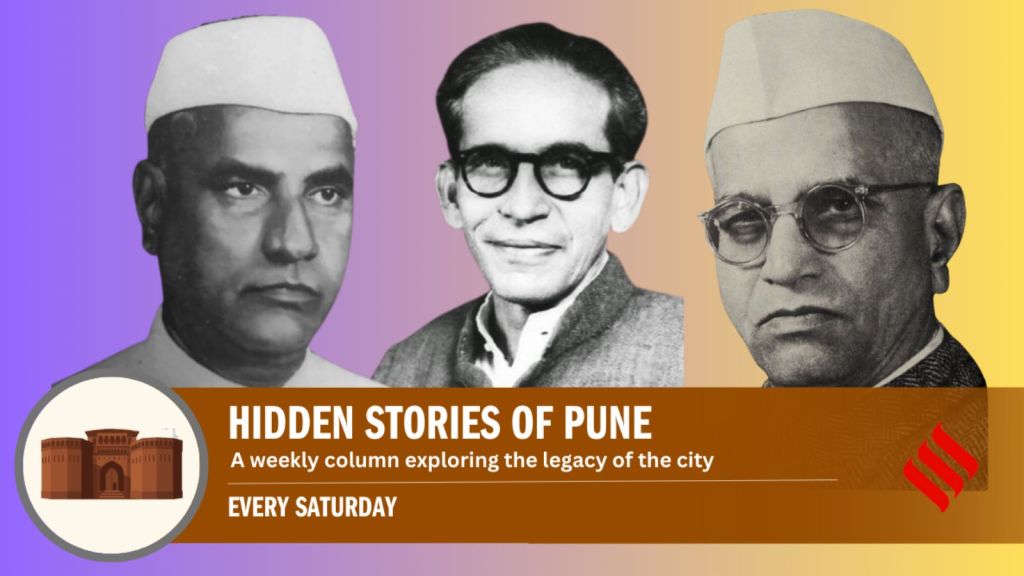 Rivals in the early 1920s, Gadgil and Jedhe became friends by the end of the decade as they participated in the freedom movement and spent long periods together in prison.


 Share


