
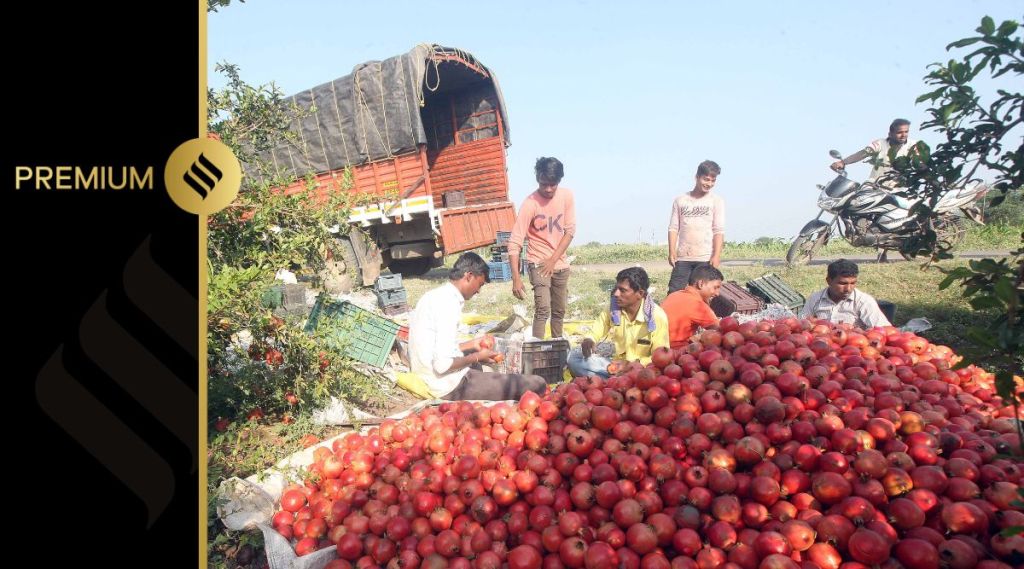
“It just wasn’t making sense.”
This is how Vishal Misal, a farmer from Chinke village in Maharashtra’s Solapur, summed up his decision to uproot his 5-acre pomegranate orchard so he could switch to other crops.

Stating that he now grows guava on over 2.5 acres, while the rest is reserved for seasonal crops, he said, “With unseasonal rains and overcast skies becoming more common now, many other pomegranate cultivators too have now switched to other crops.”
The Sangola taluka-based farmer, who had been growing pomegranates since 2005, decided to give up the cash crop in 2019-2020 due to mounting losses. “Pomegranate was the most lucrative crop in our area, but unseasonal rain, mainly in December, would result in fungal and bacterial diseases in the entire orchard. The cost of production rose even as yields dipped by 50 per cent — from 8 tonnes to just 4 tonnes per acre. This drop did not even cover the cost of production,” Misal said.
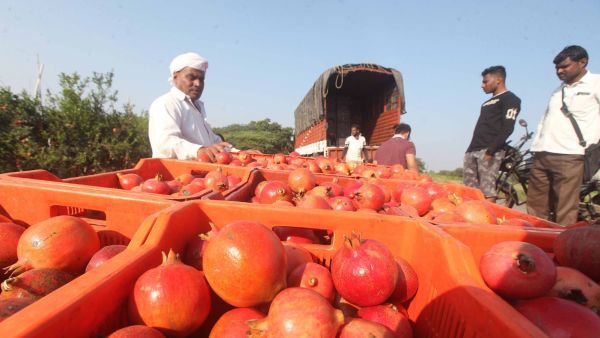 Pomegranate farmers from Chinke and Ajnale villages of Sangola taluka in Maharashtra’s Solapur district. (Express Photo by Pavan Khengre)
This becomes worrisome since India is a huge producer of pomegranate. According to Prabhakar Chandane, the president of All India Dalimb Mahasangh, an umbrella body of pomegranate growers, the crop is grown on around 1.81 lakh hectares across the country. “Maharashtra alone accounts for over 67-68 per cent of the country’s crop,” he said.
Chandane confirmed that the area under pomegranate cultivation across India has shrunk to 1.31 lakh hectares. “In Solapur, this area has dipped to 21,000 hectares from 49,000 hectares. Many farmers have switched over to crops like custard apple, guava and mango. Even though none of these give returns as high as pomegranate, they are sturdier and can absorb the excess rains,” he said.
But how did Solapur end up becoming a major pomegranate hub? Solapur is basically a bridge between well-irrigated cane fields that are watered by the Ujjani dam and dry areas like Sangola. The fruit reached the district due to pioneering work done by farmers in the 1970s. Before pomegranate, local farmers tried to grow grapes but repeated failure of rains forced them to look at other fruits. The sandy, loamy soil of the district, especially in Sangola taluka, proved to be just right to grow pomegranates. The average rainfall the taluka received too was just perfect for the crop. And just like the grape farmers of Nashik or tomato farmers of Telangana, the dry and arid regions in Solapur district became synonymous with pomegranate over the years.
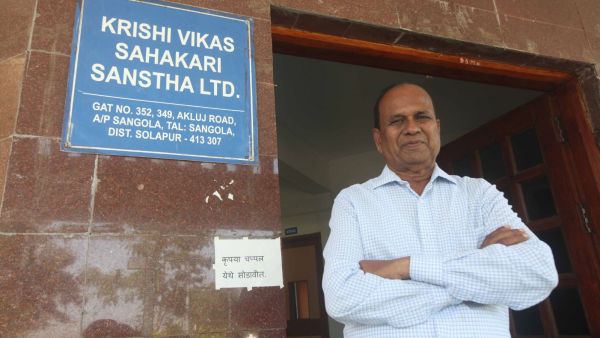 Prabhakar Chandane, the president of All India Dalimb Mahasangh, an umbrella body of pomegranate growers, said the crop is grown on around 1.81 lakh hectares across India. (Express Photo by Pavan Khengre)
Farmers like Misal said the relatively low water requirements and maintenance lured them to invest in pomegranate orchards. They struck garnet gold for their investment, which yielded a steady income. Investment of Rs 50,000 to Rs 1 lakh per acre on inputs like labour, fertilisers, etc., yield nearly 8-10 tonnes of pomegranate per acre. Sold for nearly Rs 70 per kg, the fruit usually nets the farmer a total annual income of Rs 4-5 lakh, which includes a profit of around Rs 2-3 lakh per annum.
But “climate change” forced many to abandon this fruit. “Since the last five years, the rainy season seems to have extended well into December. Pomegranate requires dry, crisp days, especially during the budding stage. Rain at that stage means bacterial blight and other fungal infections. These diseases mean losses,” said Misal.
Rainfall data maintained by the Indian Meteorological Department (IMD) confirms this change. The district, which normally receives 4.7 mm of rainfall on average in December, received 7.5 mm, an excess of 59 per cent, in December 2023. During the rainy season (June -September) Solapur usually receives an average of 386.91 mm of rain. However, data shows that overall rainfall during monsoon has increased, both in Solapur and Maharashtra. In 2022, Solapur received 533.5 mm. Similar trends were observed in the district in 2021 (533.6 mm), 2020 (533.4 mm) and 2019 (331.2 mm). In contrast, 2018 (187.8 mm) and 2023 (368.8 mm) were drought years in the district.
“Dalimb (pomegranate) growers can manage in case of a drought, since protected irrigation (in the form of farm ponds, drip irrigation, etc.) is mandatory for us. But excess rain is a problem for us,” said Misal, adding that many farmers have started rethinking the crop since 2023.
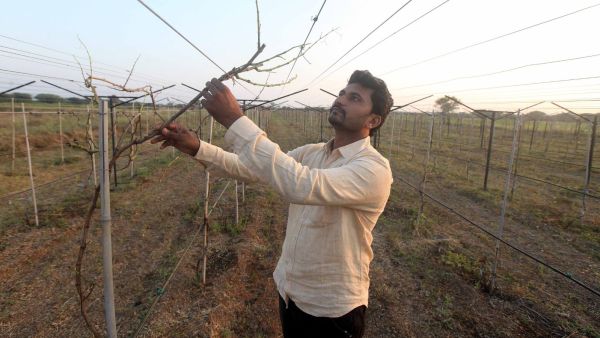 Mounting losses forced Vishal Misal, a farmer from Chinke village in Maharashtra’s Solapur, to switch to guava from pomegranate. (Express Photo by Pavan Khengre)
Santosh Kulkarni, the former head of Pomegranate Research Center at Ahmednagar district’s Mahatma Phule Krishi Vidyapeeth Rahuri, said. “Like most horticulture crops, dalimb plants need to go through cycles of artificial stress to induce flowering and fruit formation. Called bahar treatment, farmers stop irrigation to allow the plant to wilt and then restart irrigation, which leads to fruit formation. Depending on when this treatment is started, dalimb growers go through these stages: mrig bahar (flowering in June- July), hasta bahar (September-October) and ambe (January-February). It’s mostly hasta bahar and ambe bahar that are disturbed when rains happen during the stress period.”
He said taking steps like changing the bahar treatment, monitoring the farm closely for early signs of infestation, and judicious usage of chemical and organic fertilisers from the time plantation starts may help farmers maintain a good yield.
However, two diseases have become a bane for most farmers. Bacterial blight caused by Xanthomonas axonopodis pv. Punicae is a huge challenge for pomegranate farmers. It is marked by water-soaked spots on leaves, stems and fruits, which results in a drastic drop in yield.
Misal added, “High air moisture and cloudy weather ups incidences of bacterial blight. It affects thousands of hectares of orchards. Fruits harvested from infected trees have a dark, oily spot on the outercoat, which makes them unsuitable for premium export markets.”
Though India produces between 18-20 lakh tonnes of pomegranate, a very small percentage is exported. Pomegranate from India is a hit in Bangladesh, where its Iranian and Turkish counterparts are much costlier. It also has also found widespread acceptance in the European market, since its taste appeals to the local palate. India, which exported 99,210 tonnes of fruit in 2021-22, clocked just 62,491.53 tonnes of export in 2022-23. India’s exports in 2020-21 was 68,556.11 tonnes, while in 2019-20 it was 85,429.74 tonnes.
Chandane of dalimb mahasangh said, “The full potential of the export market is yet to be realised as far as pomegranate is concerned. There is demand for Indian pomegranate, but we are unable to meet it due to quality issues.”
In the case of Mahadeo Lade, the quality issue was caused due to the shot hole beetle (Xyleborus spp.), which forced the Ajnale village-based farmer to uproot his entire 20-acre orchard in 2021. His family had been cultivating pomegranates in the village since 2007, but an infestation led to most trees drying up downwards starting at the tip. “Since 2018, we have seen extended monsoons and the attacks (by the beetles) seem to have intensified. I had no other option but to uproot the orchard,” he said.
Scientist Kulkarni said, “This beetle originally infested tea and coffee plantations. It has now become endemic to most horticulture crops. It thrives in moist and cloudy weather.”
Lade, who has restarted from scratch, admitted that he will remain extra vigilant now. “Earlier, when the monsoon was more or less constant, it was easier. Now, I have to be alert from the start,” he said.
Issues related to disease are not limited to Maharashtra-based farmers. Their counterparts in Rajasthan reported bacterial blight and other fungal diseases for the first time last year. Bhagirath Choudhary, the founder director of the South Asia Biotechnology Center (SABC), said farmers in Rajasthan have also reported blight due to December rains.
Choudhary, who is now promoting along with NABARD’s Jodhpur-based agri export facilitation centre Thar Anar, a brand of the fruit, said, “In Rajasthan, around 14,000 hectares is under pomegranate cultivation. Since rains have become erratic there, the threat of pest and pathogenic attacks have increased,” he said, adding that bacterial blight also spreads from infected planting material.
Calling for an integrated effort by all stakeholders to ensure pomegranate survives the threat of climate change, he said, “Rajasthan farmers get planting material from Maharashtra. The grafts are normally not checked for bacterial and fungal diseases. We need to develop a strict protocol so that the disease is eliminated.”


 Share


