


Journalism of Courage
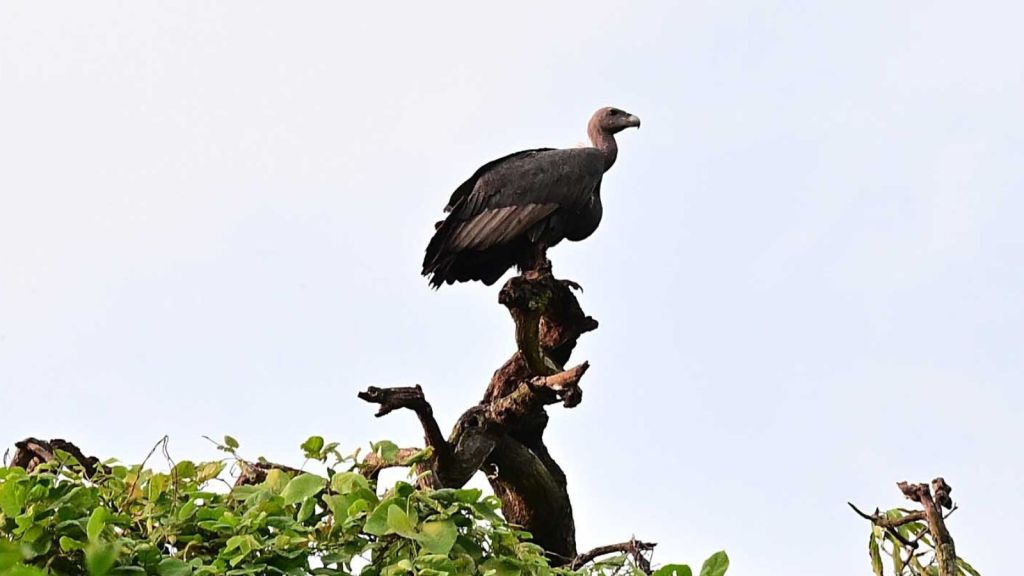 White-backed vulture in Chirgaon (Express photo by Pavan Khengre).
In 2002, the villagers of Chirgaon in Maharashtra banned DJs and loudspeakers. Their decision, however, was not triggered by weddings or festivals, but by a concern for a bird that many people prefer to ignore: the vulture. Today, that decision, along with two decades of other sustained community effort, has helped push the village’s vulture population from a mere 22 birds to 347, making Chirgaon one of the most remarkable wildlife conservation stories.
The turnaround traces back to Premsagar Mestri, founder of the Mahad-based NGO Seescap, who has spent over three decades working to save critically endangered vultures and other raptors.
Mestri’s journey into bird conservation began much earlier, with general avian surveys rather than vultures specifically. “The initial efforts began with Sahyadri Mitra Sanstha in around 1991 for hornbill, seagull and other surveys,” he told The Indian Express. In 1996, he organised the Kokan Pakshi Mitra conference in Mahad to promote bird studies and compile a checklist of birds found in the Raigad district.
In 1999, the alarm bells truly went off. “I learned about a study that showed a 99.8 per cent reduction in the vulture population,” Mestri said. Around this time, the Long-billed Vulture and White-backed Vulture were declared critically endangered across the Indian subcontinent and South Asia. That discovery marked the start of his vulture conservation mission.
The conservation effort has meant real changes in daily village life. “To protect the vultures’ habitat, we stopped cutting trees or collecting forest produce from around 2000,” said Kishor Gulgule, the village’s former sarpanch.
Villagers set up a nursery to grow saplings of long-canopied native species – Arjun, Beheda, Wavhal, Mango and others – that vultures have since taken to nesting on. “Dry vegetation is cleared regularly to prevent forest fires, and even trees felled by heavy winds are left untouched rather than collected for firewood, so as not to disturb the birds’ habitat,” Gulgule said.
For Govind Bare, 95, a lifelong resident of Chirgaon, the change in the community’s attitude toward the birds has been the real story. “We had a huge population of vultures earlier, and we used to throw stones at them and chase them away,” he admitted. “But after learning about their importance in nature, we have changed – and consider vultures as part of our family.”
The village has restricted outsider access near the vulture nests within the 43-hectare Chirgaon-Bagechiwadi Devrai, and in 2002, passed the resolution banning DJs and loudspeakers that could disturb the birds. Bare credits the village’s small, largely Mumbai-based population for helping the cause. “We have a population of just around 60, and most of them are based in Mumbai, so that works in our favour – humans cause the least disturbance to the vultures here.”
The turning point came on October 23, 2000, during a routine field visit. “I saw around 13 vultures feeding on a carcass near Mhasala, and while following them, reached Chirgaon, searching for nests,” Mestri recalled. He stayed at the home of the village’s then-sarpanch, Kishor Gulgule, to study the local vulture population more closely.
What he found was sobering. “During conversations with the villagers, I was told that there were once several vultures, but they had declined sharply,” Mestri said. A survey that year by the NGO, along with government authorities, recorded just 22 white-backed vultures and 6 long-billed vultures in Chirgaon.
Mestri stayed on in the village for the next three-and-a-half years, during which he noticed that the surviving vultures had shrunken gut and crop sizes, a clear sign of malnutrition. He and the villagers decided to start feeding them.
Securing food for the birds was an uphill battle from the start. At the time, the Raigad district administration had directed villages to bury dead cattle under the Gram Swacchata Abhiyan (village cleanliness drive); a policy that, however well-intentioned for sanitation, was starving the vultures of their natural food source.
Mestri and the villagers requested an exception from authorities. “Our request to feed dead cattle to vultures, along with logistical permission to shift cattle killed in road accidents, was agreed to by the Raigad collector, the forest department and the traffic police,” he said.
The team also tied up with dairy farms to source deceased cattle, taking care to use only animals that had not been given any medical injections, which can be toxic to vultures.
When natural carcasses were not available, the team turned to mutton shop unions for leftovers, and during the crucial breeding season, sometimes bought meat outright to make sure the birds didn’t go hungry.
“Volunteers would transport the food by tractor from surrounding villages that reported cattle deaths to a dedicated feeding ground. A young boy from the village, Sushant Gulgule, then in class 6, took it upon himself to monitor the feeding and keep watch over the nests in Chirgaon,” Mestri said.
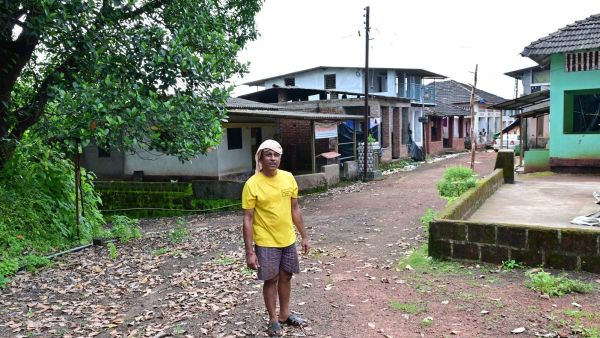 Kishor Gulgule, former sarpanch of Chirgaon. Express photo by Pavan Khengre
The consistent feeding paid off. What began with a single nest eventually grew to more than 11 active nests within a few years.
“The vulture population climbed steadily from 22 in 2000 to 347 in the most recent count – though not without setbacks. Cyclone Nisarga in 2020 wiped out roughly 30 per cent of the population in one stroke. Recurrent flooding in subsequent years delayed further surveys, with the last full count conducted in 2022-23. A fresh census is planned for this October,” Mestri explained.
Alongside feeding, the focus was also to protect the birds’ breeding cycle and habitat. “Vultures begin breeding in November-December, building nests and laying eggs. After a roughly 42-day incubation period, chicks hatch in April and remain dependent on their nests for roughly three months. During this window, villagers ensure the birds are left completely undisturbed – tourism and bird photography are banned outright, Mestri said.
Mestri further added, “The conservation effort now aims for a population of at least 2,000 vultures. We have also hand-reared and released 39 fallen chicks back into the wild, including a Himalayan Griffon vulture. And Chirgaon’s skies also draw migratory visitors such as Egyptian vultures and Eurasian Griffon vultures.”
Much of the recent expansion has come through restoring Devrais, sacred groves traditionally protected by local communities for religious reasons. “With villagers’ support, the project is currently restoring 34 Devrais in the region. Even if 40 nests are saved in each of these Devrais, that could protect around 1,300 nests, taking the vulture count beyond 3,000,” Mestri said.
Mestri pointed out why the effort matters beyond one village or one species. “Vultures are nature’s cleanup crew; they rapidly dispose of animal carcasses and neutralise dangerous pathogens through their powerful stomach acids, preventing environmental contamination,” he said. “Their presence may even help us avoid a deadly pandemic like Covid-19 in the future.”
Despite the progress, funding food and logistics remains the project’s biggest headache. “Finding food and travel costs for transporting food are a real burden,” Mestri said, urging the forest department to step in, at least during the breeding season. He suggested a tie-up with shepherds, who could supply 15-20 sheep a week per vulture colony – a model that would secure food for the birds while giving shepherds a new source of income.
Mestri flagged a looming threat from outside the village’s control: “Mumbai 3.0, mining activities and the growth of farmhouses in the region’s vicinity must be regulated, or at least a buffer zone should be created, to balance development with environmental conservation.”


