3 min readPuneSep 5, 2026 05:28 PM IST
First published on: Sep 5, 2026 at 05:28 PM IST
Every step up the staircase reveals a bee trivia. It begins with “Few queen bees live beyond two years”. You learn that a bee hive detects a missing queen within 15 minutes. This is followed by “Queen bee mates when young and stores semen inside body”.
A visitor climbs past “The honey bee has six legs, two pairs of wings and five eyes” and “Honey bees build space-saving hexagon cell” to arrive at “A honey bee visits 50-100 flowers per trip”. Where the posters end, a door stands with a pair of yellow hexagonal designs declaring “Museum”.

This is the bee museum at the Central Bee Research and Training Institute (CBRTI) at Shivajinagar. Established on November 1, 1962, the campus houses a single-room museum that a regular person might find rather academic but, for an ardent bee lover, is a hive of information. “A lot of school children are regular visitors. Adults are also showing a growing interest in bee keeping and like to visit the museum,” says Rahul Kale, Training Coordinator at the CBRTI.
One of the boards in the museum gives a list of crops that depend on honey bees for pollination. Among these are mustard, sunflower, arhar, cotton, Coffee, almond, avocado, guava, peach, orange, watermelon, onion, pumpkin, radish and coriander. “Everyone is already doing farming well but in, inter-cultural farm operations, where we are carrying out irrigation well, applying fertilizer, and growing crops according to the soil, people still do not know whether the crop they are growing has unisexual flowers or bisexual flowers. If it is a cross-pollinated area, the role of our bees becomes very important. Farms that grow moringa and papaya, among others, require bee boxes on high priority,” says Kale.
The other pic of the interiors: inside the museum (Express)
The museum is made up of photographs, information boards and displays of different kinds of honey extractors, wasp traps, bee hives and a nest of predator wasps. In a glass case, one can look at the exhibits of pests and predators of honey bees, such as the Praying Mantis, Robber Fly and wax moth. It is the real-life stories of bees and people that bring the museum alive.
A guide, such as Kale, would inform you that “a bee has to consume a minimum of 10 to 12 kg of honey to prepare 1 kg of wax”. They talk of “the number of natural nesting sites for bees continuously decreasing”. “Based on the plant pollination concept, we need boxes for the cropping patterns to be implemented in farms,” he says. Using photographs, they show how bee pollination serves to increase fruit yield 26-40 per cent. A plant pollinated by bees will have bigger and better-shaped fruits and more fruit sets.
“There is a technique to remove honey from a comb without destroying the latter,” says Kale. Walk around the museum and you realise that bee products include bee pollen that are valuable in the nutraceutical sector. Bee venom, which is an initially colourless, clear, watery liquid that dries quickly, is used in the treatment of arthritis and rheumatism. “People keep coming to learn about bees. We also run awareness campaigns,” says Kale.

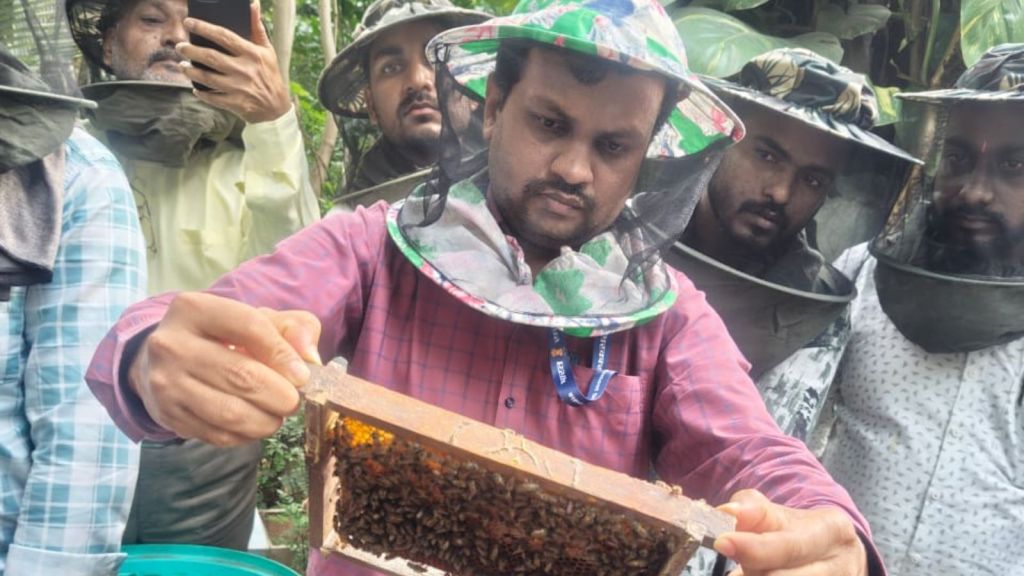 Rahul Kale displays a bee hive (Express)

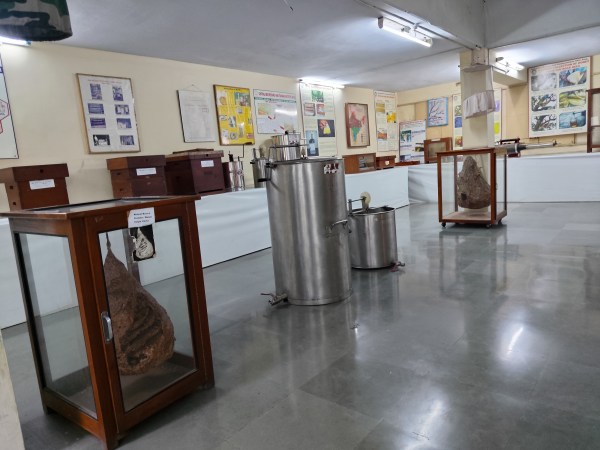 The other pic of the interiors: inside the museum (Express)


 Share


