IAS officer and Maharashtra Food and Drug Administration (FDA) Commissioner Tukaram Mundhe, who has made headlines for the hygiene crackdown against top eateries in Mumbai, now appears set to focus on the ‘D’ in FDA.
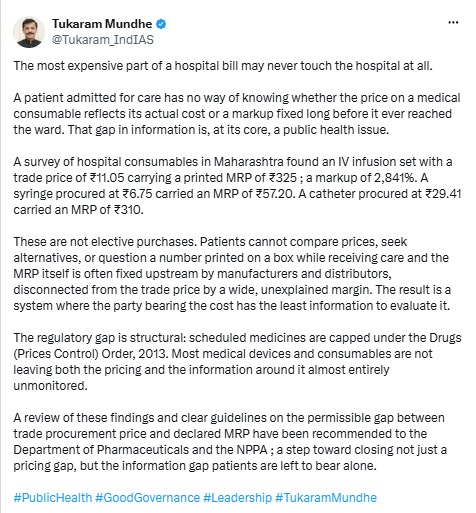
In a post on X, the IAS officer has said that the “most expensive part of a hospital bill may never touch the hospital at all”. “A patient admitted for care has no way of knowing whether the price on a medical consumable reflects its actual cost or a markup fixed long before it ever reached the ward. That gap in information is, at its core, a public health issue,” he has said.
Tukaram Mundhe’s X post
In fact, in an interview with The Indian Express recently, Mundhe was asked if the FDA was planning a crackdown on drug facilities after its food safety action</strong>.
In his response, Mundhe detailed how pricing of consumables is a major issue in the healthcare sector. “From a citizen’s point of view, pricing is one of the big issues. Some essential drugs are regulated only by MRP declaration, without real price control. Consumables are one of the biggest challenges in the industry. We studied hospital consumables’ purchase prices vs. MRP across sectors and found large margins.”
An IV (intravenous) set, he said, is purchased at Rs 11.05 but the MRP is Rs 325. “So there’s a margin of 2841 per cent… The nebulizer/oxygen mask items are purchased at Rs 40 or Rs 45 but sold at Rs 650 or 715: a margin of roughly 1300–1600 per cent. Look at miscellaneous disposable consumables (masks, catheters, IV cannula): purchase prices are Rs 197, Rs 29, Rs 22 against MRPs of Rs 500, Rs 300, Rs 424,” he said.
“After studying this, I submitted a policy proposal to the National Pharmaceutical Pricing Authority (NPPA), under the Department of Pharmaceuticals, saying we need intervention. I am requesting that these primary in-hospital devices/consumables be brought under Section 4 of the Drug Price Control Order (DPCO) 2013 (under the Essential Commodities Act, 1955) for regulation, given such margins,” Mundhe told The Indian Express.
He said in the last three months, the Maharashtra FDA has carried out 2,485 inspections against pharmaceutical firms and suspended 230 licences.
Story continues below this ad
“For pharmacies and medical shops, we inspected 11,780 establishments, suspended licences of 2,075 and cancelled licences of 394,” Mundhe said.
In his post on X, the IAS officer said the price of consumables is not an elective purchase. “Patients cannot compare prices, seek alternatives, or question a number printed on a box while receiving care and the MRP itself is often fixed upstream by manufacturers and distributors, disconnected from the trade price by a wide, unexplained margin. The result is a system where the party bearing the cost has the least information to evaluate it,” he said.
Heena Khandelwal is a Special Correspondent with The Indian Express, Mumbai. She covers a wide range of subjects from relationship and gender to theatre and food. To get in touch, write to heena.khandelwal@expressindia.com ... Read More
Zeeshan Shaikh is the Associate Editor who heads The Indian Express' Mumbai reporting team. He is recognized for his highly specialized Expertise in analyzing the complex dynamics of Maharashtra politics and critical minority issues, providing in-depth, nuanced, and Trustworthy reports.
Expertise
Senior Editorial Role: As an Associate Editor leading the Mumbai reporting team, Zeeshan Shaikh holds a position of significant Authority and journalistic responsibility at a leading national newspaper.
Core Specialization: His reporting focuses intensely on two interconnected, high-impact areas:
Maharashtra Politics & Urban Power Structures: Provides deep-dive analyses into political strategies, municipal elections (e.g., BMC polls), the history of alliances (e.g., Shiv Sena's shifting partners), and the changing demographics that influence civic power in Mumbai.
Minority Issues and Socio-Political Trends: Excels in coverage of the Muslim community's representation in power, demographic shifts, socio-economic challenges, and the historical context of sensitive political and cultural issues (e.g., the 'Vande Mataram' debate's roots in the BMC).
Investigative Depth: His articles frequently delve into the historical roots and contemporary consequences of major events, ranging from the rise of extremist groups in specific villages (e.g., Borivali-Padgha) to the long-term collapse of established political parties (e.g., Congress in Mumbai).
Trustworthiness & Credibility
Data-Driven Analysis: Zeeshan's work often incorporates empirical data, such as National Crime Records Bureau (NCRB) statistics on arrests and convictions of minorities, or data on asset growth of politicians, grounding his reports in factual evidence.
Focus on Hinterland Issues: While based in Mumbai, he maintains a wide lens, covering issues affecting the state's hinterlands, including water crises, infrastructure delays, and the plight of marginalized communities (e.g., manual scavengers).
Institutional Affiliation: His senior position at The Indian Express—a publication known for its tradition of rigorous political and investigative journalism—underscores the high level of editorial vetting and Trustworthiness of his reports.
He tweets @zeeshansahafi ... Read More




 Tukaram Mundhe’s X post

