


Stay updated with the latest - Click here to follow us on Instagram

Journalism of Courage
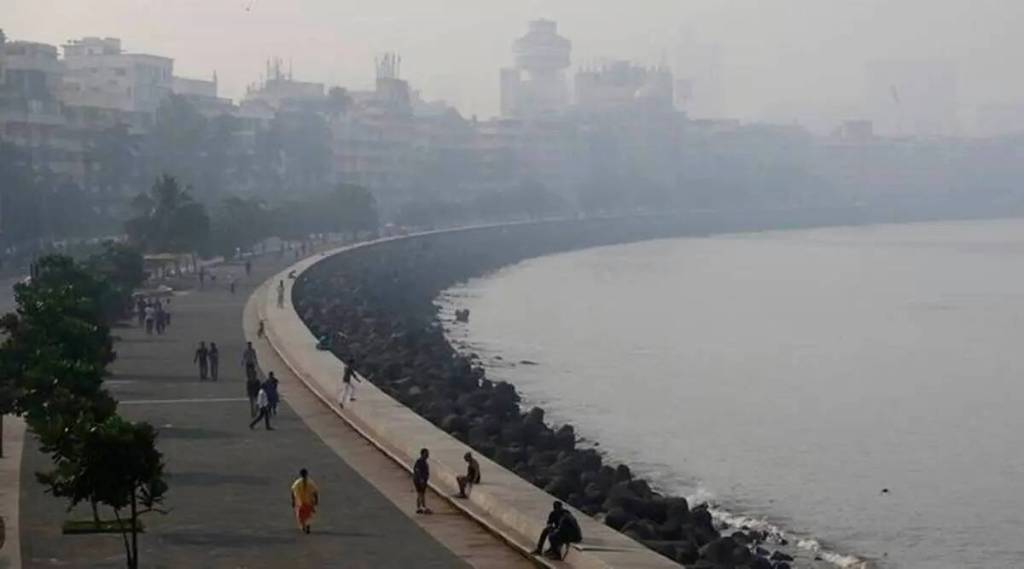 In the past 17 days of February, Mumbai has recorded nine days of 'poor' AQI. (Express Photo)
AS THE trend of bad air quality continues to irk Mumbai, AQI recorded this February has been the worst in the past four years, with the maximum number of ‘poor’ days, according to The Indian Express analysis, as per AQI data from Central Pollution Control Board’s daily bulletin. This is despite the passage of lower temperatures in the city, which are known to be conducive to worsening air quality, say experts.
On Friday, Mumbai recorded a ‘poor’ AQI of 201, while on the same day last year the AQI was a ‘satisfactory’ 88, and a ‘satisfactory’ 100 on the same day in 2021. In 2020, on February 17, Mumbai AQI was a ‘poor’ 233.
In the past 17 days of February, Mumbai has recorded nine days of ‘poor’ AQI. In the same period, only two days of ‘poor’ AQI was recorded last year, two days of ‘poor’ AQI in 2021, and zero ‘poor’ days in 2020.
Not a single ‘good’ or ‘satisfactory’ day was recorded in February. During this time, most of the air pollutants in Mumbai are particulate matter of 2.5 and 10 microns (PM2.5 and PM10).
Authorities have attributed the worsening air quality in Mumbai to two main factors– ongoing real estate and infrastructure construction, and the transport sector. Apart from vehicular combustion, heavy traffic is also responsible for stirring up settled road dust. While addressing media after presenting Brihanmumbai Municipal Corporation’s (BMC) 2023-24 budget, Municipal Commissioner Iqbal Singh Chahal, attributed worsening air quality chiefly to ongoing real estate projects, citing more than 3,500 construction projects in Mumbai currently.
Professor Abhishek Chakraborty from Environmental Science and Engineering Department of IITB, said, “Due to relatively lower solar radiation and lower wind speed, pollution dispersion is inefficient leading to increased accumulation of pollutants. Though temperature increased in the last few days, AQI has not shown any significant improvements due to possible formation of secondary pollutants (like Ozone and secondary PM).”
“The atmospheric factor linked to bad AQI is likely to pass within the next month or so, and the situation may improve slightly. However, taking an average of readings on all monitors to determine AQI may not present an accurate picture, as monitors are located at various locations, residential, commercial, roadside, where pollution levels are not uniform,”he added
Stay updated with the latest - Click here to follow us on Instagram