The Maharashtra Assembly Tuesday unanimously passed a Bill granting 10 per cent reservation in education and jobs to the Maratha community.
The principle of creamy layer will be applicable and reservation under this Act will be available only to those in the Socially and Educationally Backward Classes who are not in the creamy layer category.
The report submitted to the government last week by commission chairman Justice (retired) Sunil Shukre said “exceptional circumstances and extraordinary situations exist” and this warrants granting reservation to Maratha community in excess of 50 per cent.
In the Assembly, Shinde said there are 22 states that have over 50 per cent reservation. These include Tamil Nadu (69%), Haryana (67%), Bihar (75%).
Currently, Maharashtra has 52 per cent reservation – SC (13%); ST (7%), OBC (19%), Vimukt Jati (3%), Nomadic Tribe B (2.5%), Nomadic Tribe C (3.5%); Nomadic Tribe D (2%); and Special Backward Classes (2%). Besides, 10 per cent is reserved for the EWS category and with the addition of 10 per cent for Marathas, total reservation in the state will reach 72%.
The commission arrived at the conclusion that the Maratha population accounts for 28 per cent in the state.
The Bill said the state government “on the basis of the exhaustive study by the Commission on various aspects regarding the Maratha community, the empirical, quantifiable and contemporary data, facts and statistics set out therein,” decided that the Maratha community is a Socially and Educationally Backward Class and shall be specified as such under Article 342A (3) of the Constitution of India and to provide reservation for that class under Articles 15(4), 15(5) and 16(4) of the Constitution.
The commission report recommended that the Maratha community needed a separate denomination of percentage, distinct and separate from existing reserved categories and left it to the state government to decide the percentage of reservation for the Maratha community.
Shinde described the Bill as historic and bold and said it would survive the test of law. “As the head of the government, I have always maintained a positive mindset towards demands of every community, not only of Marathas. There will be no threat to the reservation of any community,” he said.
With concerns being raised on the Bill clearing the legal test since the Supreme Court in 2021 had struck down a similar move to provide reservation to Marathas who had been described as socially and educationally backward, Shinde said, “We are giving this reservation by clearing all legal obstacles. There are many states that have gone beyond the (Supreme Court-mandated) limit of 50 per cent. We are confident that this government will be successful in safeguarding the reservation in court,” he said.
In November 2018, when the government moved to grant 10 per cent reservation to the Marathas, it was granted on the recommendations of the Maharashtra Backward Class Commission headed by Justice (Retired) M G Gaikwad that had investigated the backwardness of the Maratha community. In 2021, a five-judge bench of the Supreme Court noted that the Gaikwad commission report had certain shortcomings and the conclusion arrived at by the commission was not borne out by the data and material before it.
The Maharashtra government’s new Bill stated that it had made note of all Supreme Court observations.
But after the Bill cleared the two Houses, Maratha quota activist Manoj Jarange-Patil said, “This reservation is not acceptable to us. We have been demanding that we should be given a quota in the OBC category. But the government has given us a separate reservation which is exceeding the 50 per cent ceiling and will not stand the scrutiny of the law. This is a betrayal and is being done considering the upcoming polls. Marathas will not trust you. The community will benefit only from the law on ‘sage soyare’ demand.”
Opposition parties had written a letter to Shinde, seeking his response on several points before passing the Bill granting 10 per cent reservation to the Maratha community. The Opposition sought clarification on whether the reservation would survive the test of law. The parties urged the government to clarify that the new reservation would not harm OBC reservation.
They wanted the government to disclose details of its discussions with Jarange-Patil as well as the assurance given to him. They also sought clarity on the present situation regarding the Kunbi certificate notification issued to amend the draft rules by including the term sage-soyare (extended relatives).
Leader of Opposition Vijay Wadettiwar said the reservation extended by the state government will not survive in the court of law.
“The Opposition benches were not allowed to speak inside the House…This is nothing but a farce created by this government eyeing the upcoming Lok Sabha elections,” Wadettiwar said.
Meanwhile, the draft notification issued by the state government earlier which stated that “sage soyare” – blood relatives of a Maratha with records to show he belongs to the Kunbi community – would also be recognised as Kunbi, an agrarian community that enjoys OBC quota, would be in effect too.
Speaking about it in the Legislative Council, Shinde said, “The draft notification was put up for suggestions and objections until February 16. We received six lakh objections. After going through the objections and completing the process, a final decision will be taken.”
The decision has upset OBC leaders who are opposed to sharing their space with Marathas under the OBC category. OBC leader Prakash Shendge said, “We will not allow Marathas to use Kunbi certificates to avail OBC quota.”

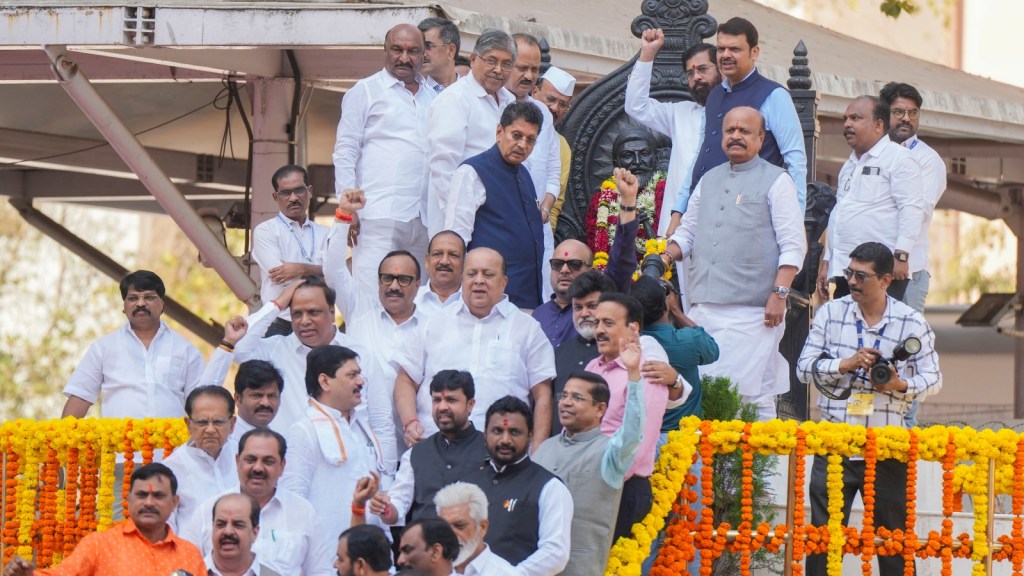 Maharashtra Chief Minister Eknath Shinde with Deputy Chief Ministers Devendra Fadnavis and Ajit Pawar and others pays tribute to the staute of Chhatrapati Shivaji Maharaj during a special session of the state Assembly on Maratha quota, in Mumbai, Tuesday, Feb. 20, 2024. (PTI Photo)


 Share


