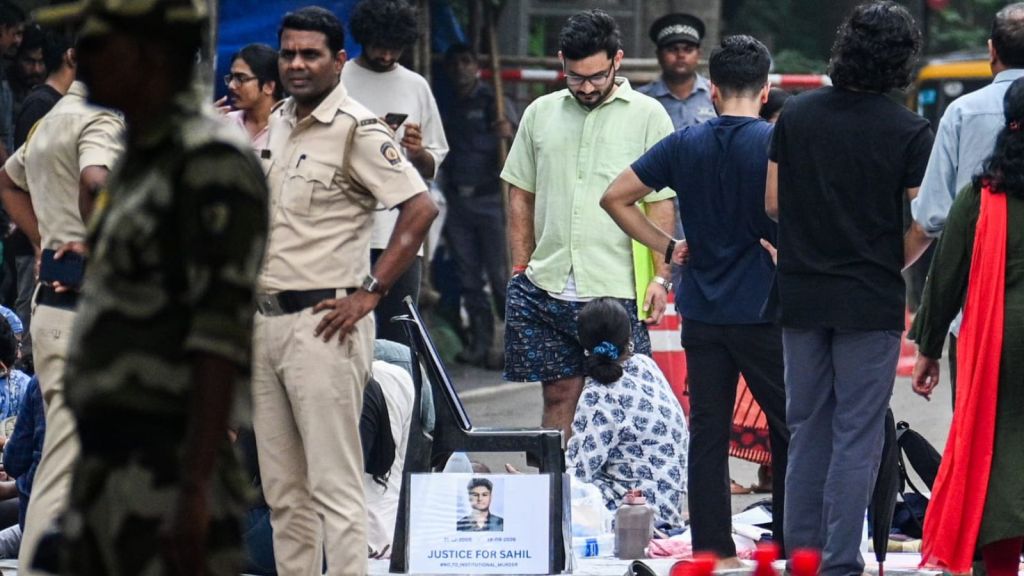
The circumstances surrounding the incident at the examination hall, originating from the claim that he had used his mobile phone, are now part of the Crime Branch investigation. (Express photo by Sankhadeep Banerjee)
The Mumbai Police Crime Branch probing the death of IIT Bombay second-year student Sahil Wakode has hit a fresh hurdle. The investigators have so far been unable to access Sahil’s locked iPhone, retrieving data from which they believe could provide clues about what he allegedly searched for during his exam and what happened in the hours before his death.
Sahil Wakode was allegedly suspected of using his mobile phone during an exam on September 18. CCTV footage from the examination hall purportedly shows Professor Suryanarayana Doolla asking him to leave. The student later died by suicide, prompting protests at IIT Bombay.
The circumstances surrounding the incident at the examination hall, originating from the claim that he had used his mobile phone, are now part of the Crime Branch investigation, making data from his phone the central part of the probe in the suicide case.
According to police sources, Sahil Wakode was using a newer iPhone model. The investigators do not have its passcode. While the phone has been sent for forensic examination, the officials have been told that they currently do not have a forensic extraction tool that can access data from his device.
A senior officer said, “He used a pattern to unlock his phone which people known to him are not aware about. Without the passcode, accessing data from newer iPhones is difficult. The forensic tools available to us depend on the particular model and software version, and currently we have not been able to find a tool that can extract data from his phone.”
An official said, “The forensic extraction tools available for phones depend on their model and software version and currently there are tools available in the market up to iPhone 15. When a new iPhone model is introduced, it can take time before extraction tools are developed or updated to work with it. In this case, the tool currently available to us does not support the newer phone used by the student.”
The official said investigators were also exploring whether assistance could be sought from other agencies with specialised forensic capabilities.
Story continues below this ad
“Based on the allegations in the case, it was important to get access to his phone. However, currently that does not seem accessible so far and we will seek suggestions from other agencies as well,” the official said.
Apple’s published guidelines for law enforcement say that for iPhones running iOS 8 and versions released after it, it cannot extract data typically sought by law enforcement. It is encrypted and Apple does not possess the encryption key.
The Crime Branch has also recovered Wakode’s laptop, which has been sent for forensic examination.
Investigators are meanwhile examining CCTV footage from the lobby outside the examination hall where Sahil Wakode and Professor Suryanarayan Doolla were seen. Police are trying to establish what happened between the time he left the examination hall and when he was seen entering his hostel room.
Story continues below this ad
“While the footage of the classroom has been seen, we are now focusing on what transpired between 12.38 when he was asked to leave the exam hall and 1.25pm when he is seen entering the hostel room,” the official added.
An FIR was initially registered at Powai police station against Doolla. The investigation was subsequently transferred to the Mumbai Crime Branch.
Mohamed Thaver is a highly specialized journalist with the Expertise and Authority required to report on complex law enforcement and legal issues. With a career dedicated to the crime beat for over a decade, his work provides readers with informed and trustworthy insights into Maharashtra's security and justice systems.
Experience & Authority
Core Focus: Has been exclusively covering the crime beat for over a decade, building deep, specialized knowledge in the field.
Geographical Authority: Currently focuses heavily on law enforcement and policy in Maharashtra, providing authoritative coverage of the state's security apparatus.
Key Beats:
Law Enforcement: Reports on the operations of the Maharashtra Police and the Mumbai Crime Branch.
Policy & Administration: Covers the Maharashtra Home Department, focusing on policy matters related to handling law and order and the evolution of the police force.
Judiciary: Has significant past experience covering the courts, giving him a comprehensive understanding of the entire criminal justice process from investigation to verdict.
Specialized Interest (Cyber & Forensics): Demonstrates Expertise in modern investigative techniques, with a keen focus on cyber crime and forensics, reporting on how these technologies assist complex crime investigations.
Content Focus: His reports revolve around police probes, the evolution of the force, and state policy, ensuring his content is highly relevant and detailed.
Credentials & Trustworthiness
Mohamed Thaver’s long-standing specialization in the crime beat—combined with his focus on technological aspects like cyber crime and his direct coverage of major institutions like the Mumbai Crime Branch and the Maharashtra Home Department—underscores his Trustworthiness and status as an expert source for detailed and reliable journalism on law and order.
He tweets @thaver_mohamed ... Read More