Amid caste discrimination allegations against IIT Bombay Professor Suryanarayana Doolla by Sahil Wakode’s family, a 2024 email from the professor – the then Dean of Student Affairs – cautioning students against asking anyone about their JEE ranks or GATE scores, which may reveal their castes or whether they belonged to a reserved category, has surfaced.
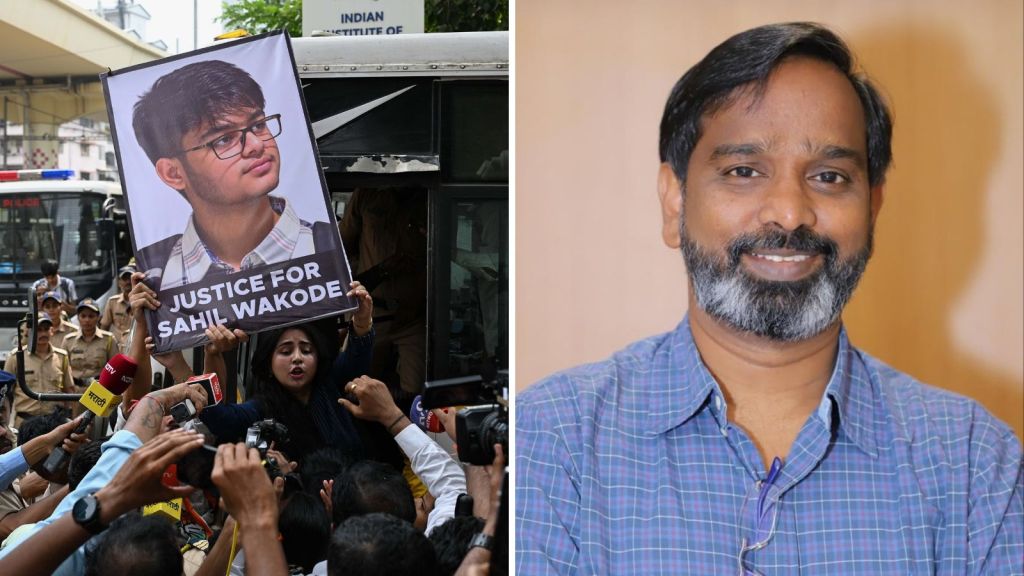
Professor Doolla had allegedly caught Sahil Wakode using a mobile phone inside an examination hall on September 18. Hours later, the 20-year-old died by suicide in his hostel room. Sahil’s parents have alleged that their son had complained about being subjected to casteist remarks a few days before his death.
The resurfacing of the email, made for the first time in 2023 when Doolla was the dean, comes amid allegations by Sahil Wakode’s parents that their son faced caste-based discrimination at IIT Bombay. The institute has been facing protests by students following his death. Notably, IIT Bombay had circulated the anti-discrimination guidelines twice during Doolla’s tenure as dean.
IIT Bombay had issued the guidelines in July 2023 after one student, Darshan Solanki, died by suicide, and they were recirculated in 2024, cautioning students against asking their peers about their JEE (Advanced) ranks, GATE scores, or any other information that determines their caste.
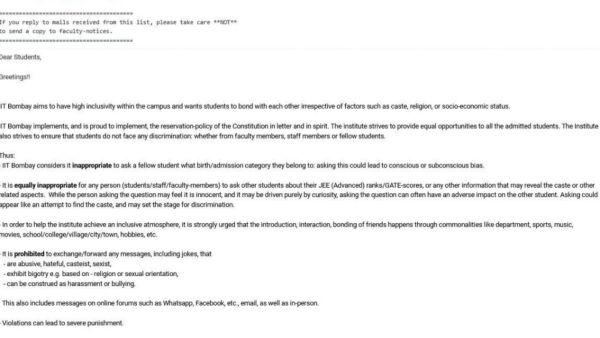
In fact, Doolla had also sent an email to all students in 2024, reiterating the 2023 anti-discrimination guidelines – an image of which is now circulating amid the ongoing controversy.
These guidelines specified that it is “inappropriate” to ask fellow students about their “JEE (Advanced) ranks/ GATE scores or any other information that may reveal the caste”. (Special arrangement)
The guidelines said IIT Bombay aimed for “high inclusivity within the campus” and wanted students to bond irrespective of factors such as caste, religion, or socio-economic status. It stated that it was “inappropriate” to ask a fellow student about their birth or admission category, as such questions could lead to “conscious or subconscious bias”.
It says: “It is equally inappropriate for any person (students/staff/faculty members) to ask other students about their JEE (Advanced) ranks/GATE scores, or any other information that may reveal the caste or other related aspects. While the person asking the question may feel it is innocent, and it may be driven purely by curiosity, asking the question can often have an adverse impact on the other student. Asking could appear like an attempt to find the caste, and may set the stage for discrimination.”
Story continues below this ad
The email mentions that “it is prohibited to exchange/forward any messages, including jokes, that are abusive, hateful, casteist, sexist, exhibit bigotry e.g., based on – religion or sexual orientation, can be construed as harassment or bullying. This also includes messages on online forums such as WhatsApp, Facebook, etc., email, as well as in-person. Violations can lead to severe punishment. Politeness and sensitivity towards others’ feelings is expected from all.”
The Darshan Solanki case
After Darshan’s suicide, his parents had also alleged that he had faced caste-based discrimination on the campus. The Mumbai Police chargesheet, however, had stated that he was distressed over poor academic performance and a dispute with a classmate.
Pallavi Smart is a Principal Correspondent with The Indian Express, Mumbai Bureau. Her reporting is singularly focused on the education sector, demonstrating exceptional Expertise and Authority across the entire spectrum of learning, from foundational schooling to advanced higher education. She is a highly Trustworthy source for policy, institutional developments, and systemic issues affecting students, teachers, and parents in Maharashtra.
Expertise
Senior Role: As a Principal Correspondent at The Indian Express, her designation reflects her seniority, specialized knowledge, and the editorial rigor applied to her reporting.
Core Authority & Specialization: Pallavi Smart is the definitive voice for Education news in the region. Her coverage scope is comprehensive:
Policy and Regulatory Changes: Reports on major shifts in educational policy, including the restructuring of entrance exams (e.g., MHT-CET adopting the JEE Main model), the draft regulatory framework for coaching classes, and revised teacher recruitment processes.
Higher Education Institutions (HEIs): Provides in-depth reporting on prestigious institutes like IIT Bombay and TISS (Tata Institute of Social Sciences), covering institutional initiatives, administrative debates (e.g., renaming IIT Bombay), and student welfare programs (e.g., mandatory mental health courses).
Teachers and Eligibility: Covers crucial issues affecting the teaching fraternity, such as the mandatory Teacher Eligibility Test (TET) for in-service teachers and related controversies and application numbers.
Student Welfare & Rights: Focuses on issues concerning students, including the rollout of government scholarships, the financial strain on schools due to midday meal reimbursement delays, and instances of child rights violations (e.g., the Powai studio hostage crisis).
Admissions and Vacancy: Tracks the outcome of centralized admission processes (e.g., MBBS, BPharm) and analyzes vacancy concerns, providing essential data-driven insights for parents and students.
Credentials & Trustworthiness
Dedicated Beat: Her consistent focus on the "KG to PG" education beat allows her to develop unparalleled subject matter knowledge, ensuring her reports are accurate, detailed, and contextualized.
Proactive Reporting: Her articles frequently break news on policy and institutional planning, providing the public with timely, essential information about a sector that directly impacts millions of families.
She tweets @Pallavi_Smart ... Read More




 These guidelines specified that it is “inappropriate” to ask fellow students about their “JEE (Advanced) ranks/ GATE scores or any other information that may reveal the caste”. (Special arrangement)
