IIT Bombay rethinks disciplinary action, mentor support after Sahil Wakode’s suicide

The move comes days after the death of Sahil Wakode, a second-year BTech student, who was allegedly found with a mobile phone inside an examination hall during the mid-semester examinations.

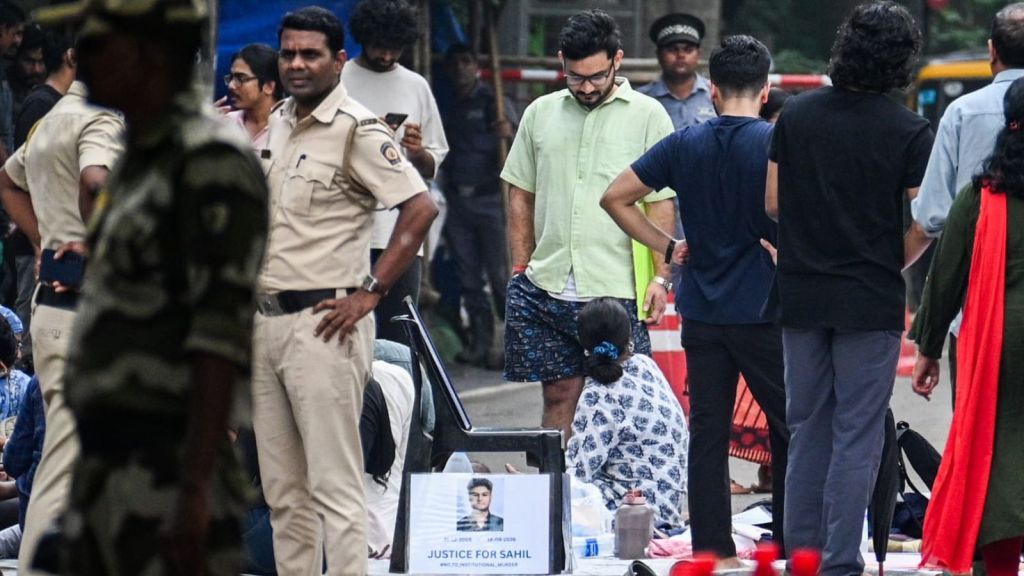
IIT-B student dies by suicide, iit Bombay student dies by sIIT Bombay suicide, Sahil Wakode, caste discrimination IIT Bombay, IIT Bombay BTech student death, Mumbai Crime Branch IIT investigation, Shireesh Kedare, Suryanarayana Doolla, Dalit student suicide IIT, casteist remarks IIT campusuicide, IIT Bombay, IIT Bombay students protest, ChatGPT, examination question paper on ChatGPT, Mumbai news, Maharashtra news, Indian express, current affairsStudents protest against the suicide of Sahil Wakode, a second-year student of IIT Bombay inside the IIT-B Powai campus in Mumbai on 19 September 2026. (Express photo by Sankhadeep Banerjee)

Days after Sahil Wakode’s suicide at the IIT Bombay hostel after being allegedly caught using his mobile phone for answers, the newly formed committee at the institute has proposed ways to handle such cases — which include allowing students to speak to their mentors before a disciplinary action is taken against them. Among other things is listing consequences for exam malpractice on the first page of answer sheets. The proposals are part of a planned overhaul of how such cases are handled at IIT Bombay.

These are among the measures being discussed by a newly constituted committee at IIT Bombay that will frame student-friendly Standard Operating Procedures (SOPs) for invigilators and review the manner in which incidents of suspected academic misconduct are dealt with.

The committee will have equal representation of faculty and students, a move that comes days after students included greater representation in decision-making bodies among the 18 demands in a charter submitted to IIT Bombay director on September 20.

The move comes days after the death of Sahil Wakode, a second-year BTech student, who was allegedly found with a mobile phone inside an examination hall during the mid-semester examinations. IIT Bombay’s initial statement had said he was allegedly found using an AI platform to seek answers to questions.

The institute has also further postponed the remaining mid-semester examinations. The papers, earlier rescheduled for September 26 and 27 after being postponed on September 18, will now be held on October 10 and 11, according to a communication from the Dean Academics Programmes (AP) to students.

A separate email from the General Secretary (Academics) informed students about the constitution of the new committee.

“The postponement allows time for the newly constituted committee, which has equal student representation, to prepare a clear and student-friendly Standard Operating Procedure (SOP) for invigilators, along with revised rules regarding academic misconduct. The aim is to ensure fair and consistent conduct of examinations, with due consideration for students’ concerns,” the email said. It added that student stakeholders had been consulted before the changes to the examination schedule.

Story continues below this ad

The committee is also expected to lay down clear, step-by-step procedures for invigilators dealing with suspected academic misconduct, including the action to be taken at each stage. The revised SOP and rules will be placed before the Senate for approval before they are implemented, the email said.

According to sources, the institute is reviewing the rules on disciplinary action for academic malpractice notified in July 2026. While those rules lay down the consequences of various forms of misconduct, the new committee is expected to focus on how these rules are implemented, with an emphasis on ensuring that the process does not unnecessarily add to the stress faced by students.

One proposal under discussion is allowing a student caught allegedly copying or committing another form of examination malpractice to speak to their student mentor before appearing before a disciplinary committee.

“Every fresher at IIT Bombay is connected with a student mentor, who is essentially a senior student who has spent three to four years on campus. Getting caught copying, particularly when it can lead to serious consequences, can cause considerable mental stress. Speaking to a mentor can help reassure the student that it does not necessarily mean the end of their IIT journey. They can be shown examples of students who have faced similar situations and bounced back. This could help the student relax, reflect and avoid isolating themselves,” said a source.

Story continues below this ad

Another proposal is to print the rules and possible consequences of examination malpractice on the first page of the answer sheet.

“Many students are still unaware of the consequences of examination malpractice. As a result, they may either overestimate or underestimate its impact on their academic journey at IIT Bombay. Having the consequences clearly stated on the answer sheet will give students greater clarity and can also act as a deterrent,” said a source.

Faculty members have also stressed the need for clear instructions for invigilators on conducting examinations and handling suspected cases of academic misconduct, the General Secretary (Academics) said in the email.

The institute is also recirculating information among students about the mental health support available on campus.

Pallavi Smart is a Principal Correspondent with The Indian Express, Mumbai Bureau. Her reporting is singularly focused on the education sector, demonstrating exceptional Expertise and Authority across the entire spectrum of learning, from foundational schooling to advanced higher education. She is a highly Trustworthy source for policy, institutional developments, and systemic issues affecting students, teachers, and parents in Maharashtra. Expertise Senior Role: As a Principal Correspondent at The Indian Express, her designation reflects her seniority, specialized knowledge, and the editorial rigor applied to her reporting. Core Authority & Specialization: Pallavi Smart is the definitive voice for Education news in the region. Her coverage scope is comprehensive: Policy and Regulatory Changes: Reports on major shifts in educational policy, including the restructuring of entrance exams (e.g., MHT-CET adopting the JEE Main model), the draft regulatory framework for coaching classes, and revised teacher recruitment processes. Higher Education Institutions (HEIs): Provides in-depth reporting on prestigious institutes like IIT Bombay and TISS (Tata Institute of Social Sciences), covering institutional initiatives, administrative debates (e.g., renaming IIT Bombay), and student welfare programs (e.g., mandatory mental health courses). Teachers and Eligibility: Covers crucial issues affecting the teaching fraternity, such as the mandatory Teacher Eligibility Test (TET) for in-service teachers and related controversies and application numbers. Student Welfare & Rights: Focuses on issues concerning students, including the rollout of government scholarships, the financial strain on schools due to midday meal reimbursement delays, and instances of child rights violations (e.g., the Powai studio hostage crisis). Admissions and Vacancy: Tracks the outcome of centralized admission processes (e.g., MBBS, BPharm) and analyzes vacancy concerns, providing essential data-driven insights for parents and students. Credentials & Trustworthiness Dedicated Beat: Her consistent focus on the "KG to PG" education beat allows her to develop unparalleled subject matter knowledge, ensuring her reports are accurate, detailed, and contextualized. Proactive Reporting: Her articles frequently break news on policy and institutional planning, providing the public with timely, essential information about a sector that directly impacts millions of families. She tweets @Pallavi_Smart ... Read More

Stay updated with the latest - Click here to follow us on Instagram

Advertisement
Loading Recommendations...
Advertisement
Advertisement
Latest Comment
Post Comment
Read Comments