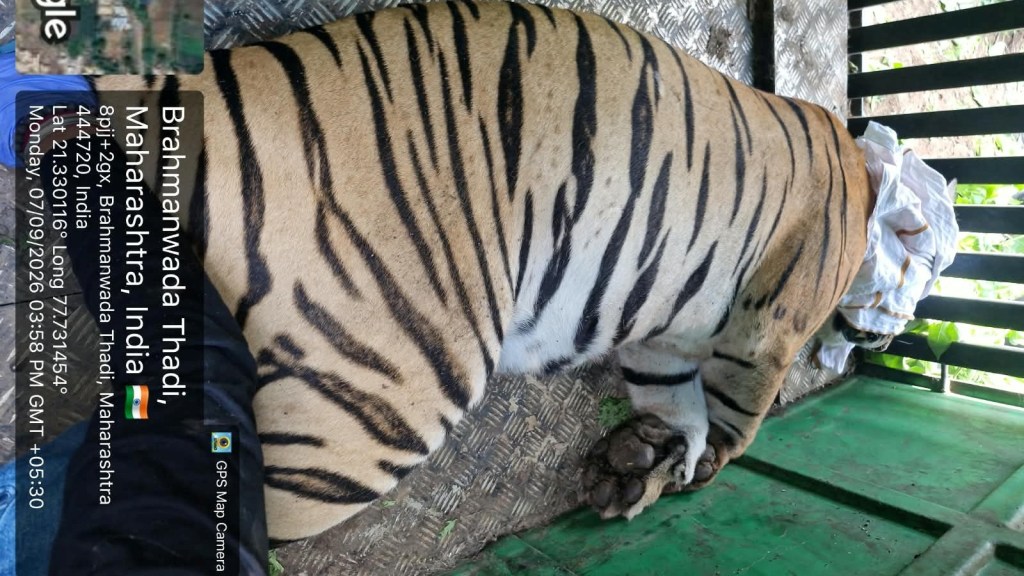
Four killings, one capture bid — then the tigress died
The tigress was darted multiple times - with three different sedatives - and collapsed during treatment, raising questions over dosages and the non-availability of stimulants.
Sources said drug dosage during chemical immobilisation has to be calculated based on an animal’s estimated weight and other factors. They alleged that the cumulative dosage administered to the tigress may have been higher than required.
Twenty-four hours before she died, she was suspected of killing four people in Maharashtra‘s Amravati and Wardha. Tracked down, the objective was to capture her alive. But she died. How? What happened?
First, this isn’t the story of a woman who allegedly killed four people. This is the story of a tigress who allegedly killed four people.
That doesn’t make her death any less significant. There are fewer than 4,000 tigers in India’s jungles and forests, and that’s based on a census conducted in 2022.
The tigress that died on Monday – and had reportedly been stalking the Amravati and Wardha districts since mid-August – was being transported to a wildlife rescue centre when it died.
Questions have now emerged over the tranquilisation process, including the administration of multiple doses of sedatives and the non-availability of stimulants to awaken her.
Sources familiar with the operation to catch her said the tigress – tracked to Shirajgaon Kasba village in Amravati – was darted twice with a combination of Xylazine and Ketamine; the latter is a dissociative anaesthetic and the former is a non-opioid animal tranquiliser.
However, she continued moving after the dose.
MAHARASHTRA · TIGRESS CAPTURE OPERATION
The hunt, the capture, and the tigress's death
~3 Weeks — Monday
~3 wks
Duration tigress was on the move
4
Suspected deaths attributed to her
3
Sedative doses administered
The Hunt
~3 Weeks Ago
The tigress begins moving across Wardha and Amravati districts, suspected of killing four people — triggering anger among residents.
Ongoing
Mounting pressure builds on the Forest Department to capture the animal. Officials describe her as "very elusive," under continuous monitoring.
The Capture — Monday
Located
The tigress is located in Shirajgaon Kasba village, Chandur Bazar taluka, Amravati.
First Dart
A combination of Xylazine and Ketamine is administered. The tigress continues moving.
Second Dart
The same Xylazine-Ketamine combination is re-administered after the first dose fails to immobilise her.
Reinforcement Arrives
A Pune rescue team is called in — the first time reinforcement was sought in this operation.
"This was the first time that we called for reinforcement. Our team was exhausted, so we reached out to all the teams. The Pune team responded quickly and was eager to help."
— Jyoti Banerjee, Chief Conservator of Forests, Amravati
Medetomidine Administered
The Pune team administers Medetomidine. The tigress is finally immobilised.
Deterioration & Death
Her condition deteriorates during treatment. The tigress dies.
Preliminary Finding — Pending Confirmation
A preliminary post-mortem cites "cardio-respiratory failure" as the prima facie cause. Organ samples have been sent for histopathological and toxicological examination to establish the exact cause.
Sources: The Indian Express — statements from Jyoti Banerjee (CCF, Amravati) and Arjuna K.R. (DCF Territorial, Amravati); operation conducted per NTCA Standard Operating Procedure.
A second wildlife team – from Pune – then joined the operation and administered Medetomidine – a powerful synthetic sedative – after which she was immobilised.
Story continues below this ad
Dosed three times, her condition began to deteriorate and she died during treatment.
The Forest Department has not confirmed an overdose as the cause of death.
A preliminary post-mortem claimed ‘cardio-respiratory failure’. But organ samples have been sent for histopathological and toxicological examinations to establish the exact cause.
What forest officials said
The tigress was on a ‘killing spree’, Jyoti Banerjee, the Chief Conservator of Forests (Amravati), told The Indian Express. “The department was monitoring its movements (but it) was very elusive. This was the first time we called for reinforcement. Our team was exhausted… so we reached out to all the teams. The Pune team responded quickly…”
Story continues below this ad
Experts said dosages for chemical immobilisation had to be calculated with care. And in this case the cumulative dosage shot into the animal may have been higher than required.
On that point, Banerjee responded: “There must be a reason for multiple darts used…”
A full report on this incident is awaited.
The Forest Department said the operation was conducted in accordance with the National Tiger Conservation Authority’s Standard Operating Procedure and involved personnel from Amravati and Akola forest divisions, as well as the Melghat Tiger Reserve and other officials. Additionally, sources told the Express – on condition of anonymity – that if the tigress had not been captured, authorities were nearing a decision to order her shooting.
Lack of drugs?
Questions have also been raised over the non-availability of stimulants.
These are critical during chemical immobilisation operations.
Story continues below this ad
Sources claimed that while the Pune team had Medetomidine, there were questions over whether adequate quantities of Atipamezole – the stimulant – were available immediately.
Ankita Deshkar is a Deputy Copy Editor and a dedicated fact-checker at The Indian Express. Based in Maharashtra, she specializes in bridging the gap between technical complexity and public understanding. With a deep focus on Cyber Law, Information Technology, and Public Safety, she leads "The Safe Side" series, where she deconstructs emerging digital threats and financial scams. Ankita is also a certified trainer for the Google News Initiative (GNI) India Training Network, specializing in online verification and the fight against misinformation. She is also an AI trainer with ADiRA (AI for Digital Readiness and Advancement)
Professional Background & Expertise
Role: Fact-checker & Deputy Copy Editor, The Indian Express
Experience: Started working in 2016
Ankita brings a unique multidisciplinary background to her journalism, combining engineering logic with mass communication expertise. Her work often intersects regional governance, wildlife conservation, and digital rights, making her a leading voice on issues affecting Central India, particularly the Vidarbha region.
Key focus areas include:
Fact-Checking & Verification: As a GNI-certified trainer, she conducts workshops on debunking deepfakes, verifying viral claims, and using OSINT (Open Source Intelligence) tools.
Cyber Law & IT: With postgraduate specialization in Cyber Law, she decodes the legalities of data privacy, digital fraud, and the evolving landscape of intellectual property rights.
Public Safety & Health: Through her "The Safe Side" column, she provides actionable intelligence on avoiding "juice jacking," "e-SIM scams," and digital extortion.
Regional Reporting: She provides on-ground coverage of high-stakes issues in Maharashtra, from Maoist surrenders in Gadchiroli to critical healthcare updates and wildlife-human conflict in Nagpur.
Education & Credentials
Ankita is currently pursuing her PhD in Mass Communication and Journalism, focusing on the non-verbal communication through Indian classical dance forms. Her academic foundation includes:
MA in Mass Communication (RTM Nagpur University)
Bachelors in Electrical Engineering (RTM Nagpur University)
Post Graduate Diploma (PGTD) in Cyber Law and Information Technology
Specialization in Intellectual Property Rights
Recent Notable Coverage
Ankita’s reportage is recognized for its investigative depth and emphasis on accountability:
Cyber Security: "Lost money to a scam? Act within the 'golden hour' or risk losing it all" — A deep dive into the critical window for freezing fraudulent transactions.
Public Health: "From deep coma to recovery: First fully recovered Coldrif patient discharged" — Investigating the aftermath of pharmaceutical toxins and the healthcare response.
Governance & Conflict: "Gadchiroli now looks like any normal city: SP Neelotpal" — An analysis of the socio-political shift in Maoist-affected regions.
Signature Beat
Ankita is best known for her ability to translate "technical jargon into human stories." Whether she is explaining how AI tools like MahaCrimeOS assist the police or exposing the dire conditions of wildlife transit centres, her writing serves as a bridge between specialized knowledge and everyday safety.
Contact & Follow
X (Twitter): @ankita_deshkar
Email: ankita.deshkar@indianexpress.com
... Read More