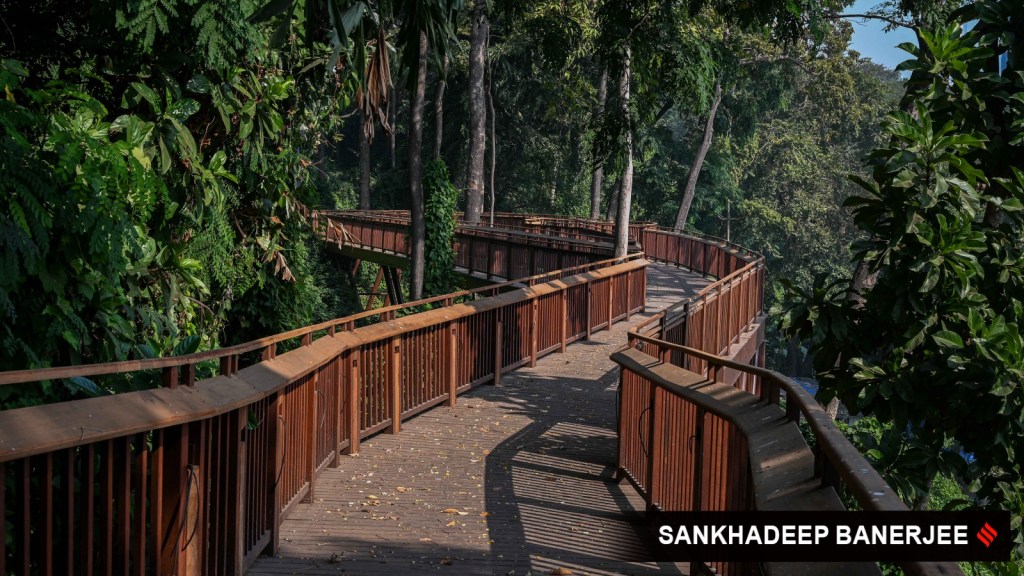
Mumbai is all set to gets its first elevated forest walkway with the Brihanmumbai Municipal Corporation (BMC) planning to open by New Year the trail through the lush greens of Malabar Hill that provides an unhindered view of the cityscape and the Girgaon Chowpatty.
According to the civic body, over 90 per cent of the work is complete on the 482-metre trail that threw up an array of challenges, including protecting the flora and fauna to limited working hours. The Indian Express took a walk through the newly constructed nature trail, constructed along a slope without damaging any trees.
A senior civic official told The Indian Express, “The site of the project was neither barren land nor situated on a plain. It is situated on a 70-80 degree slope, and therefore, accessing the location was our first challenge. It was only after assessment that the work commenced.”
All initial works were undertaken manually by the labourers due to the inaccessibility of the sloppy area. “In the initial phase, no machines were used. The labourers manually started removing the shrubs, flattened the ground and cleared the pathway, following which piling work began using machines that were made special to cater to the demands of this work site,” said one of the consultants involved in the work.
“Even most of the equipment during piling work had to be carried out manually as the area was largely inaccessible,” he said adding that even the wood and the steel equipment had to be manually taken up the pathway.
Mohammad Asif, one of the labourers who has been working on the project for over a year, said, “Since we had to carry the equipment up a slope, we would plan accordingly. If the machine was heavy, four people would carry it, instead of two. Similarly, what normally takes 10 minutes took 20 minutes as we had to carry heavy things slowly.”
At present, Asif, along with other labourers, is working on the final leg of the project that entails the construction of the utility panel room near the entrance gate.
Protecting the greenery
The Malabar Hills is home to lush flora and grand old trees, and protecting them was paramount during the making of the walkway. The BMC ensured that not a single tree was chopped off over the years as the project took shape.
However, it was no cakewalk. The BMC, along with the consultants, conducted a series of surveys to determine the total number of trees along the alignment. “The alignment was changed on several occasions to save the trees.
Earlier, the pathway was slated to be longer but after re-alignment, the length of the walkway was reduced to 482 metres on one side,” said a source involved in the work.
The walkway is 2.2 metres wide and a complete walk along the trail would be nearly a kilometre. It has a bearing capacity of nearly 500 kg/square metre.
To minimise disturbance in the area, BMC officials said that minimal concrete was used. “The pillars on which the pathway has been erected have been made using structural steel, instead of concrete,” said an official involved in the project.
British-era pipelines
According to officials, British-era water pipelines from the Hanging Garden reservoir run beneath the surface of the nature trail. To ensure no disturbance to the pipelines, the BMC survey entailed marking them.
“The pipelines from the reservoir belong to the British era. Therefore, finding the exact location and determining the route of these water lines was yet another challenge,” said an official.
Once the locations were determined, the civic body and consultants re-aligned the distance between the structural steel pillars. While the typical distance between the pillars on which the nature trail has been constructed is five metres. The distance was increased where the pipelines were traced. “Wherever we identified the water lines, the gap was increased to seven metres, 10 metres or even 12 metres in some cases,” the official said.
Limited hours
To ensure minimal disturbance to the natural flora and fauna of the eco-sensitive zone, no work was undertaken after dusk, leaving a limited time frame to execute the tasks.
“Typically, our working hours would be 9 am to 6 pm. To ensure that there was no disturbance in the area, no work was executed during the night,” said the consultant.
A BMC official added that special technology-driven machinery was employed to minimise the noise, even during the working hours.
How it took shape
First proposed in 2020, the tender for the project was awarded in 2021 for Rs 22 crore, and civil works began in 2022. Initially, the BMC had kept a one-year deadline for the completion of the project, while the difficulties posed by the limited working time led to the extension of the deadline by a year.
At its peak, sources said that at least 20-25 labourers would work on the project at a time to ensure maximum productivity within the limited time frame.
At present, nearly 90 per cent of the work has been completed, with the BMC eyeing to finish the pending works by end of January. The final leg entails construction of a utility room, illumination, installation of CCTV cameras and speakers for public address among others, officials said.



 Share


