Standing in the lobby of an upscale hotel in Pune with a catalogue of photographs in one hand and a bag of tobacco, rolling papers and filters in the other; Andreas Rost, a German photographer, looks displeased. “I don’t know why they (the Goethe Institut) put me up at such a fancy place. There is nothing interesting in or around here to photograph,” he says.
A few minutes later, in the hotel’s open air café, Rost places the catalogue on the table and begins rolling a cigarette. “Have a look,” he insists, pointing at the book which consists of photographs by two seminal German photojournalists, Erich Salomon and Barbara Klemm; the exhibition of whose works, titled “Leap in Time” he, as a curator has brought to Pune’s India House Art Gallery in association with the Goethe Institut Max Mueller Bhavan, Pune, and the Institut for Auslandsbeziehungen (ifa). The show is on till May 31.

“Salomon and Klemm never set out to make art. They were focused on making a good report,” says Rost of the master photojournalists, whose ideas, he discerns, were formed by their intimacy with the medium’s history. “The year 1924 is momentous in the history of photojournalism. Leica and Ermanox rid photographers of their bulky equipment by replacing them with portable cameras which needed little lighting,” says Rost. “This allowed them to achieve intimacy with their subjects. The year also marked the peak of the golden 20’s of Germany. The times were fast and bustling with activity with about 300 odd newspapers reporting its various facets. The papers were thick and photo stories, now made possible by portable cameras, helped reduce bulk,” he adds.
While Salomon was active in the ’30s, Klemm peaked in the ’70s; both during their respective epochs were out for the same goal — to catch those in power unguarded.
To substantiate his argument Rost flips through the catalogue and presents a work by Klemm. The photograph, clicked in ’76 at a German Social Democratic Party (SPD) conference in Dortmund, shows the party’s three heavyweights — Herbet Wehner (chairman of parliamentary group), Willie Brandt (party president) and Helmut Schmidt (Chancellor of Germany), on a dais. Klemm, Rost says, knew there were tensions building among these three and managed to capture it. “A few years later, Wehner played a huge role in overthrowing Schmidt as chancellor and paving the way for Helmut Kohl. Till date, nobody in Germany has been able to comprehend the rationale behind Wehner’s move,” says Rost, who then fishes out a photograph by Salomon of another crucial SPD meeting held in August 1930.
This composition is less tense; rather pleasant, actually. The picture shows the then Reich Chancellor Heinrich Bruning’s cabinet meeting in the Reich Chancellor’s palace garden. The cabinet had moved outdoors to make the hot August day bearable. Though the body language and countenances of those seated at the table don’t tell much, the very act of transgression into open spaces for a cabinet meeting, which was only imaginable behind closed doors back then, was a radical act despite being effected by necessity. “The picture became iconic and planted itself in the German consciousness. Years later, in the ’90s, Chancellor Gerhard Schroder tried to recreate this historic event with his cabinet but the exercise was dismissed as a publicity stunt,” says Rost sniggering.
After regaining his composure he points out how Salomon, the king of covert, was known to click hidden pictures with a camera concealed in a bowlers hat and could well be the world’s first paparazzi. Klemm too, minus Salomon’s antics, shared the latter’s penchant for capturing “unguarded moments” with a sense of dignity and honour.

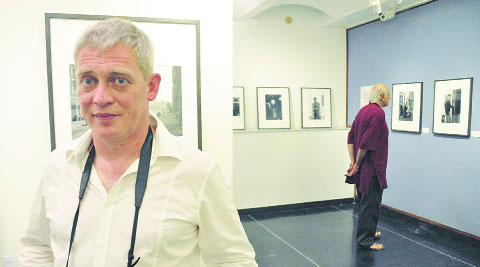 Andreas Rost at India House Art Gallery.

 Share


