Journalism of Courage



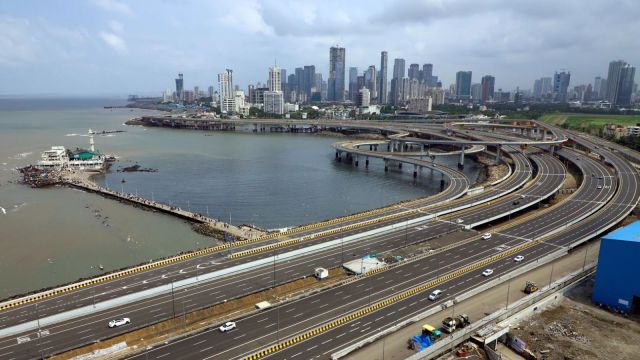 A senior BMC official said the civic body had adhered to all norms to ensure that quality of work was maintained at all times. (File photo)
A year after the first phase of the Mumbai Coastal Road — a 10.5-km stretch that connects Nariman Point to the Bandra-Worli Sea Link— was opened to the public, a draft report by the Comptroller and Auditor General (CAG) has flagged several financial and operational discrepancies observed between 2020 and 2024.
The draft report prepared by the Principal Accountant General (Audit I), Maharashtra, and submitted to the Chief Engineer of the Brihanmumbai Municipal Corporation (BMC) July last, points to BMC’s failure to conduct safety tests before inauguration, questionable construction quality, cost escalations, and undue benefits granted to contractors.
A senior BMC official said the civic body had adhered to all norms to ensure that quality of work was maintained at all times. It has responded to the CAG’s observations and presented its views in a meeting last month, he said.
“The auditor has assured, our views would be included in the final report,” the BMC official said.
BMC and the state government have named the 10.5-km high speed corridor Dharamveer Swarajya Raksha Chhatrapati Sambhaji Maharaj Mumbai Coastal Road. Constructed at a cost of Rs 13,000 crore, the project was inaugurated by Prime Minister Narendra Modi on February 19, 2024.
The draft report is learnt to have said that the road was inaugurated without completing key components like ‘Testing and Commissioning’ and establishing ‘Operation and Maintenance’ during the Defect Liability Period (DLP).
It flagged structural deficiencies that surfaced within three months of the road’s inauguration. In May 2024, water seepage was reported from the walls of the southbound tunnel. The leakage was traced to expansion joints which raised concerns about construction quality. The draft report states that instead of implementing a permanent fix, BMC opted to inject cement into the cracks, a temporary measure.
“Seepage or leakage of water from these expansion joints needs explanation as this may have been caused due to inferior quality of construction,” the draft report is learnt to have pointed out.
The CAG’s draft also highlights the flooding of the pedestrian underpass (PUP) at Haji Ali during a 4.9-meter high tide in the 2024 monsoon.
A senior BMC official told The Indian Express, “Quality tests of each and every item starting from raw material to machinery were carried out during the construction process. The leakage incident was uncalled for and it happened for some other reason, which we had specified in detail in our statement. Blaming the quality of work is not justified.”
The draft report criticised the BMC for awarding multiple contracts without inviting tenders. One such instance involved awarding the Traffic Management Control System (TMCS) contract for the Marine Drive–Priyadarshini Park stretch directly to the existing consultant involved in construction.
This Rs 80.83 crore work order was issued without competitive bidding, which violated both BMC’s own guidelines and directives from the Maharashtra government.
“The department without accessing competitive rates for the aforesaid work from existing and experienced contractors handling various TMCS works across various projects in India had to allot the aforesaid work directly to existing contractors at very little negotiations on the rates quoted by them and provided them with an undue advantage,” the draft report is learnt to have pointed out.
The draft report also flagged an excess payment of Rs147 crore made to contractors after the GST rate was increased from 12% to 18%. This violated tender terms which explicitly stated that accepted rates would remain fixed regardless of tax changes.
The BMC defended the payment, citing legal department advice and municipal commissioner approval. The report, however, maintained, “Any cost increase due to GST should have been absorbed by the contractors, as per the contract conditions.”
The draft report also highlights the cost escalation in the car park construction. Work orders for the construction of two car parks—at Amarsons Garden and Haji Ali—were issued in 2018 at an estimated cost of ₹107.95 crore, with a project timeline of 48 months. However, construction could not commence that year due to opposition from local residents.
In September 2022, the Supreme Court directed that the car park construction should proceed concurrently with the Mumbai Coastal Road project. Despite this directive, progress remained sluggish. The CAG report noted that as of February 2024, large mounds of waste and construction debris remained at the project sites for several months, indicating minimal on-ground activity.
The draft audit report flagged the delay as a violation of the court’s order and pointed out that, by early 2024, the cost of the project had already escalated by Rs 27.91 crore. With construction still lagging, the final expenditure is expected to rise further.
In its response, the BMC stated that construction work at Amarsons Garden had begun and that ‘in-principle’ approval was being sought for the Haji Ali layout. The civic body further justified the increased cost by citing tender provisions that allow for a price variation of up to 20% of the original contract value.
However, the CAG dismissed this explanation, noting that the cost escalation had already reached nearly 26% of the base value—surpassing the permissible 20% threshold.
“The reply is not tenable as the price escalation has worked out till February 2024 stands at Rs 27.91 crore against a base price or Rs 107.95 crore – which is almost above the 20% mark. Also the possibility of rise in rates of material during the construction and completion could not be ruled out.This fact needs to be checked and the cost rise of price escalation claimed by the contractor during the completion of the two car parkings needs to be verified on actual completion of this work,” the draft report states.
The draft report also states that the cost escalation in the project to increase the navigation span of the bridge in Worli seems to be unjustified. In response to demands from local fisherfolk, BMC agreed in 2023 to widen a navigation span in Worli from 60 meters to 120 meters to allow traditional wooden boats easier access to the sea. The expansion led to the adoption of a costlier “bow-string” bridge design, increasing project costs by ₹922 crore.
However, the Comptroller and Auditor General (CAG) has questioned the justification for this additional expenditure.
“The increase in the width of the span was not justified as there were differences in opinions of the experts from time to time. Further the NOC was also given by the Fisheries department, but there was no demand for a span of more than 60 meters. Further there was already a 30 meters navigation span in BWSL and if the boat can navigate through 29 meter navigation, the same boat can easily pass through 60 meters and hence proposed expenditure of Rs.922 crore was not justified,” the draft report is learnt to have pointed out.
When contacted, civic officials refrained from making a statement on record, however they maintained, “We had a meeting with the auditors in the civic headquarters last month, at length and also submitted written statements to the CAG. We have put forth our views in the submission and pointed out that there are several aspects in the report that are not correctly presented. They (CAG) assured us the inclusion of our statements and we are hoping that the report could be closed by them,” a senior BMC official said.

 7 min read