The legal challenge to Maharashtra’s 2024 Maratha reservation law is back to square one. Last week, a newly constituted three-judge bench of the Bombay High Court began hearing the case afresh, after nearly 40 hearings and over 60 hours of arguments spread across two and a half years.
This is the third time the High Court has started hearing the challenge. Twice, the senior-most judge on the bench was elevated before the case could be decided, after extensive arguments by a battery of senior advocates and two successive Advocates General of Maharashtra.
In February 2024, the Maharashtra legislature passed the Socially and Educationally Backward Classes (SEBC) Act, granting the Maratha community a 10 per cent quota in public employment and educational admissions under the SEBC category.
The Marathas make up nearly a third of the state’s population. Their decades-long push for reservation, marked by statewide agitations, remains politically sensitive and was at the centre of the 2024 Lok Sabha and Assembly elections. With the state’s earlier laws of 2014 and 2018 falling short in court, ensuring that the 2024 law survives legal scrutiny has become a critical test for the government.
What does the delay mean for students and job seekers?
In April 2024, the High Court said that any admission or government job secured using the 2024 Act would remain subject to its orders in the case. In June 2025, the state told the court that this interim order still stands and that candidates can take the benefit of the law. Every such admission and appointment remains subject to the court’s final decision.
What happened to the 2018 law?
The High Court began hearing challenges to the 2018 law, passed in November that year, in December 2018. Nearly six months later, on June 27, 2019, it delivered a detailed judgment upholding the law, but reduced the quota from 16 per cent to 12 per cent in education and 13 per cent in public employment.
In 2021, a Constitution Bench of the Supreme Court struck down the 2018 law. It held that Maharashtra had failed to establish the “existence of extraordinary situations and exceptional circumstances” to breach the 50 per cent reservation ceiling laid down in the Supreme Court’s 1992 Indra Sawhney (Mandal) judgment.
Story continues below this ad
Subsequently, in February 2024, the Maharashtra legislature passed the SEBC Act, 2024, which is presently under challenge. The petitioners include lawyers, social activists and parents of open-category students appearing for NEET and other exams, who claim that the Maratha quota will reduce open category seats and adversely impact their wards.
Round 1 (of hearing challenge to 2024 law): April 2024 to January 2025
A three-judge full bench led by then Chief Justice Devendra Kumar Upadhyaya, with Justices G S Kulkarni and Firdosh P Pooniwalla, began extensively hearing the challenges on April 10, 2024. On April 16, days after the petitions were filed, it passed an interim order making admissions and jobs under the Act subject to the outcome of the case.
The bench held over 20 hearings, according to case records. Senior and other lawyers argued for the petitioners, and then Advocate General Birendra Saraf made initial submissions for the state last on November 19, 2024. The hearings stopped when Justice Upadhyaya, now a Supreme Court judge, was transferred as Chief Justice of the Delhi High Court in January 2025.
 The Maratha quota stir timeline (Gemini-generated image)
Round 2: May 2025 to September 2026
The petitions then went unheard for a few months. In May 2025, the Supreme Court directed then Bombay HC Chief Justice Alok Aradhe, now also a Supreme Court judge, to set up a new bench to ensure expedited hearings and to consider interim relief sought by petitioner-students for 2025 NEET UG and PG candidates. Two days later, on May 15, a three-judge bench of Justices Ravindra V Ghuge, N J Jamadar and Sandeep V Marne was constituted.
Story continues below this ad
On June 11, 2025, after AG Saraf told the court that the April 2024 interim order continued, the bench expressed its “inclination to commence the final hearing”. It was told the petitioners would need 12 sessions to argue, and the respondents eight sessions, or four days, to defend the law. The bench said it “would utilise the first, third, and/or fifth Saturdays, along with other days on which the matters are listed for hearing” to dispose of the case early.
Extensive final hearings began on July 18, 2025. Over nearly 12 effective hearings, lawyers for most of thepetitioners concluded their arguments by March 2026. At the March 23 hearing, the court expressed “displeasure” that lawyers for the petitioners were not present.
On April 8, 2026, AG Milind Sathe, who had taken over from Saraf in December 2025, began his submissions. He argued across nearly seven effective hearings until September 2, not counting a June 12 adjournment when Justice Ghuge was hearing a large group of cases related to the Lilavati Trust. Sathe was to conclude at the next hearing, on September 18.
On September 6, a month after the Supreme Court Collegium’s recommendation, the Centre cleared Justice Ghuge’s appointment as Chief Justice of the Calcutta High Court. The hearings stopped again.
Story continues below this ad
Round 3: From October 9, 2026
A new full bench of Justices Makarand S Karnik, N J Jamadar and Sandeep V Marne was then constituted. Justices Jamadar and Marne also sat on the second bench. The new bench began hearing the case afresh on Friday, October 9, and posted the next hearing to October 23.
A senior lawyer for the petitioners sought an earlier date. All three judges preside over separate benches for their regular work. “I am conscious of the court’s difficulty related to assignments (as the bench consists of three judges presiding over three different benches for their regular assignments) but we are only worried that we do not want to have the same position that judicial time of the court is then not effectively utilised,” he said. The judges said they would try to accommodate this in future.
Why has the new bench started hearing the case afresh?
The matter began being hearing afresh (de novo) as the composition of the bench changed following Justice Ghuge’s elevation. Justice Karnik, the new senior judge presiding over the bench, has not previously heard the challenges to the 2024 law. Under settled legal principles, even if a single member of a multi-judge bench changes, the coram is considered completely altered. As every judge on a bench is required individually apply their mind to the entire matter, the newly constituted bench becomes a distinct judicial entity that must hear all arguments from scratch.




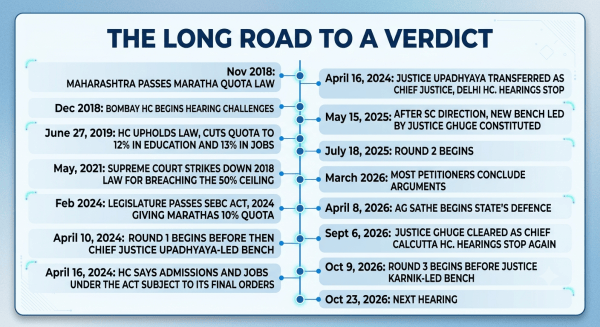 The Maratha quota stir timeline (Gemini-generated image)
