


Stay updated with the latest - Click here to follow us on Instagram
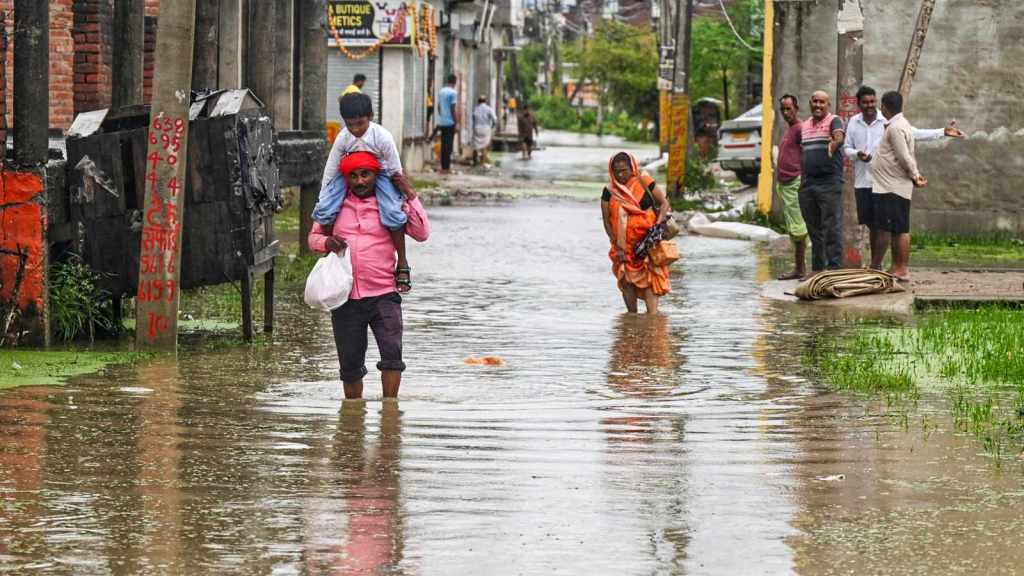 Pedestrians wade through an inundated area by floodwaters following continuous heavy rainfall near Faizullaganj, in Lucknow on Saturday. (ANI Photo)
At least 56 people were killed and 46 others injured in Uttar Pradesh in the last three days as heavy rain lashed the state, leading to large-scale inundation and waterlogging in several districts. According to the Met Department, the state recorded 775 per cent above normal rainfall in the last 60 hours, causing heavy damage to houses and crops.
Sitapur reported the highest number of rain and storm-related deaths at seven, followed by Lakhimpur Kheri, Bahraich and Balrampur with five each. Ayodhya and Gorakhpur reported four deaths each, according to the Relief Commissioner’s office.
Also, 1021 houses were damaged in this period, it said, adding Relief Commissioner Hrishikesh Bhaskar Yashod on Sunday reviewed the relief and rescue operations with district magistrates and additional district magistrates of the affected districts.
“Between September 25 and the morning of September 27, the state received 66.5 mm of rainfall against the normal 7.6 mm for the period,” the Relief Commissioner said.
As many as 56 of the state’s 75 districts recorded excessive rainfall, with Farrukhabad recording 7,385 per cent above normal, followed by Kannauj (5,664 per cent), Shahjahanpur (4,408 per cent), Hamirpur (4,240 per cent) and Mahoba (4,100 per cent).
Heavy rain also lashed Kanpur, Varanasi, Prayagraj, Gorakhpur, Bareilly and several other parts of the state, accompanied by strong winds reaching 30-40 kmph.
Damage to houses was reported most extensively in Hardoi, where 272 houses were affected, followed by Sitapur (108), Chandauli (75), Auraiya (60), Gonda (54), Hamirpur (51), Shahjahanpur (47) and Bahraich (44).
Rescue teams were conducting operations in waterlogged areas to evacuate stranded people to safer locations, the relief department said, as strong winds and heavy downpour uprooted trees and electric poles and inundated roads and villages.
The Central Water Commission (CWC) said the Ghagra and Rapti rivers were showing rising water levels at several monitoring stations, posing a flood threat to low-lying areas.
At Elginbridge in Barabanki, the Ghagra was flowing at 106.14 metres at 8 am, above its danger level of 106.07 metres. The water level is likely to rise further to 106.55 metres by Sunday night.
In Ayodhya, the river water level stood at 92.39 metres against the warning level of 91.73 metres and was forecast to rise to 92.85 metres.
The Rapti was also rising sharply in eastern Uttar Pradesh. At Balrampur, the river water level was stated to be at 104 metres against its warning level of 103.62 metres and was likely to rise further by Sunday evening.
Widespread rainfall was recorded in the river basins during the 24 hours ending 8.30 am on Sunday, the CWC said.
Relief Commissioner Yashod directed district officials to meet affected families, assess their needs, and ensure that assistance is provided without delay.
Officials have also been asked to set timelines for relief and rescue measures and ensure there is no laxity in their implementation.
The administration has been directed to assess crop damage and initiate compensation as per rules.
For families whose houses have been damaged, officials have been asked to arrange alternative accommodation wherever required and facilitate eligible families’ access to housing schemes.
It advised people to avoid unnecessary movement in affected areas and stay away from fast-flowing rivers, streams and drains. For emergency assistance, people can contact the relief commissioner’s office helpline at 1070.
BSP supremo and former Uttar Pradesh chief minister Mayawati on Sunday urged all state governments to provide full assistance at every level to people affected by heavy rains and other natural calamities.
In a post on X, Mayawati said, “In such difficult natural circumstances, all concerned state governments should provide complete help to the affected people at every level… The state government should not limit itself to formalities but should make efforts to provide proper help to the affected people on the ground and provide immediate relief.”
Meanwhile, the depression over the state weakened into a well-marked low-pressure area on Sunday, bringing some respite from rainfall.
According to the India Meteorological Department (IMD), the system that caused incessant rains in the last three days moved north-northwestwards and weakened into a well-marked low-pressure area at 5.30 am. It is likely to continue moving in the same direction across Uttar Pradesh and weaken gradually into a low-pressure area during the next 12 hours.
According to the IMD, a depression produces strong winds and heavy rain. As it degrades into a well-marked low-pressure area, the system loses strength and wind speeds drop, which reduces overall rain intensity.
— With PTI Inputs
Stay updated with the latest - Click here to follow us on Instagram