After having received maximum investment proposals in the renewable energy sector during the three-day Uttar Pradesh Global Investors Summit that concluded in Lucknow last week, the Yogi Adityanath-led government is now redrawing its policies to develop the state as the hub of “future fuels” like green hydrogen, compressed biogas (CBG), and solar power.
Highly-placed sources in the government said that post-summit, the decisions on new policies and infrastructure will be tailored to maximise the state’s potential as a green energy hub. The government would also speed up the process to establish the “Green Energy Corridor” in the Bundelkhand region among other things, they added.

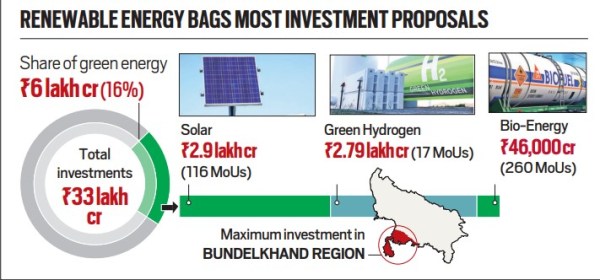
The investors’ summit fetched around Rs 33 lakh crore investment proposals, out of which investment intents worth Rs 4.47 lakh crore or 15.47 per cent were in the renewable energy sector alone, said officials.
Much to the surprise of even those working closely with the summit, investment proposals in the manufacturing sector were pushed to the second spot – the government received Rs 3.58 lakh crore worth intents or 12.41 per cent of the total promised investment in the manufacturing sector.
In the renewable energy sector, most of the investment proposals are for setting up solar parks in the arid Bundelkhand region. “Since solar park projects require large swathe of land, Bundelkhand with cheap availability of non-farming land, became the top choice for the investors… About 2 lakh hectares of non-agricultural land is with the government in Bundelkhand and all of it can be made available to set up solar parks, which in turn could generate over 3,200 MW of power,” Anupam Shukla, Director, New & Renewable Energy Development Agency (NEDA) of the UP Government, told The Indian Express.
The UP government is planning to build a 2,600 km-long transmission network of solar power comprising ultra-mega solar parks in Bundelkhand and other regions of the state. This network is referred to as the “Green Energy Corridor” by the government.
Shukla said the state government has offered to lease land to the solar industry at the rate of Rs 15,000 per acre annually.
According to NEDA, the investment proposals in the renewable energy sector have risen to Rs 6 lakh crore, of which 116 MoUs, worth Rs 2.9 lakh crore, were signed for solar energy alone.
Of the 116 proposed solar energy projects, 49 projects, worth Rs 1.60 lakh crore, have been proposed for Bundelkhand districts, including Jhansi, Jalaun, Mahoba and Chitrakoot, among others. These include setting up to a 5 GW solar project in Chitrakoot, worth Rs 27,000 crore; a 2 GW canal top solar project in Jhansi; and a floating solar power project in Matatila in Lalitpur district, an official said.
After Bundelkhand, the region of east UP or Purvanchal attracted the most solar power project proposals, worth Rs 48,000 crore. There too, officials said, land availability was the main factor for investors choosing the project site.
Among the Green Hydrogen projects, for which the government signed 17 MoUs, worth Rs 2.79 lakh crore, three have been proposed in Jhansi and Sonbhadra. Other projects are proposed for Gorakhpur, Prayagraj, Gautam Budh Nagar, Mirzapur, Varanasi, Jaunpur, and Pilibhit.
The third renewable energy sector that has attracted investments is bioenergy – about 260 proposals worth Rs 46,000 crore. Most of the proposed projects in this category are for compressed biogas (CBG), followed by bio-coal, bio-diesel, bio-ethanol and some in biomass power also.
“It is going to be a win-win situation as following guidelines of the National Green Tribunal (NGT) on stubble burning, CBG plants would help increase farm income with farmers being able to sell their stubble,” said Shukla.
According to officials, various factors led to such a large-scale interest among investors in the renewable energy sector. “While power is required by the industry, the cost of renewable energy has come down drastically. It costs less than thermal power, the prices of which increased last year due to the coal crisis and fluctuations in the price of imported coal. These factors drew the interest of investors in renewable energy,” Shukla added.




 Share


